

{
  "authors": [
    "Darshana M. Baruah",
    "Alexander Gabuev",
    "Michito Tsuruoka"
  ],
  "type": "commentary",
  "centerAffiliationAll": "",
  "centers": [
    "Carnegie Endowment for International Peace",
    "Carnegie Russia Eurasia Center"
  ],
  "collections": [],
  "englishNewsletterAll": "",
  "nonEnglishNewsletterAll": "",
  "primaryCenter": "Carnegie Endowment for International Peace",
  "programAffiliation": "",
  "programs": [],
  "projects": [],
  "regions": [],
  "topics": []
}
Source: Getty
Podcast: Russia and the Indo-Pacific
Podcast host Alex Gabuev; Darshana Baruah, an associate fellow at the Carnegie Endowment for International Peace; and Michito Tsuruoka, an associate professor at Keio University in Tokyo, examine relations in and around the Indo-Pacific.
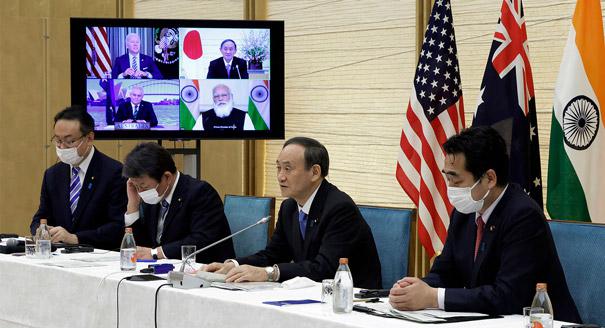
In the wake of the first summit of the Quad countries (the United States, Japan, Australia, and India), this episode of the podcast focuses on the grouping’s scope, its cooperation with other nations, Russia’s significance in the region, and whether the rapprochement between Moscow and Beijing is impacting the long-established relationship between Russia and India.
Listen or download: SoundCloud | Subscribe: iTunes, Google Podcasts, Google Play, Spotify, RSS
About the Authors

Former Nonresident Scholar, South Asia Program
Darshana M. Baruah was a nonresident scholar with the South Asia Program at the Carnegie Endowment for International Peace where she directs the Indian Ocean Initiative.

Director, Carnegie Russia Eurasia Center
Alexander Gabuev is director of the Carnegie Russia Eurasia Center. Gabuev’s research is focused on Russian foreign policy with particular focus on the impact of the war in Ukraine and the Sino-Russia relationship. Since joining Carnegie in 2015, Gabuev has contributed commentary and analysis to a wide range of publications, including the Financial Times, the New York Times, the Wall Street Journal, and the Economist.
Michito Tsuruoka
Carnegie India does not take institutional positions on public policy issues; the views represented herein are those of the author(s) and do not necessarily reflect the views of Carnegie, its staff, or its trustees.