

Report
- +9
Richard Youngs, Erik Jones, Dan Baer, …
{
  "authors": [
    "Rosa Balfour"
  ],
  "type": "commentary",
  "centerAffiliationAll": "",
  "centers": [
    "Carnegie Endowment for International Peace",
    "Carnegie Europe"
  ],
  "collections": [],
  "englishNewsletterAll": "",
  "nonEnglishNewsletterAll": "",
  "primaryCenter": "Carnegie Europe",
  "programAffiliation": "",
  "programs": [],
  "projects": [],
  "regions": [
    "Eastern Europe",
    "Western Europe"
  ],
  "topics": [
    "Democracy",
    "Economy",
    "Climate Change",
    "Foreign Policy"
  ]
}
Source: Getty
The composition of Giorgia Meloni’s government will be an important signal.
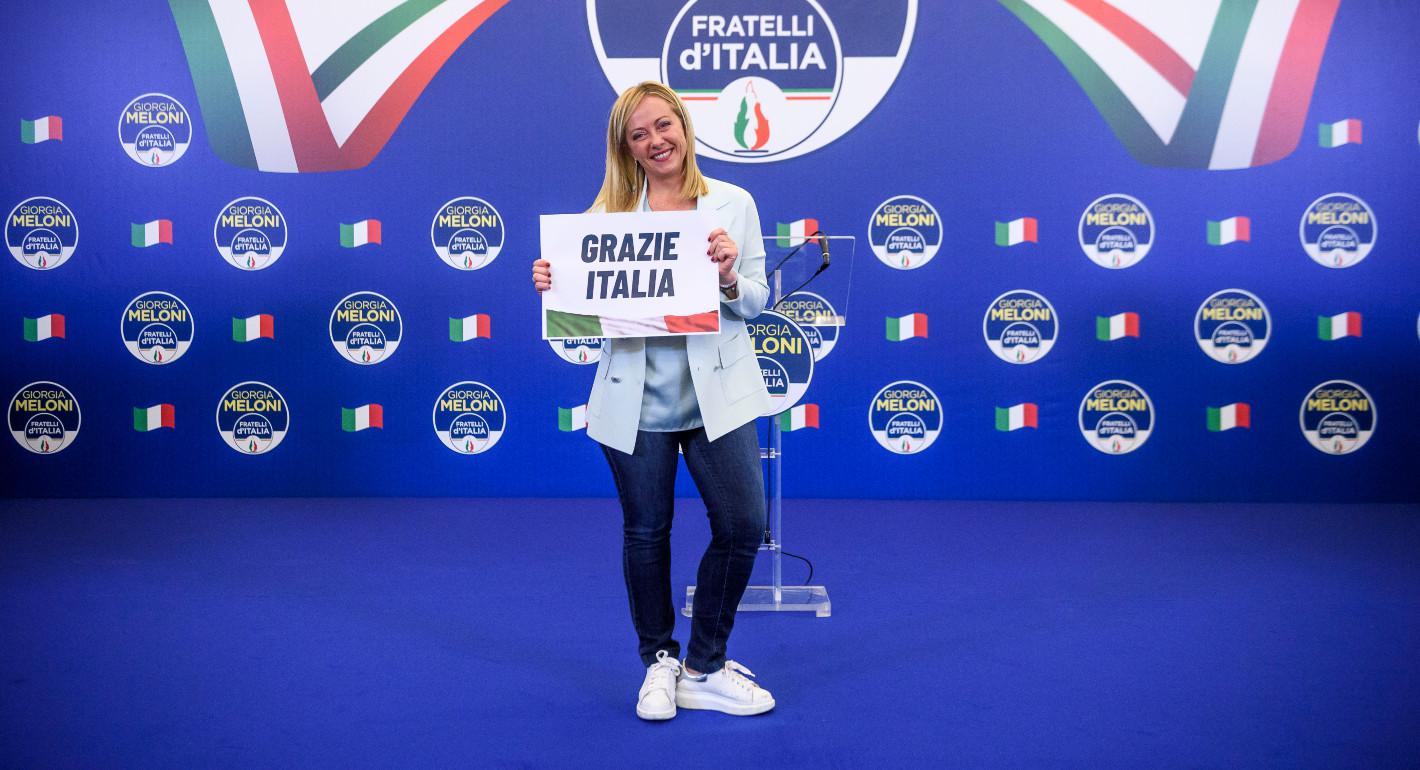
On Sunday, one in four Italians who went to the polls cast their vote for Giorgia Meloni, the leader of the far-right Fratelli d’Italia (FdI) party. Now, this fraction of the electorate who secured Meloni’s victory has ushered in new fears about a far-right turn in European politics, as well as concerns that Italy will bring turmoil to Europe while the continent is engaged in a war.
As the only party in opposition to the previous government, FdI raked in the protest vote, leaping from just over 4 percent in the 2018 election to 26 percent this year. This jump is not unprecedented in Italy’s political landscape, where populist parties have successfully risen on the ashes of the party system that crumbled back in 1992. But Meloni is the first prime minister to hail from a party with roots in the country’s post-fascist movement, as well as the first woman to hold the top leadership position. Italy’s current electoral system also gives Meloni’s right-wing coalition a stunning majority in both chambers of Parliament.
FdI surged mostly by bleeding its right-wing populist allies Forza Italia and Lega. Still, the right-wing coalition broadened its support by about 7 points, and the geographic spread of the vote—with FdI conquering Lega strongholds in Northern Italy—suggests that supporters of the populist right have switched to the far right, notwithstanding the different ideological roots of Meloni’s party.
Italy has long seen the populist right occupy the space vacated by the centrist Christian Democrats, which imploded after the end of the Cold War. The trend was started by former prime minister Silvio Berlusconi’s Forza Italia, which gradually built alliances to its right (including with Northern League, the separatist-turned-federalist-turned-nationalist party now known as Lega, as well as with a post-fascist party as junior partner). As this space was solidified, the language of populist platforms—xenophobic, anti-immigration, nationalist, anti–minority rights—was progressively mainstreamed.
The dynamic of mainstreaming the populist right has been reflected in European politics since the 2000s. In the European Parliament, Forza Italia joined the European People’s Party (EPP), the group that includes the German Christian Democrats, the Spanish Popular Party, and other center-right parties. These parties have struggled to contain the hemorrhage of votes toward right-wing populism, sometimes by creating a firewall to keep the right out of power but more often through tactics such as adopting their platforms to attract voters or forging alliances with them. For instance, the Sweden Democrats, which are also rooted in fascist ideology, had been kept out of government coalitions until they became the second largest party in the country’s elections in early September. Conversely, the EPP has tried to keep Hungarian Prime Minister Victor Orbán’s Fidesz party within its fold (notwithstanding Hungary’s departure from democratic values) until Fidesz itself left the pan-European group in spring 2021. Clearly, neither tactic has worked.
Against this backdrop, far-right antics are hardly seen as threatening to the right-leaning electorate, and the Italian left’s electoral campaign warning of the dangers of voting for the right made little impact. More remarkable has been the inability of the Italian centrist and leftist political spectrum to propose an alternative vision, reach coalition agreements, and thus benefit from the electoral system. The success of the right also has much to do with the fragmentation across the center and left and to the unprecedently high level of abstention: only 64 percent of Italians voted, compared with 73 percent in 2018.
Domestically, the coalition’s absolute majority gives the next government room for maneuver on the issues where the parties find agreement. Although Meloni has offered assurances on abortion rights, the coalition parties’ track records do not bode well for the rights of immigrants, minorities, and LGBTQ people. In the past, migrants without proper documents have faced criminal charges, progressive gay rights legislation has been blocked in Parliament, and the independence of the judiciary and the rule of law have been attacked. However, the opposition in Parliament and in the country were able to push back. Italy’s institutions and constitution have so far reined in the antidemocratic instincts of these parties in power. The resilience of Italy’s democracy should not be underestimated.
Also, electoral success may not breed governmental stability. In addition to the total inexperience within FdI, it is hard to imagine that the macho leaders of the two diminished coalition parties stand by while a woman pulls the threads of government. Even just finding competent individuals to fill government leadership positions will be a hard venture for the coalition, especially since Forza Italia lost some of its experienced members to the centrist parties. And Italy’s widespread rage against technocracy that explains the right’s electoral success will constrain the next government’s willingness to attract technocrats to key positions.
Within the EU, Meloni has two possible paths. The first is to try to gain some legitimacy in Europe and work constructively with partners. Italians may have forgotten that in 2011 the same coalition government collapsed with Italy on the brink of bankruptcy—but EU institutions have not. The composition of the government will be an important signal in this regard. If the new government appoints an economically literate finance minister and a foreign minister well-versed in European politics, it will signal the intention to negotiate in the “interests of Italians” but without rocking the boat too much. Brussels has both carrots and sticks to constrain and shape Italy’s economic policies.
The alternative path would be far more confrontational. Meloni may choose to invest in her party’s political allies and likeminded partners in Europe, such as the governments of Poland and Hungary. FdI and Poland’s Law and Justice party belong to the same political groups in the European Parliament, and both have already voted against downgrading Hungary to an electoral autocracy. All these parties share anti-immigration and ultra-conservative values, though Forza Italia has more liberal positions.
But their respective nationalisms have so far prevented them from more systematic EU cooperation. Italy could support Poland and Hungary on curbing Brussels’s attempts to defend the rule of law, but with the conditions attached to disbursing funding, Brussels has sharpened its toolkit. Defending the “interests of Italians” may not square with supporting the interests of Orbán. And Meloni may want to think twice about which partners she teams up with. Poland will be going to the polls in 2023, and Hungary is increasingly seen as Russian President Vladimir Putin’s Trojan horse and finds itself ever more isolated in the EU. Meloni will need to tread carefully if she is intent on gaining credibility outside Italy.
In this spirit, the next government is likely to continue supporting the EU’s pushback on Russia’s invasion of Ukraine. The foreign policies of Italy’s past right-wing governments have been nuanced (but not outlandish) compared to the center-left and to the technocratic governments of the past thirty years, and immigration is the only issue on which these parties want to be seen challenging Brussels. Members of the coalition government will certainly ride the waves of discontent over rising energy costs, including some stunts on ceasefires and dialogue with Russia, but doing so will also reveal their fragilities. If the right wants to stay in power in Italy, it will have to tread a fine line between nationalist and populist antics and the benefits and constraints of being an EU member.

Director, Carnegie Europe
Rosa Balfour is the director of Carnegie Europe. Her fields of expertise include European politics, institutions, and foreign and security policy.
Recent Work



Richard Youngs, Erik Jones, Dan Baer, …
Rosa Balfour
Carnegie India does not take institutional positions on public policy issues; the views represented herein are those of the author(s) and do not necessarily reflect the views of Carnegie, its staff, or its trustees.

After the chill in ties between 2020 and 2024 that brought India–China relations to their lowest point in several decades, the two countries have engaged each other afresh. This paper argues that there are predominantly four imperatives guiding India’s approach to China, and they exist in an order of priority.

Saheb Singh Chadha

This piece argues that India’s central challenge is not managing a single flashpoint but resolving the underlying tension between expansion and institutional coherency of the BRICS grouping.

Vrinda Sahai

A partnership between India, a country of subcontinental size, and Africa, a continent of fifty-four countries, may seem asymmetric until one notes that both are home to nearly the same number of people—1.4 billion. This essay spells out the existing challenges to the partnership, its optimal potential, and the possible pathways to realize it over the next quarter-century.

Rajiv Bhatia

The India–EU Free Trade Agreement (FTA) is shaping up to be one of the most consequential trade negotiations, both economically and strategically. But, what’s in the agreement, what’s missing, and what will determine its success in the years ahead
Vrinda Sahai, Nicolas Köhler-Suzuki

On March 10, 2026, India’s Union Cabinet approved amendments to Press Note 3, a regulation that mandated government approval on all foreign direct investment (FDI) from countries sharing a land border with India. This amendment raises questions primarily about whether its stated benefits will materialize and if the risks have been adequately weighed. This piece will address the same.

Konark Bhandari