

Article
Zainab Usman
{
  "authors": [
    "Zainab Usman"
  ],
  "type": "commentary",
  "centerAffiliationAll": "dc",
  "centers": [
    "Carnegie Endowment for International Peace"
  ],
  "collections": [
    "Chart of the Month",
    "Africa’s Shifting Politics and Geopolitics",
    "Trade and Investment"
  ],
  "englishNewsletterAll": "africa",
  "nonEnglishNewsletterAll": "",
  "primaryCenter": "Carnegie Endowment for International Peace",
  "programAffiliation": "AFP",
  "programs": [
    "Africa"
  ],
  "projects": [],
  "regions": [
    "Southern, Eastern, and Western Africa"
  ],
  "topics": [
    "Economy"
  ]
}
Source: Getty
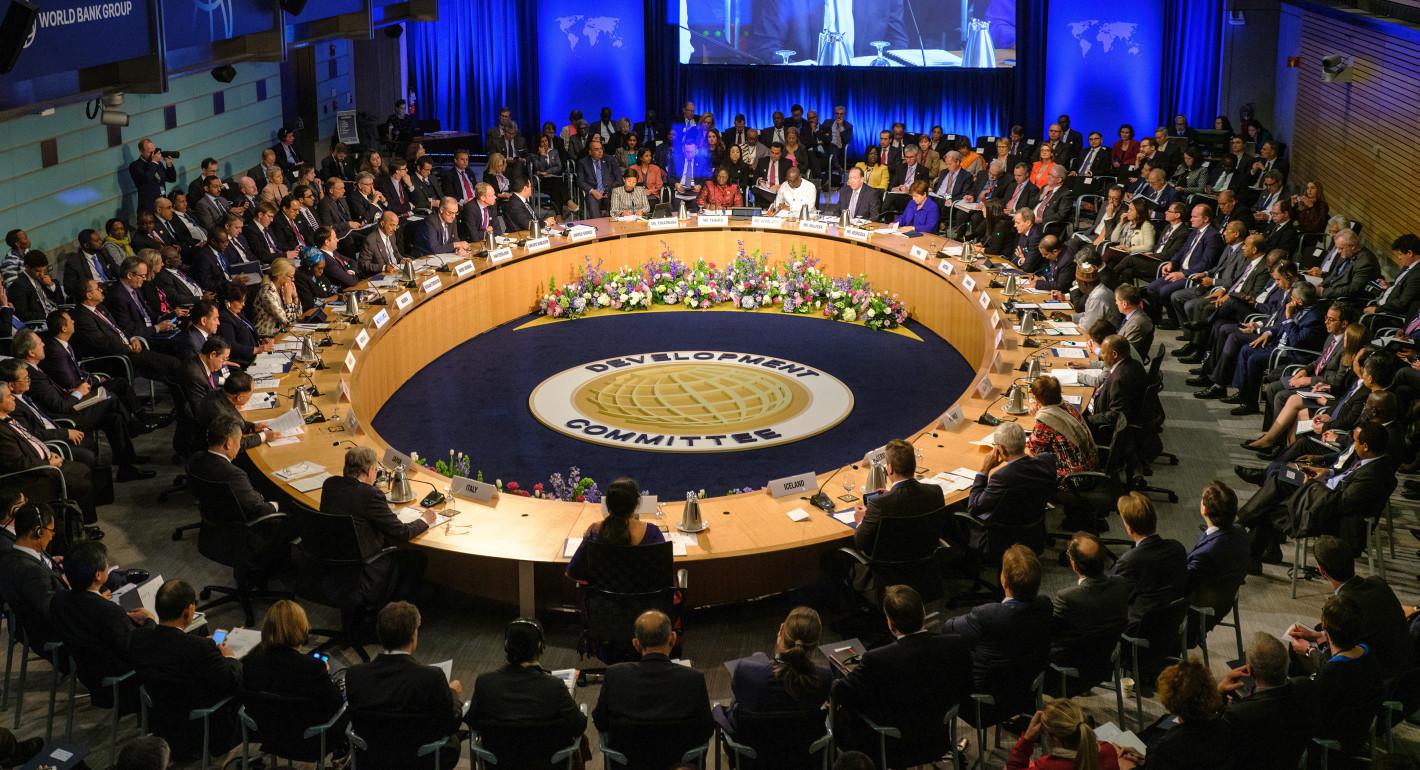
Since the International Development Association is an important component of the World Bank and Africa is the major recipient of IDA commitments, the region is crucial to the bank’s overall balance sheet.
The World Bank plays an influential role in African economies. For half a century, the world’s largest multilateral development bank has influenced the monetary and fiscal trajectory of African economies and shaped prevailing norms around policy reforms. The bank has featured prominently across the phases of the evolution of the intellectual underpinnings of “global development”—from the physical capital investments to drive industrial takeoff in the immediate postcolonial years of the 1960s and 1970s; to the structural adjustment and Washington Consensus reforms to recover from the debt and economic crises of 1980s and 1990s; to the emphasis on poverty reduction, debt forgiveness, and withdrawal from infrastructure lending of the 2000s; to an attempted neo-infrastructure renaissance of the 2010s; and now the imperative to invest in climate change mitigation in the 2020s.
But what if one were to flip the recurring question of the World Bank’s role in Africa’s development to examine how important Africa is to the World Bank? It turns out that Africa is central to the World Bank’s continued global role as a top development financier for at least two reasons.
First, the portfolio of the World Bank’s concessional arm, the International Development Association (IDA), is overwhelmingly African. For close to two decades, the bulk of financial commitments have increasingly been concentrated in Africa (see figure 1). In FY2022, for instance, 83 percent ($27.5 billion) of IDA commitments were to the forty-eight countries of sub-Saharan Africa. Regions such as East and South Asia used to be large IDA recipients, but over this twenty-year period, their countries have largely graduated from needing concessional loans as they transitioned to middle-income status.

Most IDA projects are now in sub-Saharan Africa because the region has the world’s largest number of low-income and fragile countries that can only borrow from IDA. Thus, the World Bank’s nonconcessional lending arm from which middle-income countries can borrow, the International Bank for Reconstruction and Development (IBRD), is more global in nature. In FY2022, Africa was the destination for 10 percent ($3.3 billion) of the total IBRD commitments, a figure that is more than a tenfold increase from the $97 million it received in the year 2000 (see figure 2). Today, there are twenty-three middle-income countries in sub-Saharan Africa (and five countries in North Africa) that are able to borrow from IBRD.

Second, any effort by the World Bank to be involved in infrastructure projects will only be truly realized in Africa. Currently, about 30 percent of its lending goes to infrastructure sectors (if we define infrastructure to include water and sanitation, transportation, and energy and mining, as figure 3 shows). A further disaggregation of the sectoral composition of World Bank lending in Africa shows the two largest destination sectors to be public administration (19 percent) and agriculture (16 percent). The distribution of lending to infrastructure sectors includes transportation (13 percent), energy and mining (12 percent), and water and sanitation (10 percent). This information is better appreciated within the context of Africa’s estimated infrastructure financing gap of around $100 billion per annum. In other words, large infrastructure gaps exist in Africa, and the bank could do more on that front.

Since IDA is an important component of the World Bank and Africa is the major recipient of IDA commitments, the region is crucial to the organization’s overall balance sheet. Even though most of the loans that go to the region are concessional—for development projects, at interest rates below market rates, and with lengthy repayment terms—they are loans nevertheless. They are not free and must be paid back down the line. The African continent, whose approach to achieving development outcomes has been shaped for decades by the bank, should in turn be able to weigh in on the organization’s direction as the momentum for reforming the World Bank picks up steam. And indeed, any efforts in the future by the bank to go back to being heavily involved in infrastructure will need to have Africa at its core.

Former Director, Africa Program
Zainab Usman was a senior fellow and the inaugural director of the Africa Program at the Carnegie Endowment for International Peace.
Recent Work

Zainab Usman, Anthony Carroll
Carnegie India does not take institutional positions on public policy issues; the views represented herein are those of the author(s) and do not necessarily reflect the views of Carnegie, its staff, or its trustees.

A partnership between India, a country of subcontinental size, and Africa, a continent of fifty-four countries, may seem asymmetric until one notes that both are home to nearly the same number of people—1.4 billion. This essay spells out the existing challenges to the partnership, its optimal potential, and the possible pathways to realize it over the next quarter-century.

Rajiv Bhatia

On March 10, 2026, India’s Union Cabinet approved amendments to Press Note 3, a regulation that mandated government approval on all foreign direct investment (FDI) from countries sharing a land border with India. This amendment raises questions primarily about whether its stated benefits will materialize and if the risks have been adequately weighed. This piece will address the same.

Konark Bhandari

This piece examines India’s response to U.S. sanctions and tariffs, specifically assessing the immediate market consequences, such as alterations in import costs, and the broader strategic implications for India’s energy security and foreign policy orientation.

Vrinda Sahai

This paper examines the evolution of India-China economic ties from 2005 to 2025. It explores the impact of global events, bilateral political ties, and domestic policies on distinct spheres of the economic relationship.

Santosh Pai
The India-U.S. relationship currently appears buffeted between three “Ts”—TRUST, Tariffs, and Trump.
Arun K. Singh