In March 2022, President Nayib Bukele introduced a national state of exception in El Salvador that suspended certain civil liberties, including due process. This move was supposed to bring security to a country that has long suffered extreme homicide rates caused by street gangs engaged in protracted conflicts and oppressive extortion rackets. But over the past year, Bukele’s government has arrested over 65,000 people—one in six of whom the police forces themselves estimate are innocent. International organizations have reported on wide-scale human rights abuses in the prisons, including overcrowding and deaths.
At the same time, Bukele, the self-proclaimed “world’s coolest dictator,” has turned his eye to civil society organizations and the media, framing them as defenders of gangs. Last month, the country’s leading independent news outlet relocated its operations to Costa Rica, stating that it is currently too dangerous to have its headquarters in El Salvador.
Yet one aspect of El Salvador’s democratic backsliding under the state of exception has so far received less attention: its harmful impact on women. Amid the ongoing crackdown, gender-based violence and gendered vulnerabilities have become a form of collateral damage.
Women and Gangs in El Salvador
Gangs have often been reduced to a male phenomenon, with media and policy circles portraying women primarily as their victims. Countless testimonies support this view. Women have been coerced into sexual relationships and forced into becoming “girlfriends” of gang members. They have been raped and killed when extortion payments are not made. El Salvador has one of the highest femicide rates in the world.
However, women have also been central to the survival and operation of gangs, albeit within a gendered division of labor that often excludes them from leadership positions and charges them with support tasks.
Since the early 2000s, when mano dura (“iron fist”) policies first led to the mass incarceration and persecution of the MS-13 and Barrio 18 gangs, women affiliated with gangs and close relatives of gang members have been in a situation of constant transit between prisons and homes. Many became responsible for bringing food, clothing, and basic items to the incarcerated. Their roles also diversified as gangs consolidated their power from inside prisons, with women taking on logistical roles that ensured the smooth operation of gang extortion rackets. For example, they engaged in surveillance, weapons smuggling, and intelligence gathering as well as serving as communication channels between imprisoned gang leaders and members outside.
The current crackdown also has major, though diverse, impacts on women. On one hand, with tens of thousands of gang members imprisoned, some women are enjoying the relative calm in their neighborhoods. For the first time in years, they report being able to walk freely and engage in community-building activities without gang surveillance and the fear of violence. However, others have found that under the state of exception, the gendered violence and vulnerabilities they are exposed to have evolved rather than disappeared.
The Gendered Implications of the State of Exception
Preliminary field research with women’s organizations and women living in formerly gang-controlled neighborhoods highlights three ways in which women face new and transformed forms of violence and vulnerability under the Salvadoran state of exception.
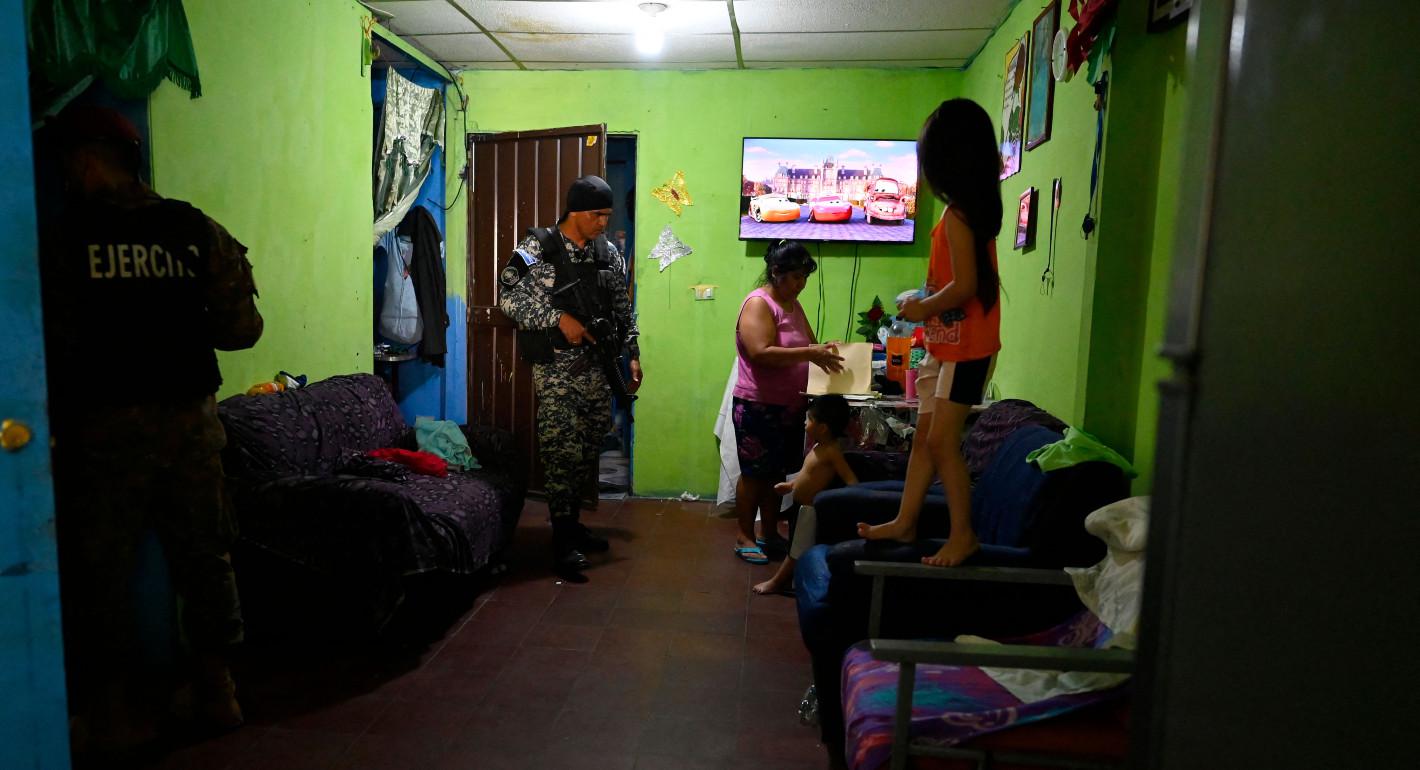
First, while women previously feared gang members and the extreme violence they used against their female neighbors, they now fear violence at the hands of government authorities. One woman who works for a women’s rights group and lives in a gang-controlled neighborhood told us that “five years ago, we were afraid of mareros [gang members], and now we are afraid of groups of soldiers.” Speaking about the state of exception, she noted: “It brings a false sense of security. . . . There is so much harassment from police and soldiers, because they have increased their presence in our communities, and you can’t say anything about it.”
This activist explained how she feels threatened by the increasing militarization of her neighborhood, as the army has been deployed to patrol the streets. She hides her identity, telling her neighbors that she is a teacher. She fears that if the soldiers knew her real job, she could be arbitrarily apprehended under the state of exception, and she would have very little recourse to protect herself. She is also clear that although many gang members have been arrested, others have gone into hiding and continue to live in and control certain areas.
Second, women who are family members of incarcerated people now face pressure to support their families financially. Previously, many women who lived with gang members relied on them—or fellow gang members, if their partner was in jail—for income. Not only are thousands of these women newly in charge of single-headed households, they also need to deliver money to their incarcerated family members. Food, uniforms, and essential hygiene supplies such as soap, toilet paper, and toothpaste are not provided by the prisons, and the expenses—including transportation, sometimes far from their homes—impose a heavy economic cost on poor households. Some worry about the risk of their young children joining gangs to help make ends meet.
Other women spend their days in vigil outside jails, where they desperately ask for information about their detained loved ones.
Women interviewed also expressed fear for their young daughters. Now that they need to go outside their homes to earn an income, they often have to leave their children unaccompanied at home. They fear that their daughters may face sexual violence at the hands of the police and soldiers stationed in their communities. They also fear heightened intrafamilial violence while their children are left unsupervised.
Third, organizations that defend and protect women’s rights are under increasing attack by authorities. The government has already slashed the budget of the state women’s institute and the highly praised Ciudad Mujer project, which assists women victims of violence and provides access to healthcare, job training, and financial advice. According to the official narrative, violence against women is no longer a priority now that the gang problem has been “eliminated.” In an interview, one woman who works for a human rights organization revealed that there are now only two functioning women’s shelters in the entire country, to her knowledge.
While reliable data about gender-based violence is hard to access in El Salvador, women’s organizations note that intimate-partner violence remains high, and that the mass incarceration of gang members has not necessarily led to a decrease in these cases.
Meanwhile, women who have spoken out against the government’s human rights abuses report that they have been harassed, doxxed online, and stalked by state forces. They now aim to maintain low profiles, and some have had to cease their more public-facing advocacy for women’s rights.
Gender and National Security Policies
El Salvador will hold presidential elections in 2024, and most analysts predict that Bukele’s Nuevas Ideas party will win by a landslide, defying the Salvadoran constitutional ban on reelection. Although it is unclear whether Bukele will maintain the current state of exception, his justice minister has declared that imprisoned gang members will “never return” from prison.
Yet despite the high costs to democracy, Bukele has managed to address the country’s gang problem, at least temporarily. Homicides in the country have declined dramatically. Other countries in Central America are assessing whether mano dura models like Bukele’s state of exception might be the tough medicine required to crack down on gang violence.
But as human rights defender Verónica Reyna shared in an interview, the history of security policy in El Salvador points in the opposite direction. “This quick formula, recycled from the penal populism of past Arena and FMLN governments appears to yield quick and effective solutions, but it brings profound ‘collateral damages’ that are increasingly difficult to reverse,” says Reyna.
Historically, mano dura strategies have transformed gangs into more powerful groups capable of exercising vast territorial control. Moreover, they have led to an increase in the number of human rights violations carried out by state security forces.
The current security situation in El Salvador is based on the government restricting fundamental rights, including the rights to legal counsel, fair trial, and freedom of expression. For women already victimized prior to the state of exception, the absence of such rights exacerbates their gendered vulnerabilities, by making it more difficult to advocate for effective solutions to all forms of violence and demand accountability from the state. These patterns point to the limits of repression as a sustainable solution.
Understanding how extreme militarization policies create new sites of gendered vulnerability is essential not only in El Salvador, but also in other countries in Central America and beyond. It should broaden policymakers’ imaginations beyond short-term security initiatives that, while delivering immediate results, also exacerbate the harm that criminal violence already inflicts on women.