China-Europe Relations, Two Years After Russia Invaded Ukraine
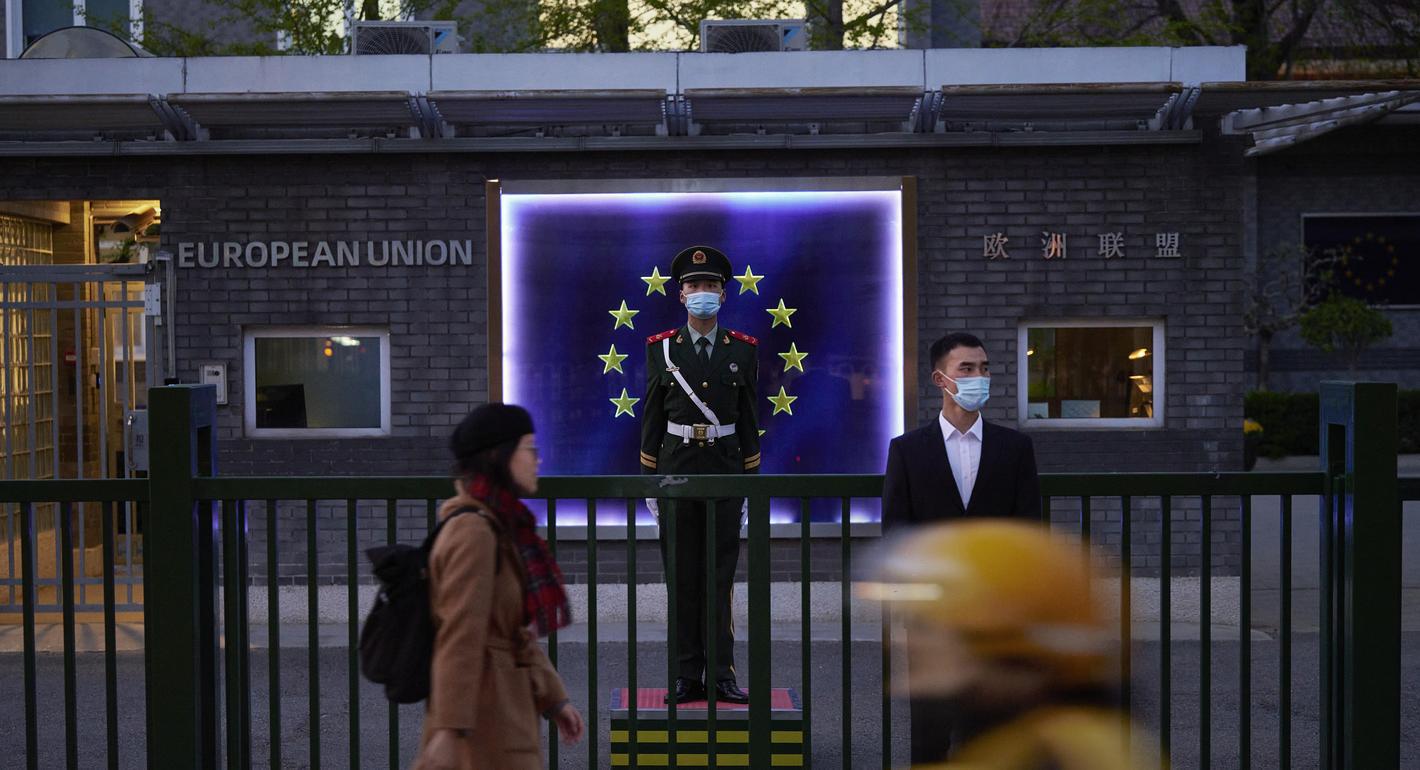
The Russian invasion of Ukraine is a turning point in the EU-China relationship, and evolution of the China-Russia relationship will continue to impact EU-China relations.
Link Copied
By Yifan Ding and Alice Ekman
Published on Mar 11, 2024
This Q&A was adapted from a Carnegie China live event assessing China–EU relations. It has been edited for clarity.
Yifan Ding: The origin of tension between Europe and China can be traced back to the European Commission’s 2019 Strategic Outlook, which for the first time described China as a cooperation partner, a market competitor, and systemic rival. The mistrust that began in 2019 was reinforced by the Russia-Ukraine war.
When U.S. President Joe Biden came to power, he tried to put China and Russia in the same basket to create a confrontation between a coalition of democracy and a coalition of authoritarianism. Although China never recognized Russia’s behavior in Crimea or in Eastern Ukraine, China did not blame Russia for its military actions. China considered the sequence of events more complicated than its appearance.
Behind the military action, there is the fact that Russia was forced into a corner by NATO’s successive enlargement and Western countries’ treatment of Russia. So China could not afford to blame Russia in the same way as Western countries. While Europeans have considered China’s attitude toward the Russia-Ukraine war as ambiguous, they also have interpreted China as providing passive support to Russia. European public opinion has considered every declaration about the war by the Chinese government as unfair and unjust because the Chinese government does not blame Russia. As a result, the Russia-Ukraine war has reinforced mistrust between Europe and China.
Alice Ekman: China’s foreign policy strategic documents tend to consider Russia and the emerging or developing world as natural partners of China. The United States is seen as China’s top rival, despite its willingness to avoid escalation of tension through channels of communication.
In between these two groups is Europe, which is seen as a gray zone for China. Europe is put in the Western basket by Beijing, which considers that by default Europe cannot truly be trusted. But Beijing also sees Europeans as potentially useful Westerners, especially when there exist divergences with the United States. That is why China appreciates expressions such as “strategic autonomy” and an “independent” foreign policy, which can fuel transatlantic divergences and isolate China’s main rival, the United States. I think Mao Zedong’s “Three Worlds” theory is a legacy here, even if the world has evolved. In a world order divided into three, Europe is seen as useful but certainly not a natural, legitimate, or priority partner. Russia is China’s most natural and key partner.
I was interested to read in the South China Morning Post a quote from Professor Ding saying that that Russia can be an example for China to manage financial and economic sanctions coming from the West in the future. China is learning from Russia’s ability to handle sanctions and maintain a rather stable economic situation.
Overall, I have the impression when I read the joint statements and communications following meetings between [Russian President] Vladimir Putin and [Chinese President] Xi Jinping that the Russia-China relationship is developing long term—independent of the evolution of the war in Ukraine and independent of Europe’s dissatisfaction with China’s position. The EU hoped that it could use its economic leverage to push China to clarify its position toward Russia’s invasion of Ukraine and possibly to distance itself from Russia. Not only has Europe not managed to push China in that direction, but on the contrary, China has reinforced rapprochement with Russia, even as Europe remains an important market. I agree that the Russian invasion of Ukraine is turning point in the EU-China relationship and evolution of the China-Russia relationship will continue to impact EU-China relations.
About the Authors
Yifan Ding
Yifan Ding is the president of the China Society for France Studies.
Alice Ekman
Alice Ekman is a senior analyst at the European Union Institute for Security Studies.
Carnegie India does not take institutional positions on public policy issues; the views represented herein are those of the author(s) and do not necessarily reflect the views of Carnegie, its staff, or its trustees.
After the chill in ties between 2020 and 2024 that brought India–China relations to their lowest point in several decades, the two countries have engaged each other afresh. This paper argues that there are predominantly four imperatives guiding India’s approach to China, and they exist in an order of priority.
This piece argues that India’s central challenge is not managing a single flashpoint but resolving the underlying tension between expansion and institutional coherency of the BRICS grouping.
A partnership between India, a country of subcontinental size, and Africa, a continent of fifty-four countries, may seem asymmetric until one notes that both are home to nearly the same number of people—1.4 billion. This essay spells out the existing challenges to the partnership, its optimal potential, and the possible pathways to realize it over the next quarter-century.
The India–EU Free Trade Agreement (FTA) is shaping up to be one of the most consequential trade negotiations, both economically and strategically. But, what’s in the agreement, what’s missing, and what will determine its success in the years ahead
Trump 2.0 has unsettled India’sexternal environment—buthas notoverturned its foreign policystrategy,which continuesto relyon diversification, hedging,and calibrated partnerships across a fractured order.
+6
Milan Vaishnav, ed., Sameer Lalwani, Tanvi Madan, …