

Source: Getty
Engaging History: The Problems & Politics of Memory in Russia and the Post–Socialist Space
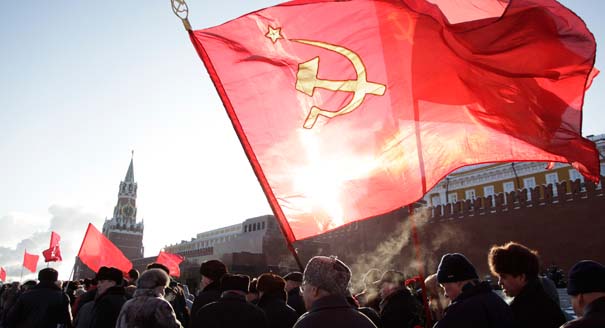
The use and misuse of history as a tool for political competition and control has become an increasingly visible phenomenon in public and political life in Russia and other post-Soviet countries over recent years.
Source: Carnegie Moscow Center Working Paper

In this Working Paper, Alexei Miller argues that the politics of history is steadily eroding possibilities for public discussion in Russia itself and between Russia and its neighbors, as both sides attempt to inculcate ideas that run counter both to reality and the interests of the opposite side. By following its neighbors down the road of historical politics, Russia is only reinforcing the atmosphere of “a dialogue of the deaf.” Alexander Astrov holds that Estonia’s successful accession to NATO and the EU gave birth to an increasing sense of uncertainty: the shared, consolidated narrative that had dominated public life for so many years has now suddenly lost its relevance. This so-called “ontological anxiety” ultimately led to a succession of internal political crises, to which the “anti-totalitarian” rhetoric attempts to provide a response. Georgy Kasyanov describes the development of the Holodomor narrative in Ukraine, which, he argues, pursued the goal of turning the 1932-33 famine into one of the founding symbols of the national historical myth.
Key conclusions include:
- Due to society's allergy to ideology, as well as to the lack of consensus on the major events of the 20th century, Russia does not possess enough “national myths” to build a national identity.
- The only event that could act as a basis for a unifying ideological narrative—the victory in World War II—is rife with contradiction.
- The Russian government’s position in this case is biased and simplistic, leaving no space for pluralism.
- There are three approaches to engaging with history in Russia: political activism, discourse activism and research activism. Although the field of civic engagement with history is lively, and historical activists in Russia seem to be interested in what each other are doing, still they do not have much impact on society, a failure due primarily to Russians’ indifference not only to their past, but to their present political life.
Summing up a seminar on historical politics held in Kazan, Andrei Ryabov writes that historical politics has become an increasingly visible phenomenon in public and political life in the post-Soviet countries over recent years, extending far beyond the widespread practice of politicizing history. Historical politics emerges only in a pluralistic (though not necessarily fully democratic) system that has public competition between various actors. It is carried out with the aim of forming in the public consciousness certain dogmatic interpretations of national history. At the same time, historical politics as an activity aimed at forming specific images in the minds of the “mass consumer” does not mean renouncing or banning debate within the professional community of historians. It seeks, rather, to draw a dividing line between “history for the masses” and history for a narrow circle of professionals and intellectuals.
About the Authors
Former Deputy Director for Operations, Moscow Center
Sam Greene was a deputy director for operations at the Moscow Center. He joined the Moscow Center in 2005. Previously, he was senior media program advisor for the New Eurasia Foundation, and a London and Moscow correspondent for FT Business.
Former Scholar in Residence, Society and Regions Program, Editor in Chief, Pro et Contra, Moscow Center
Lipman was the editor in chief of the Pro et Contra journal, published by the Carnegie Moscow Center. She was also the expert of the Carnegie Moscow Center’s Society and Regions Program.
Former Scholar-in-Residence, The East East: Partnership Beyond Borders Program, Moscow Center
Ryabov was chair of the Carnegie Moscow Center’s East East: Partnership Beyond Borders Program. He is also the chief editor of the journal World Economy and International Relations and a leading researcher at the Russian Academy of Sciences’ Institute of World Economy and International Relations.
Alexei Miller
Alexander Astrov
Georgy Kasyanov
Carnegie India does not take institutional positions on public policy issues; the views represented herein are those of the author(s) and do not necessarily reflect the views of Carnegie, its staff, or its trustees.