• Research
  • About
  • Experts
Carnegie India logoCarnegie lettermark logo
Photo Essay: Libya’s Path to Civil War

Source: Getty

Article

Photo Essay: Libya’s Path to Civil War

An exclusive, on-the-ground look at Libya as it fractures.

Link Copied
By Frederic Wehrey
Published on Dec 10, 2014
Photograph by Frederic Wehrey
 
Downward spiral
More than three years after the fall of strongman Muammar Qaddafi, Libya is in the midst of a bitter civil war. Political factions and armed groups fight for control of a country struggling with democracy, and state institutions barely function, particularly the army and police.
Photograph by Frederic Wehrey
 
Militias gain strength
Read More
Libya’s Militia Menace: The Challenge After the Elections
Frederic Wehrey
Foreign Affairs
Much of Libya’s insecurity stems from the power of its numerous nonstate armed groups—militias denoted as “brigades” or “battalions” in local parlance. Constituted along regional, municipal, tribal, and sometimes ideological lines, these groups mushroomed in size and number as the country’s transitional government began to subsidize them. Here, the Benghazi headquarters of the Zawiya Martyrs’ Brigade, a prominent eastern militia.
Photograph by Frederic Wehrey
 
Crucible of the revolution
Read More
The Battle for Benghazi
Frederic Wehrey
Atlantic
The eastern city of Benghazi, Libya’s second largest, was the heart of the 2011 revolution. In 2012, revolutionaries remained jubilant, posing in front of the former regime’s security headquarters. The storming of this building was a pivotal moment in the early stages of the revolution, but today the city is torn apart by factional fighting, and many residents have fled.
Photograph by Frederic Wehrey
 
Misrata rising
Misrata, a port city to the east of Tripoli shown here in 2012, was the site of a ferocious siege during the revolution that caused extensive damage. Militias from the town are at the center of battles for control of post-Qaddafi Libya. They have occupied key strategic sites and ministries in Tripoli and have jostled for political supremacy with other armed groups.
Photograph by Frederic Wehrey
 
Deep wounds
At a memorial in Misrata, faces of civilian and revolutionary casualties during the siege.
Photograph by Frederic Wehrey
 
Zintan joins the fray
The well-armed militias from Zintan, a town in the western Nafusa Mountains, have been major players in the struggle for power in Libya’s capital. They have clashed with other western communities and struggled with militias from Misrata for power and resources in Tripoli. Here, a sunset view of the Nafusa.
Photograph by Frederic Wehrey
 
The lure and persistence of militias
Read More
Ending Libya’s Civil War
Frederic Wehrey
paper
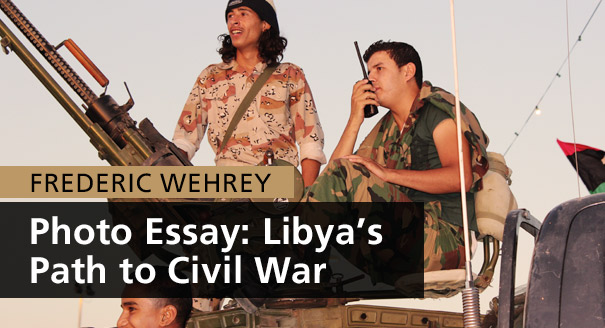
For their young members, militias provide an income, a social identity, and security. A key challenge for Libya is demobilizing these groups and moving the young men into the private sector, educational system, or regular army and police. Some of these young men manned an antiaircraft gun outside Tripoli’s Abu Slim Prison in 2012.
Photograph by Frederic Wehrey
 
Islamists and postrevolutionary justice
The Abu Slim Prison was the site of human rights abuses during Qaddafi’s rule, including the killing of over 1,000 political prisoners, many of them Islamists, in 1996. Tension between the remnants of the old guard—the technocrats and army officers who served under Qaddafi—and younger revolutionaries and Islamists is a central fault line in today’s Libya, and the prison epitomizes the dilemmas of postrevolutionary justice and reconciliation. A mural being painted on the prison wall in 2012 memorializes the massacre.
Photograph by Frederic Wehrey
 
Avoiding fragmentation
Read More
The Struggle for Security in Eastern Libya
Frederic Wehrey
paper
Libya is fragmented between competing centers of local power, with no one center strong enough to dominate the others. Under Qaddafi, the eastern part of the country was politically and economically neglected, leading to periodic calls for greater autonomy in the east. But what many Libyans desire is a healthy degree of decentralization. At a 2012 protest against a declaration of autonomy by eastern federalists, a placard read: “No to federalism, no to centralization, no to militias, and yes to national unity.”
Photograph by Frederic Wehrey
 
Dearth of democracy
Militias had become increasingly polarized by mid-2013, forming alliances with political blocs in Libya’s dysfunctional legislature, the General National Congress. A constellation of armed groups led by Misratan and eastern revolutionaries used the threat of force to secure passage of a law banning Qaddafi-era officials from future government employment and called for the prime minister’s resignation. This clear threat to democratic processes prompted popular countermobilizations in Tripoli. One protester carried a placard that read: “No to the fall of the government through weapons.”
Photograph by Frederic Wehrey
 
Violence flares
In November 2013 in Tripoli’s Ghargour district, militias from Misrata killed dozens of protesters who were rallying against the armed groups’ presence in the city. Clashes continued into the evening, and smoke could be seen rising from the district. The police and army lacked sufficient strength to respond immediately; the government scrambled fighter jets to try to disperse the gunmen.
Photograph by Frederic Wehrey
 
Backlash against militias
More demonstrations broke out in the wake of the Ghargour incident, with many calling for the complete withdrawal of all militias from Tripoli. It was a powerful display of civil society mobilization that led to the redeployment of some militias outside the city. At a rally in Algeria Square in Tripoli, a placard read, “The February Revolution was a popular revolution and not a coup.”
Photograph by Frederic Wehrey
 
Political awakening
After forty-two years under Qaddafi’s authoritarian rule, Libya still has no viable institutions that would allow for participatory politics. Yet, even in the face of great violence, Libyans have taken to the streets to protest key issues such as the power of militias, the exclusion of former regime officials from government, and plans for a federal system.
Photograph by Frederic Wehrey
 
People power
This level of popular mobilization—and Libya’s worsening security—stands in stark contrast to the Qaddafi years, when the strong arm of the state ensured an almost Orwellian calm. In practice, though, violence and dissent lurked beneath the surface as the Libyan dictator played communities against one another and squandered the economy. Still, the regime attempted to maintain the façade of popular legitimacy, and in September 2009, an older poster was moved aside to make way for newer, flashier portraits in preparation for the fortieth anniversary of Qaddafi’s seizure of power.
Photograph by Frederic Wehrey
 
A failed state
Read More
Building Libya’s Security Sector
Frederic Wehrey and Peter Cole
policy outlook
Since Qaddafi, Libya’s formal state security sector has remained weak, underfunded, and highly fragmented. Many security functions are performed by competing militias that have been put on the payroll of state ministries. Successive attempts by outsiders to train the Libyan police and army have largely failed. Despite the appearance of professionalism of this newly trained police force watching over protests in Algeria Square in 2013, the service’s power pales in comparison to the militias.
Photograph by Getty images
 
All-out war
Read More
What’s Behind Libya’s Spiraling Violence?
Frederic Wehrey
Washington Post
As of late 2014, Libya is split between two warring camps, the Dignity and Dawn forces. The Dignity forces arose in May 2014 as a campaign by retired general Khalifa Hifter (left) to evict Islamist militias from Benghazi, such as the terrorist group Ansar al-Sharia led by Muhammad al-Zahawi (right). The threat that Dignity would reach Tripoli provoked the Dawn countermovement by Misratan, Islamist, and western militias. Each camp lays claim to legitimacy, with its own parliament, armed forces, and prime minister.
Photograph by Getty Images
 
Out of the chaos
Read More
Is Libya A Proxy War?
Frederic Wehrey
Washington Post
The fighting has left hundreds dead and prompted a massive exodus of refugees, businesses, and diplomats. Foreign nations are increasingly involved, with Egypt and the UAE backing the Dignity forces and Qatar, Turkey, and Sudan backing Dawn. To ultimately move the country forward, Libyans need to reengage in the politics of recognition and reconciliation.
 

About the Author

Frederic Wehrey

Senior Fellow, Middle East Program

Frederic Wehrey is a senior fellow in the Middle East Program at the Carnegie Endowment for International Peace, where his research focuses on governance, conflict, and security in Libya, North Africa, and the Persian Gulf.

    Recent Work

  • Research
    Russia in Africa: Examining Moscow’s Influence and Its Limits
      • Nate Reynolds
      • +11

      Frances Z. Brown, Nate Reynolds, Priyal Singh, …

  • Commentary
    How the Flaws of Trump’s Gaza Deal Prevent an Enduring Peace

      Charles H. Johnson, Frederic Wehrey

Frederic Wehrey
Senior Fellow, Middle East Program
Frederic Wehrey

Carnegie India does not take institutional positions on public policy issues; the views represented herein are those of the author(s) and do not necessarily reflect the views of Carnegie, its staff, or its trustees.

More Work from Carnegie India

Get more news and analysis from
Carnegie India
Carnegie India logo, white
Unit C-4, 5, 6, EdenparkShaheed Jeet Singh MargNew Delhi – 110016, IndiaPhone: 011-40078687
  • Research
  • About
  • Experts
  • Projects
  • Events
  • Contact
  • Careers
  • Privacy
  • For Media
Get more news and analysis from
Carnegie India
© 2026 Carnegie Endowment for International Peace. All rights reserved.