

Article
This piece argues that India’s central challenge is not managing a single flashpoint but resolving the underlying tension between expansion and institutional coherency of the BRICS grouping.
Vrinda Sahai
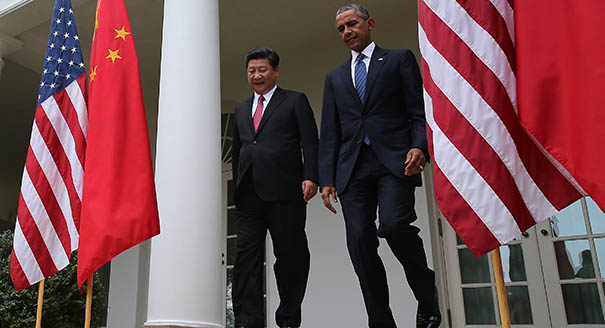
Source: Getty
The next U.S. administration is inheriting a complicated relationship with China, but steps can be taken to reduce tensions and the risk of conflict.
Regardless of who moves into the White House in January 2017, the new U.S. president will have to manage one of the world’s most complicated, controversial, and consequential bilateral relationships. If Washington and Beijing cannot work out ways to reduce suspicions and avoid conflict, peace and prosperity in East Asia and beyond will likely embark on a downward trajectory.
Many Americans—including this year’s two presidential candidates, Hillary Clinton and Donald Trump—seem to view China as a major source of some of the United States’ pressing problems at home and growing frustrations abroad. Trade with China is blamed for the loss of 3.2 million American jobs. Beijing is accused of setting up stringent market entry requirements for American businesses. Chinese companies are allegedly guilty of massive intellectual property theft. China’s actions (or inactions) are held responsible—at least partly—for the nuclear crisis on the Korean Peninsula, the Syrian impasse, the United States’ worsening relationship with Russia, and tensions in the South China Sea. China’s Asian Infrastructure Investment Bank and Belt and Road Initiative are treated as carefully crafted strategies to increase the country’s geopolitical influence at the cost of America’s.
Similar perceptions of the United States seem prevalent among a sizable portion of Chinese citizens and policymakers. The Barack Obama administration’s so-called pivot to Asia is seen as a thinly disguised American attempt to keep a rising China down. Washington is accused of supporting pro-independence movements in Hong Kong and Taiwan, emboldening the Philippines and Vietnam to adopt a confrontational approach to China regarding disputed islands, and escalating tensions in the South China Sea by sailing its naval ships in Chinese sovereign waters. U.S.-based NGOs, including government affiliated groups, are suspected of encouraging and funding activities that undermine the rule of China’s Communist Party. The United States is criticized for being unfriendly to Chinese investment and for pressuring Beijing to appreciate its currency at the cost of China’s export industries.
Against this backdrop of mutual finger-pointing and distrust, some analysts are justifiably worried that rising power China and ruling power America are headed toward war, a trajectory known as the Thucydides Trap. Others characterize the bilateral relationship as at a tipping point or a crossroads.
What can and should the next U.S. president—and Chinese leaders—do to avoid a tragedy of great power politics? It starts with some reflections on the challenges each country faces.
Though an idiosyncratic leader can significantly impact a country’s foreign policy, those policies are primarily determined by a combination of international and domestic forces. And both countries, it turns out, are facing daunting challenges at home and abroad.
In the United States, glaring inequality, rising racial tensions, a shrinking middle class, and declining public trust seem to make American democracy hollow and unattractive. For more than two hundred years Americans were predominantly white and Protestant, but the continuing influx of Hispanic and other immigrants—legal and illegal—will make whites the largest minority around 2050. Last but not least, since the end of the Second World War, the United States has been a global power—and the only superpower since 1991. The global financial crisis, the wars in Iraq and Afghanistan, and the rise of the rest (particularly China), however, have seriously constrained America’s global leadership.
On the Chinese side, three decades of extraordinary economic growth have made China arguably the second most powerful country in the world—at least in terms of aggregate GDP, global trade, and military spending. Because of what is known as a century of humiliation at the hands of foreign powers, most Chinese view their country’s reemergence as a great power as “the great rejuvenation of the Chinese nation,” as Chinese President Xi Jinping put it. This great rejuvenation—or the Chinese Dream—understandably brings about national pride; but it also leads to a strong urge to demand international respect, to calls for reforms of existing international institutions, and to the determination to flex muscles if necessary. At the same time, breakneck economic growth has left in its wake myriad social and economic challenges: worsening inequality, environmental degradation, polluted air, and unsafe food and products. Because of this, Susan Shirk calls China “the fragile superpower.”
Consequently, Washington and Beijing may not be able to resist blaming the other for domestic discontent and international frustrations. Such a strategy could whip up short-term popular support for political leaders, but it also makes a “clash of the titans” more likely in the long term.
Instead, American and Chinese leaders should take steps to educate their respective publics about the positives of the bilateral relationship. The tremendous flow of people, goods, and services across the Pacific Ocean every day already makes the relationship indispensable to both countries. Leaders should highlight, encourage, and expand this unprecedented interdependence (at least compared with relations between the United States and the former Soviet Union). If the top decision makers fail to set the agenda of U.S.-China relations and to frame the relationship as mutually beneficial, then some domestic forces will be more than happy to hijack the agenda by highlighting their grievances against the relationship.
It is imperative for the United States and China to reform their respective political systems. American democracy is in such bad shape that nothing short of another progressive movement can pacify mounting popular discontent. The China model also needs to be updated to make economic growth equitable and sustainable.
Such domestic reforms will not only improve the welfare of both American and Chinese citizens but also foster economic ties, cultural exchanges, and political empathy between the two peoples. Ultimately, these reforms will contribute to a better bilateral relationship by reducing domestic incentives to scapegoat the other.
When China’s inflated sense of power faces off with America’s deflated one, the surest recipe for resentment and revenge includes a triumphant Beijing and a paranoid Washington. An America with its wings clipped could quickly regenerate, while a rejuvenated China could just as quickly degenerate.
Leaders on both sides should learn to appreciate and accommodate the other’s legitimate interests, claims, and concerns, though this is easier said than done, given America’s history of dominance and China’s history of grievance. Still, American and Chinese leaders should marshal audacity and ingenuity to more effectively manage one of the world’s most important bilateral relationships.
Xie Tao is a professor at the School of English and International Studies, Beijing Foreign Studies University. He is also a senior fellow at the Center for China and Globalization.

Xie Tao
Xie Tao is professor of Political Science and Dean of the School of International Relations and Diplomacy, Beijing Foreign Studies University. His research interests include U.S.-China relations, Chinese foreign policy, as well as American public opinion toward China.
Carnegie India does not take institutional positions on public policy issues; the views represented herein are those of the author(s) and do not necessarily reflect the views of Carnegie, its staff, or its trustees.

This piece argues that India’s central challenge is not managing a single flashpoint but resolving the underlying tension between expansion and institutional coherency of the BRICS grouping.

Vrinda Sahai

A partnership between India, a country of subcontinental size, and Africa, a continent of fifty-four countries, may seem asymmetric until one notes that both are home to nearly the same number of people—1.4 billion. This essay spells out the existing challenges to the partnership, its optimal potential, and the possible pathways to realize it over the next quarter-century.

Rajiv Bhatia

The U.S.–India semiconductor cooperation story is well-stocked with top-level strategic intent. What remains unresolved, however, are some underlying challenges that will determine whether the cooperation actually functions. Three such friction points stand out.

Shruti Mittal

The India–EU Free Trade Agreement (FTA) is shaping up to be one of the most consequential trade negotiations, both economically and strategically. But, what’s in the agreement, what’s missing, and what will determine its success in the years ahead
Vrinda Sahai, Nicolas Köhler-Suzuki

On March 10, 2026, India’s Union Cabinet approved amendments to Press Note 3, a regulation that mandated government approval on all foreign direct investment (FDI) from countries sharing a land border with India. This amendment raises questions primarily about whether its stated benefits will materialize and if the risks have been adequately weighed. This piece will address the same.

Konark Bhandari