

Commentary
Shana Tabak
Source: Getty
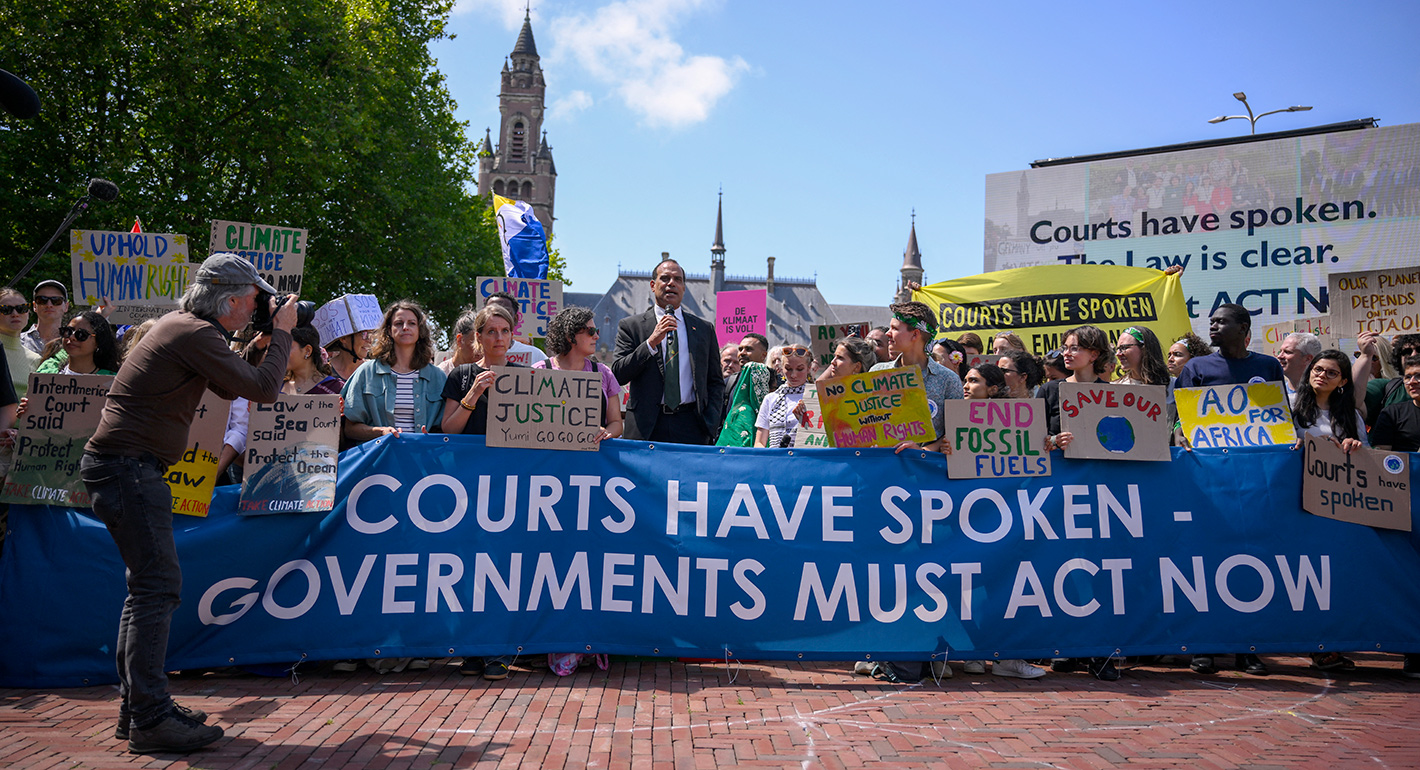
The court’s opinion aims to clarify responsibility and lay out a path to accountability on climate mitigation and adaptation. Yet concrete policy advances have been limited.
The International Court of Justice, through its 2025 Advisory Opinion in Respect of Climate Change, took a massive step toward centering people in climate action. The opinion is threaded throughout with references to the profound and unevenly distributed impacts of climate change on human habitability—where and how humans can live safely and with dignity. The advisory opinion (AO, or the opinion) provided exceptional clarity on the legal obligations of states to address climate change and the legal consequences of breaching these obligations.
The exuberance with which climate advocates greeted the decision has given way to a tempered position of realpolitik, if not pessimism, with regard to the capacity of international law to remain relevant. U.S. President Donald Trump’s administration has backed out of international climate agreements. Other polluting nations made weak decarbonization commitments at the most recent United Nations Framework Convention on Climate Change (UNFCCC) Conference of the Parties (COP). Basic tenets of international law have been called into question and states regularly flout norms of interstate relations through cross-border interventions, human rights abuses, and forced regime change. Multilateralism is under attack, and the United States, in evidence of its climate bullying tactics, has gone to great lengths to prevent coalitions from advancing climate action.
In contrast, the AO elevates itself above these dynamics, asserting that human rights and environmental justice are of paramount value for all states. The contrast between the world envisioned by the nonbinding AO and today’s existential crisis regarding the relevance of multilateralism and internationalism could not be starker. In March 2026, a group of UN experts noted that “states at the UN Climate Conference of November 2025 (COP30) were unable to uphold the legal and scientific standards clarified by the ICJ, or agree on meaningful outcomes on climate mitigation.” And in the time since the landmark decision, global climate action can only be described as having backslid, rather than leapt forward as hoped.
This article examines implementation of the ICJ climate case thus far, suggesting potential for its continuing impact amid an atmosphere of climate backlash.
Dozens of articles have been published analyzing the 140-page opinion. In contrast, this article examines implementation of the ICJ climate case thus far, suggesting potential for its continuing impact amid an atmosphere of climate backlash. In doing so, it takes up the concept of climate mobility as a case study; the question of where people can live in a world reshaped by climate change is directly affected by the mitigation and adaptation obligations analyzed in the advisory opinion. This article first highlights the relevance of the court’s decision for human habitability. Second, it assesses the opinion’s impact thus far in climate policy negotiations and in climate litigation, drawing on examples related to climate mobility to illustrate where that implementation gap is most visible. It examines several reasons for the significant divergence between the hortatory language in the decision and the outcomes of COP30. Third, it offers recommendations for strategic engagement with the opinion, arguing that despite the current political context of withdrawal from climate commitment, the AO can serve as an enduring reference point for human-centered climate action.
International legal mechanisms such as advisory opinions are not drafted with short-term implementation goals in mind; observers would have been mistaken to expect instant gratification. Instead, the court’s decision should be understood within a longer timeframe in which the court is part of an ongoing, complex, multi-stakeholder process of international law and policy. While the decision from a historically conservative court is indeed remarkable, its ultimate impact will depend on the advocates, policymakers, and courts who leverage it to increase support for climate-impacted communities, whether they aim to stay in place and adapt or safely and humanely move.
Just as many states are experiencing democratic backsliding, climate policy has similarly experienced recent backsliding, as commitments on climate are undermined. And yet, in the radically different multilateral landscape of only three years ago, in 2023 Vanuatu successfully petitioned the United Nations General Assembly to unanimously request that the ICJ issue an advisory opinion clarifying how climate change should be treated under international law. This campaign was spearheaded by a group of students who lobbied Vanuatu to advance the case. For them and their supporters, it was past time for the world’s highest court to clarify whether and how international law could prevent greenhouse gas emissions from causing irreversible damage to future generations.
The court clarified that all nations owe a communal duty to protect the international community from damage caused by climate change.
On July 23, 2025, the International Court of Justice delivered a historic and unanimous decision: the Advisory Opinion on Climate Change. Observers that day in the Great Hall of Justice were rightly floored by the sweeping nature of the decision. The court clarified that all nations owe a communal duty to protect the international community from damage caused by climate change. The court also confirmed that failures to comply with these obligations—whether through inadequate national targets, fossil fuel licensing, or lack of support for vulnerable states—may amount to violations of international law and thus trigger the full range of legal consequences under the law of state responsibility.
The decision reflects a deep concern for mitigation of climate change, but also with climate adaptation. The connections between climate adaptation and human migration have been contemplated by scholars, who explain that failure to adapt to climate impacts can make out-migration inevitable. Climate-related migration and displacement are impacted by declines in habitability; climate-related changes and risks include extreme heat, irregular rainfall, flooding, sea-level rise, loss of biodiversity, desertification, and environmental degradation. These impacts in turn affect the complex motivations that drive a person to migrate, or to attempt to adapt in the face of climate change. Thus, the ICJ decision has potentially far-reaching implications for people displaced, migrating, or relocating, but also for another category of climate mobility, those who stay, willingly or not.
As discussed elsewhere, the court’s clarifications regarding climate mobility can be categorized into four holdings. First, the court affirmed existing jurisprudence that found a person who has been displaced across borders due to climate change is entitled to be protected under international law and cannot be returned to his or her country of origin if it has been devastated by climate to an extent that conditions have become life-threatening (paragraph 378). Second, while the court did not find a standalone right to a clean environment, it found that a clean, healthy, and sustainable environment is a precondition for the enjoyment of other human rights (paragraph 393). This finding implicated people who may be displaced, whether within or across borders, because climate change may undermine their intrinsic human rights. Third, it recognized that sea-level rise resulting from climate change threatens forced displacement and jeopardizes territorial integrity. Yet, the court found that even the displacement of populations from a territory due to climate would not necessarily undermine the right to statehood, implying that affected people would not necessarily become stateless in such a case of climate displacement.
Finally, on climate adaptation and finance, dozens of states asked the court to clarify what obligations wealthy states had to finance adaptation for states impacted by climate change. In direct response to this request, the court looked to the Paris Climate Agreement and found that states who have not aggressively pursued and financed mitigation of greenhouse gases are likely in violation of their obligations: The Paris commitment of limiting warming to 1.5 degrees Celsius is not discretionary. States least responsible for greenhouse gas emissions find themselves facing the greatest impacts, including sea-level rise, desertification, extreme heat, and flooding. These climate impacts will either force people to adapt if they want to stay in their homes or play a contributing role in their displacement. In its holding, the court found that developed parties have an additional obligation “to assist developing country parties in meeting the costs of adaptation” (paragraph 268 and Article 4 paragraph 4 of the Paris Agreement). The preventative nature of this obligation—to fund anticipatory action so that communities need not leave land that has been rendered uninhabitable by climate change—is an important contribution to jurisprudence on climate mobility.
Taken together, these four holdings establish a meaningful legal framework for communities at risk of or impacted by climate displacement. The court, recognizing the interconnectedness between climate change and all aspects of human rights and human dignity, provided legal grounding for communities to use this decision to advance their capacity to adapt in situ, as well as to move with dignity, and (perhaps most significantly) clarified the legal obligations of wealthier states to finance both mitigation and adaptation efforts aimed at human-centered climate action. And yet, in the months since the opinion was handed down, policymakers and attorneys have failed to transform this significant—yet nonbinding—decision into policy action. In the legal sphere, some advances have been made, but more needs to be done. Understanding why requires examining the gap between what the court clarified and what stakeholders have been willing and able to do with that legal clarity.
Much of the promise of the AO has been undermined by the geopolitical tumult challenging multilateralism of late, which has had particularly threatening effects on global climate ambitions. This section examines the gap between the bold challenges laid out for climate action in the decision and what has been realized thus far, using climate mobility as a lens through which to examine broader impact.
When it was published, the ICJ decision was heralded as an opportunity to accelerate international cooperation by providing both an opening for increased climate litigation as well as renewed climate diplomacy. International climate litigation may include advisory opinions by courts, but also litigation at the state, regional, and international levels. Policy and diplomacy processes, on the other hand, reference multilateral negotiations on climate such as UNFCCC climate negotiations. Yet climate policy processes are intertwined with state level policy engagement, such as negotiations of Nationally Determined Contributions (NDCs), National Adaptation Plans (NAPs), or national regulatory policies on Environmental, Social, and Governance (ESG) standards. Policy impacts may also be reflected through engagement on informal, track 2 conversations, and other efforts to promote international cooperation.
In the months since the ICJ decision was released, several cases have advanced the opinion’s holdings through direct incorporation.
In the months since the ICJ decision was released, several cases have advanced the opinion’s holdings through direct incorporation. In one recent case, the Dutch territory of Bonaire brought a claim against the Netherlands that it had failed to protect residents from climate-change related sea-level rise in the Caribbean. The Dutch court’s decision, citing the AO as evidence of “international consensus that the state has an obligation to take timely action,” ordered the Netherlands to take timely action to finance Bonaire’s climate adaptation efforts. This holding echoes the ICJ’s interpretation of the Paris Agreement, finding that wealthy countries must assist developing states in meeting the costs of adaptation, therefore helping people stay in place. Although the Netherlands recently appealed the holding, if it’s upheld, it will be legally binding upon the Dutch state to mitigate the impacts of climate change for the island nation’s inhabitants.
Another recent case at the European Court of Human Rights (ECtHR) referenced the AO but declined to mandate climate action limiting greenhouse gases when it had the opportunity to take a more decisive approach. In the 2025 decision Greenpeace Nordic v. Norway, the question of whether Norway had violated the rights of Norwegian citizens by failing to consider the risks of the climate crisis in the state’s approval of a new fossil fuel project was considered. Norway was found to have committed a procedural violation of the law through its exploration of fossil fuels. And yet, the ECtHR missed an opportunity to find that the practice of fossil fuel exploration was legally incompatible with Norway’s obligations and duties clarified by the ICJ to mitigate greenhouse gases.
Perhaps unsurprisingly, cases that address climate adaptation are significantly fewer than those that address mitigation. A 2025 report on climate change litigation by the Grantham Institute found that of 2,500 climate cases, only 205 addressed adaptation. Yet, in their submissions to the ICJ, Pacific Island and Global South countries led the way on adaptation, emphasizing extensively the need to address and finance adaptation so as to avoid displacement.
In turn, the ICJ decision provided pathways forward to increase legal accountability for climate adaptation. State submissions argued that adaptation to climate change must be well-financed, and the court agreed in its holding. Now, litigants have an opportunity to more explicitly link human mobility and adaptation in future claims. Legal claims that seek recompense for human rights violations that lead to displacement, or that force states to finance adaptation to build resilience, offer litigants opportunities to protect the rights of those who are displaced by climate and to drive anticipatory action that may mitigate climate as a driver of displacement.
As climate-related displacement increases, it is probable that courts will hear cases testing the ICJ’s holding that non-refoulement applies in the context of climate change. This relatively minor holding within the AO, referenced only once, will prove to be a springboard for petitions from climate displaced people hoping to avoid removal to their climate-devastated home countries. Yet this simple holding exists in stark contrast to the reality of treatment of migrants and refugees in the current political atmosphere. The court’s holding describes the law and affirms a long-awaited interpretation regarding climate, but it presumes that nations respect the underlying treaty obligation of non-refoulement. This presumption is undermined by unprecedented actions in the United States directly breaking its treaty obligation of non-refoulement and in Europe through policies that push back asylum seekers without assessing their claims for protection. Over the coming years, legal observers will monitor an iterative process as states and claimants clarify this holding’s value for individuals and for states.
While the impacts of litigation efforts take years to evolve, the political sphere moves at a quicker pace. And yet, advocates who hoped that the AO would advance bold policy positions and international cooperation were disheartened by the outcome of COP30. Although COP30 had been referred to as the “COP of Truth,” parties were unable to agree upon a roadmap to phase out fossil fuels, and in fact did not mention fossil fuels in the agreement at all. Only a very limited agreement emerged on how to address the gap in emissions. COP30 had also been lauded as focusing on adaptation, but the financial commitment and timeline were constricted in a way that does not meet the current need. A set of indicators for the Global Goal on Adaptation were eventually finalized, but these fell far short of the initial recommendations proposed by technical experts.
Despite these disappointments, states did manage to leverage the decision to take strong policy positions. Mexico, for example, presented an NDC at COP30, which was reported to have been influenced by the advocacy of the climate displaced community of El Bosque. The decision was referenced positively in the Belem Declaration on the transition away from fossil fuels. The AO also found its way into the undercurrent of conversations at COP30. In consultations with the Brazilian presidency, Monaco and Mexico proposed the AO’s inclusion in negotiations, and it was also the subject of debate during the Warsaw International Mechanism for Loss and Damage (WIM) review. There, according to observers, Saudi Arabia vehemently opposed inclusion of the AO as a “red line,” stating that if it were discussed, “we might as well just suspend this session to not waste each other’s time.” Ultimately, petrostates’ influence dominated COP30 and the advisory opinion was omitted entirely from the conference president’s concluding decision.
Many climate negotiators, particularly in under-resourced states, flew to COP30 ill-prepared to fully take advantage of the Advisory Opinion’s findings during COP negotiations.
This implementation gap between the ICJ’s unambiguous climate-centered decision and its lackluster reception at COP30 can be attributed to three factors. First is a technical explanation: National governments are notoriously siloed by design. In the instance of the ICJ advisory opinion, legal engagement was led within states by attorneys general or the legal teams. Unfortunately, legal teams did not engage sufficiently with the negotiators who led COP engagement. As a result, many climate negotiators, particularly in under-resourced states, flew to Belém ill-prepared to fully take advantage of the AO’s findings during COP negotiations. These structural divides between legal advisers and negotiators within relevant ministries are not only observed in practice but are also widely documented across international environmental governance literature. This framing sees the implementation gap as a failure of capacity and coordination, rather than as principled opposition to using the AO for climate negotiation.
Second, short term political and financial dynamics may also have led to a failure to effectively integrate the ICJ decision at COP30 negotiations. 2025 saw seismic shifts in the funding landscape due to U.S. retrenchment on climate policy and international aid. Impacts on philanthropy, NGOs, and international organizations were felt by actors working on climate, human rights, and international law. Previously, these groups might have logically served as interlocutors, experts, and conveners, but in the lead up to COP, many were instead navigating layoffs, budgetary cuts, and reflecting on their own tolerance for political risk rather than supporting ambitious climate policy and coordinating negotiating positions.
Finally, and most consequentially, today’s climate policy must be contextualized within the current ongoing and wholesale attack on the international legal order in which climate protections have been downgraded in global priorities. Not only has the Trump administration withdrawn from the UNFCCC and the Paris Agreement, but its flouting of international legal norms and multilateralism pose a massive challenge for normative institutions such as the ICJ that rely on states to care what it says and does. Other petrostates and Global North states have seized the moment to backtrack on climate commitments, leading to increased pessimism about the world’s commitment to energy transition and ecological protection. Ongoing implementation of the ICJ decision occurs in a dramatically different geopolitical situation than in 2023 when the UNGA unanimously referred the AO to the court. Shifts in the geopolitical landscape raise existential questions as to whether international law has the capacity to effectively modulate power dynamics of nations determined to cling to fossil fuel economies, much less to acknowledge or adapt to the human impacts of climate change. As a result, current backsliding on climate commitments and disregard for international law do not bode well for the ongoing impact of the advisory opinion’s sweeping text.
However large the implementation gap between the court’s opinion and its demonstrable impact in policy and law thus far, one must not measure the opinion’s impact in the short term. While geopolitical conflicts play themselves out, the ICJ’s decision adopted an empowered position, anticipating its long-term relevance. Its prescient tone implies that opportunities must and will exist for blocs of like-minded nations to align around climate goals, shaped by the clear legal positions outlined in the advisory opinion.
Despite the limited impact thus far of the ICJ advisory opinion in the climate policy context, there is still room for this decision to play an important role, not only for first-order impacts such as cases where AOs are directly referenced, but also through its influence in the policy realm. The ICJ AO should be viewed as framing international law obligations not only for the current moment, but for future generations to come.
In the context of litigation, strategic coordination moving forward may be beneficial to avoid conflicting rulings and precedent that may have a negative impact on climate justice and human rights. Legal experts and claimants tend to have diverging opinions regarding what types of cases should be prioritized, as some advocates desire to file ambitious yet potentially unwinnable cases, with the hope of rousing public pressure. Other stakeholders will be more risk averse, discouraging bringing cases that risk dangerous precedent. And yet, it appears inevitable that the approach must eventually welcome a diversity of approaches and “let a thousand flowers bloom,” as explained by an attorney for one small island nation.1 The gatekeeping of global climate litigation is impossible; claimants should be supported to take this monumental decision and bring cases that leverage its holdings driven by locally-led goals.
To support litigation efforts, strategic coordination by neutral experts may catalyze uptake of the AO in courts across the globe. Of note, a coalition of climate experts recently published a climate litigation guide, seeking to translate the normative clarity in the ICJ decision into a roadmap for attorneys who may want to leverage these findings in cases at the state, regional, or international level. Additionally, efforts to track climate litigation such as those advanced by Columbia Law School’s Sabin Center and the Global Strategic Litigation Council provide resources for litigants across the globe to test-drive new legal theories.
This once-in-a-lifetime framing by the justices in the climate AO mirrors the approach taken in the 1996 Advisory Opinion on Nuclear Weapons. In both opinions, the court appears to be aware that their holding will resonate for decades to come. For example, the 1996 AO held as a core finding that disarmament constituted an international law obligation, both as a policy but also as an outcome. In subsequent decades, this legal interpretation ultimately gave states significant leverage in nuclear policy negotiations. Negotiators emphasized the relevance of these standards in UN negotiations dealing with nuclear nonproliferation, specifically in the First Committee at UN headquarters. Additionally, the 1996 AO was eventually leveraged to result in the agreement of the 2017 binding Treaty on the Prohibition of Nuclear Weapons, which lacked universal endorsement yet further cemented the normative framework of the advisory opinion.
If nothing else, both opinions establish a normative floor for action; they clarify what states are obligated to do at a minimum, to comply with their obligations under international law. One climate negotiator from a country impacted by sea-level rise indicated at COP30 that clear guidance advising how states could best bridge structural gaps to leverage the climate AO in future negotiations would be a welcome resource and beneficial for negotiating teams, especially for small island states and others with limited capacity.2
At a time when fragmentation between nations feels more tangible than ever, some states still seek to build consensus that the advisory opinion can drive global climate policy.
At a time when fragmentation between nations feels more tangible than ever, some states still seek to build consensus that the advisory opinion can drive global climate policy. Vanuatu has advanced an UNGA resolution endorsing the ICJ climate ruling that offers a renewed path for international cooperation. The goals of this resolution (to be voted upon May 2026) are to fully and unreservedly welcome the ICJ’s advisory opinion, to strengthen climate action in line with clarified legal obligations, and to advance climate justice through mechanisms to operationalize it. Some concessions have already been made as the United States and other fossil fuel states lobby against the resolution; the draft text has already shifted from demanding a “phase-out” to a “transition away from” fossil fuels. This resolution, proposing to operationalize the AO functions not only as political endorsement. It is also part of a broader process of consolidating opinio juris and facilitating coordinated compliance of international law that, through endorsement, partially enables states to fulfill the obligations pertaining to climate explicitly laid out within the opinion itself.
Led by civil society leaders and dozens of states, a coalition dedicated to transitioning away from fossil fuels has formed, highlighting the 1.5 degrees Celsius temperature rise as a non-negotiable survival threshold for humanity. In response to the disappointing outcome of COP30 including the failure to include the words “fossil fuels” in the COP30 decision, this group convened for the First Conference on Transitioning Away from Fossil Fuels in April 2026 to support the Fossil Fuel Treaty. This group will leverage the ICJ AO’s weight to drive home the legal obligations to reduce greenhouse gas emissions through ending production of fossil fuels, as well as to advance biding measures and legal strategies that center the human rights of people at risk of climate displacement. While such an approach may prompt criticisms of naivete, the 1997 Treaty to Ban Landmines found a similarly humble start in an informal process initiated by six international NGOs who had failed to achieve consensus through existing formal processes.
Multiple opportunities exist for developed nations to make good on the ICJ’s admonition that they must finance the adaptation for impacted nations. The court went so far as to preview remedies for breaches of these established rules on state responsibility, concluding that the responsibility for “the loss and damage associated with the adverse effects of climate change, is to be determined by applying the well-established rules on State responsibility under customary international law” (paragraph 420). Numerous climate funds have been established, and donor states can also direct bilateral funding to target climate mobility, both in helping adaptation programs aimed at improving habitability to limit displacement and in financing specific resilience and stabilization measures for displaced populations. The recently established Fund for Responding to Loss and Damage will also disburse its first trench of funding in 2026. If states include displacement and mobility impacts of climate change in funding requests, this fund could enable states to put into action the ICJ’s holding that well-established rules on state responsibility dictate that funding for adaptation and mitigation is not optional.
Optimistic commentators recently argued that despite the gloomy outlook on climate reflected by most headlines, there is a certain inevitability to climate action. They attribute this positive outlook partially to citizen polling that finds that 80 percent of people globally want their countries to do more on climate. They identify further backstops to climate regression, as well as state laws that have incentivized climate action, city-level networks, and investment in climate action, electrification of grids, investment in infrastructure incentivized by state policy, climate litigation, and indeed, reference the AO as the epitome of backstopping regression on climate action.
The 2025 Advisory Opinion in Respect of Climate Change aims, at its core, to clarify responsibility and lay out a path to accountability on climate mitigation and adaptation. In a fashion befitting the world’s highest court, it builds a carefully constructed legal architecture to support human-centered climate action. The findings on human rights, adaptation financing, non-refoulement, and statehood continuity in the context of sea-level rise and displacement demonstrate a preoccupation with human habitability. Critically, the decision prevents states from obfuscating their climate obligations under law; this clarity is the decision’s most important contribution.
Despite this clarity, concrete policy advances have been limited (although legal engagement has provided glimmers of hope). COP30 failed to operationalize its findings. The UN institutions established eighty years ago to drive collaborative action and consensus are struggling to maintain relevance in a world where dominant actors have largely opted out of multilateralism. And yet, the implementation gap documented in this article is not a verdict on the opinion’s ultimate relevance. Advisory opinions do not transform state practice overnight. It took two decades for the 1996 Advisory Opinion on Nuclear Weapons to produce the Treaty on the Prohibition of Nuclear Weapons, which only happened because a sustained coalition of states and civil society actors refused to let its normative floor be forgotten.
Furthermore, the ICJ, in issuing its opinion, was aware of its place in the legal and policy community: This decision was intended to be aspirational, to harmonize legal holdings and public opinions. It represents a lofty ambition, laying out a challenge to states to drive action through both international law and policy—acknowledging the “existential problem of planetary proportions” that cannot be addressed by courts alone and explicitly mentions the need to ensure that policy and legal and other actors are involved (paragraph 456). This is a call to action as well as an admission of the constraints of international law.
A clear-eyed read of the implementation gap between the decision and its impact thus far understands the court’s opinion as playing the long game. While geopolitical conflicts continue, the ICJ’s decision adopted a bold posture, anticipating its long-term relevance. Its prescient tone implies that opportunities must and will exist for blocs of like-minded nations to align around climate goals, shaped by the clear legal positions outlined in the advisory opinion. States have now been put on notice that they are legally obligated to finance adaptation, cooperate on displacement, refrain from rendering territories uninhabitable, and secure the right to a clean environment as a basis for all other human rights. These findings give states—in policy contexts, in litigation, as well as in the court of public opinion—opportunities to help realize the ambitious vision of the advisory opinion.

Senior Fellow and Director, Climate Mobility Project, Sustainability, Climate and Geopolitics Program
Shana Tabak is senior fellow and director of the Climate Mobility Project at the Carnegie Endowment for International Peace.
Recent Work
Shana Tabak

Shana Tabak, Alejandro Martin Rodriguez
Carnegie India does not take institutional positions on public policy issues; the views represented herein are those of the author(s) and do not necessarily reflect the views of Carnegie, its staff, or its trustees.
The government has been working to effect a radical shift in Indian energy production and consumption patterns to reduce dependence on fossil fuels.

R. K. Misra

Electric vehicles offer advantages that are particularly suited to India’s economic and environmental conditions.
Ananth Padmanabhan, Shashank Reddy
Whatever the outcome in Paris, this round marks an important shift in India’s climate diplomacy.
C. Raja Mohan

Building a causeway across the Palk Strait could become the most powerful symbol of South Asia’s new regionalism.
C. Raja Mohan

As the Indian government presents the rail budget, it is worth reflecting on the growing gap between the Indian railway system and that of its Asian peer, China.
C. Raja Mohan