

Commentary
David M. DeBartolo
{
  "authors": [
    "David M. DeBartolo"
  ],
  "type": "commentary",
  "blog": "Diwan",
  "centerAffiliationAll": "dc",
  "centers": [
    "Carnegie Endowment for International Peace",
    "Malcolm H. Kerr Carnegie Middle East Center"
  ],
  "collections": [],
  "englishNewsletterAll": "menaTransitions",
  "nonEnglishNewsletterAll": "",
  "primaryCenter": "Carnegie Endowment for International Peace",
  "programAffiliation": "MEP",
  "programs": [
    "Middle East"
  ],
  "projects": [],
  "regions": [
    "North America",
    "United States",
    "Middle East",
    "Iran"
  ],
  "topics": [
    "Political Reform"
  ]
}
Source: Getty
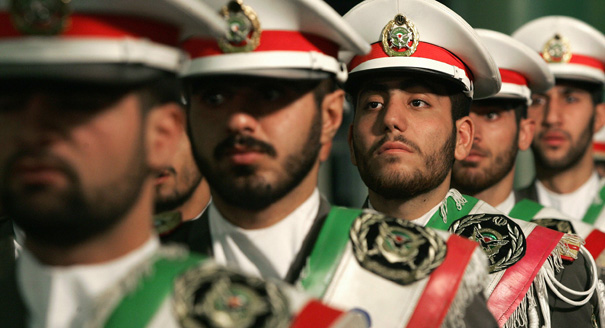
A Carnegie and Center for a New American Security report suggests new ways of constraining Iran’s regional influence.
President Donald Trump’s October 13 speech on Iran received the most attention for his comments that he would not recertify that the sanctions relief under the Joint Comprehensive Plan of Action (JCPOA), as the nuclear deal with Iran is called, remained appropriate and proportional to the steps Iran had taken.
However, Trump also announced what he described as “a new strategy to address the full range of Iran’s destructive actions.” This consisted of four elements: working with allies to counter Iran’s destabilizing activity in the Middle East, increasing sanctions to block the Iranian regime’s financing of terrorism, addressing the proliferation of missiles and weapons, and denying Iran all paths to a nuclear weapon.
The speech prompted two big questions: What is the future of the nuclear deal, and how will the United States address its concerns about other Iranian activities?
On the nuclear deal, most eyes are focused on Congress. The most visible effort there is a proposal by Senators Bob Corker and Tom Cotton to automatically snap back U.S. sanctions if Iran gets to within one year of obtaining a nuclear weapon. This proposal would effectively seek to force the indefinite extension of the JCPOA’s restrictions on fissile material.
There are, however, a number of other ways the U.S. could seek meaningful long-term constraints on Iran’s nuclear program. A recent report from scholars at the Carnegie Endowment and the Center for a New American Security (CNAS), titled “Contain, Enforce, and Engage: An Integrated U.S. Strategy to Address Iran’s Nuclear and Regional Challenges,” identifies several creative options, including pursuing a new global framework for differentiating between peaceful and non-peaceful nuclear energy activities and developing a regional or sub-regional (Gulf) arrangement for handling nuclear fuel cycle activities. Iran may be more likely to abide by restrictions imposed through such multilateral approaches than through a threatened reimposition of unilateral U.S. sanctions.
On other Iranian activities, the administration’s strategy seems focused on building pressure on Iran, though it is not yet clear what forms such pressure will take. Because such an emphasis on attempting to coerce Iran is widely shared in Washington, the same Carnegie-CNAS report provides a useful complement and counterpoint by calling not only for coercing Iran but also for engaging its government and people. In particular, the report identifies specific ways to engage Iran economically in exchange for Iranian concessions on nuclear or regional issues. These include offering the possibility of reinstating the license for U-turn transactions—which would facilitate foreign trade with Iran using U.S. dollars—and allowing direct U.S. corporate involvement in Iran, as incentives for Iran to curb its activities in other areas.
All of this suggests that trade space remains between the U.S. and Iran and that incentives backed by pressure could convince Iran to restrain some of its nuclear and regional activities in a manner acceptable to the United States. What specific trades could consist of, and whether the political will exists to make them, remains to be seen.
The opinions and characterizations in this article are those of the author, who is on leave from the State Department, and do not necessarily represent the position of the United States government or the State Department.
Former Visiting Scholar, Middle East Program
David M. DeBartolo was a visiting scholar in the Middle East Program at the Carnegie Endowment for International Peace where he focuses on sanctions issues.
Recent Work
David M. DeBartolo
David M. DeBartolo
Carnegie does not take institutional positions on public policy issues; the views represented herein are those of the author(s) and do not necessarily reflect the views of Carnegie, its staff, or its trustees.
The countries in the region are managing the fallout from Iranian strikes in a paradoxical way.

Angie Omar

In an interview, Hassan Mneimneh discusses the ongoing conflict and the myriad miscalculations characterizing it.

Michael Young
In an interview, Nicole Grajewski discusses the military dimension of the U.S. and Israeli attacks on Iran.
Michael Young

In an interview, Naysan Rafati assesses the first week that followed the U.S. and Israeli attack on Iran.
Michael Young
At heart, to impose unconditional surrender on Hezbollah and uproot the party among its coreligionists.

Yezid Sayigh