

Commentary
Michael Young
{
  "authors": [
    "Michael Young"
  ],
  "type": "commentary",
  "blog": "Diwan",
  "centerAffiliationAll": "dc",
  "centers": [
    "Carnegie Endowment for International Peace",
    "Malcolm H. Kerr Carnegie Middle East Center"
  ],
  "collections": [],
  "englishNewsletterAll": "menaTransitions",
  "nonEnglishNewsletterAll": "",
  "primaryCenter": "Malcolm H. Kerr Carnegie Middle East Center",
  "programAffiliation": "MEP",
  "programs": [
    "Middle East"
  ],
  "projects": [],
  "regions": [
    "Iran",
    "North America",
    "United States",
    "Middle East"
  ],
  "topics": [
    "Political Reform"
  ]
}
Source: Getty
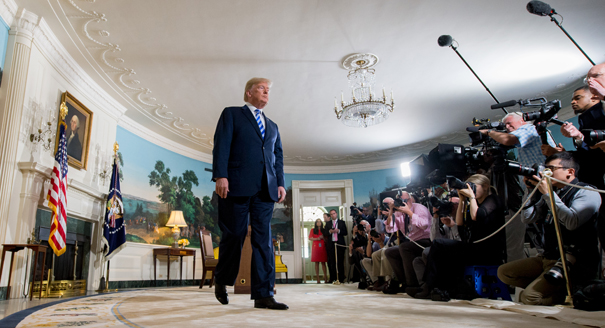
The hardliners on the nuclear deal with Iran are leaving the U.S. president with one option, namely war.
As countries around the world adapt to President Donald Trump’s decision to pull the United States out of the Joint Comprehensive Plan of Action (JCPOA), the nuclear deal with Iran, many of them doubtless understand where the American path is likely to end: in war.
When the Obama administration concluded the JCPOA, there was justified criticism of what had transpired. The question of Iranian regional ambitions was not addressed, on the assumption that it would have scuttled negotiations over a nuclear deal without any tangible gains. Others grasped that then-president Barack Obama envisaged the deal as part of a broader process that would recognize Iran’s stakes in the Middle East and create a new regional order that would justify U.S. disengagement.
It was the former president, after all, who said the following to Jeffrey Goldberg of The Atlantic in their long interview of April 2016: “The competition between the Saudis and the Iranians—which has helped to feed proxy wars and chaos in Syria and Iraq and Yemen—requires us to say to our friends as well as to the Iranians that they need to find an effective way to share the neighborhood and institute some sort of cold peace.”
Well that certainly didn’t work well, as it is undeniable that the JCPOA freed up money that Iran used to finance its agenda of expanded regional influence. Most notably, this helped it to fund its ongoing military operations in Syria on behalf of the Assad regime.
But whereas the critics may have been right in their analysis of the JCPOA, they have been wrong in advocating a U.S. withdrawal from the agreement. The reason is simple: Absent the likelihood of a consensus over how to rewrite the document—which appears fanciful today—the critics are moving America in one direction, toward a military confrontation with Iran over the nuclear issue. They won’t admit this, perhaps because Trump doesn’t appear keen to begin another war in the Middle East. But the president should realize that that is precisely where he is being led.
The logic is straightforward. Iran will remain in the JCPOA for as long as it is worth its while to do so. Yet the Trump administration is likely to impose secondary sanctions on those who do business with Iran to prevent the Islamic Republic from benefiting. The Iranians, seeing that the JCPOA no longer provides advantages, will pull out and quite possibly resume enriching uranium. The United States and Israel will ratchet up the pressure and Trump, or a successor, will then have to decide how to act. Since Iran previously carried out uranium enrichment under sanctions, it will very likely do so again in the future. Before long the United States will find itself with few alternatives other than agreeing a new deal, which Tehran will reject given America’s recent behavior with regard to the JCPOA, doing nothing about Iranian nuclear progress, or attacking Iran.
Those who pushed to scrap the JCPOA must have known that this is where their endeavors would lead, because the president outlined no plan B after his decision. Trump simply walked out, leaving himself with no fallback position. Yes, he will impose sanctions that make it costly for Iran to finance a revived nuclear program or its regional operations, but is that really going to change its behavior? The Iranian people may no longer be willing to surrender butter for guns, given the country’s economic problems, but is their victory a certainty? Iran’s repressive apparatus is vast, so that for Trump to wager on a revolution from within is hardly ideal as a policy.
This leaves only the military option to ensure that Iran doesn’t build a nuclear weapon. However, it’s not as if the Iranians haven’t prepared for that possibility. Their nuclear facilities are well protected, and the missiles they have provided to Hezbollah in Lebanon are there to act as a deterrent for any plan to bomb Iran. The Iranians have plenty of other means to hit back at the U.S. and Israel, and we can be sure they will use them. And there is also no guarantee that a military strike will succeed, or that Iran will not rebuild its nuclear program. Worse, Trump has made such a hash of his alliances, that the U.S. may find itself isolated as it builds its case to hit Iran.
This may not matter to the hardliners on the JCPOA, but it should. If their nightmare is a nuclear Iran that is also a regional powerhouse, then they may have just helped make it more of a reality. Soon, there may be nothing to contain Iran’s nuclear program, and no JCPOA to act as a possible lever to affect the behavior of the rulers in Tehran. Trump has blown up an agreement that, for all its faults, provided some constraints on the Iranian regime, in exchange for a situation that may offer none at all.
The unknown variable is Trump himself. The president reportedly does not like to be trapped with bad options. But he may soon discover that those around him have done precisely that, as they steer the U.S. toward military action against Iran. If Trump refuses their entreaties, it may mean living with a nuclear Iran. If he endorses them, he may find himself in a new war in the Middle East, something his recent remarks on withdrawing from Syria strongly suggest he doesn’t want. The president needs an escape hatch now.

Editor, Diwan, Senior Editor, Malcolm H. Kerr Carnegie Middle East Center
Michael Young is the editor of Diwan and a senior editor at the Malcolm H. Kerr Carnegie Middle East Center.
Recent Work
Michael Young
Michael Young
Carnegie does not take institutional positions on public policy issues; the views represented herein are those of the author(s) and do not necessarily reflect the views of Carnegie, its staff, or its trustees.

In an interview, Rozina Ali discusses her new book on the rise and manifestations of Islamophobia in the United States.
Michael Young

In an interview, Ian Lustick and Eli Clifton discuss their new book on why a prominent ally has so much influence in America.
Michael Young

As the U.S. stumbles in its war with Iran, we are likely to see an acceleration of its disengagement from the region.
Michael Young

Middle Eastern states should welcome an accelerated U.S. disengagement from their region.
Michael Young

In an interview, former ambassador Charles Freeman assesses the Trump administration’s war against Iran.
Michael Young