

Other
Anders Aslund
{
  "authors": [
    "Anders Aslund"
  ],
  "type": "legacyinthemedia",
  "centerAffiliationAll": "dc",
  "centers": [
    "Carnegie Endowment for International Peace"
  ],
  "collections": [],
  "englishNewsletterAll": "ctw",
  "nonEnglishNewsletterAll": "",
  "primaryCenter": "Carnegie Endowment for International Peace",
  "programAffiliation": "russia",
  "programs": [
    "Russia and Eurasia"
  ],
  "projects": [],
  "regions": [
    "Eastern Europe",
    "Ukraine"
  ],
  "topics": [
    "Economy",
    "Trade"
  ]
}
Source: Getty
2005 has been a miserable year for the Ukrainian economy. This economic deterioration has been caused by domestic economic policy. The dominant concern has been a wide-ranging discussion about reprivatization. The government has operated like a profit-maximizing state holding company oblivious of the effects on the private sector.
Source: Moscow Times

This economic deterioration has been caused by domestic economic policy. The dominant concern has been a wide-ranging discussion about reprivatization. Another problem has been a sharply increased tax burden of 5 percent to 6 percent of GDP, which was needed to finance very large increases in social transfers and public wages. A third issue has been far-reaching government intervention in the economy, including attempts to regulate the prices of petrol, meat and grain, and to reinforce state monopolies. A doubling of railway tariffs for metal freight has also harmed the economy. The government has operated like a profit-maximizing state holding company oblivious of the effects on the private sector.
Meanwhile, this government has not undertaken any of the many promised and badly needed liberal reforms. The only positive step has been the late adoption of half the World Trade Organization-related legislation that was necessary for Ukraine's accession to the WTO this year. So far, no significant deregulation has occurred, despite much talk. There have been no tax cuts. No financial legislation has been adopted, even though Ukraine still does not even have a law on joint-stock companies.
In short, this government has been an unmitigated disaster of socialist populism. On top of everything, it has maintained a revolutionary discourse of vehement public attacks against individual businessmen and politicians, including members of the government. It was therefore a great relief when President Viktor Yushchenko reasserted his authority to put an end to this public mismanagement. Sensibly, Yushchenko also let go several big businessmen who helped finance and manage his campaign, as their aspirations to make money on their positions have been another worry.
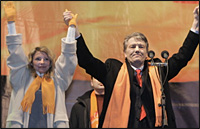
This government change marks the end of the Orange Revolution. Tymoshenko and her loyalists have now marched out of the government, and Tymoshenko has declared that her political bloc will stay independent of Yushchenko's. The question now is where various politicians and businessmen will go. One old oligarch, Alexander Volkov, and what is probably the second-largest oligarch group, Privat Group in Dnepropetrovsk, have been with Tymoshenko for a long time. More than 20 businessmen in the parliament have recently joined her faction. Sensationally, former President Leonid Kuchma's former chief of staff, Viktor Medvedchuk, and his Social Democratic Party are suddenly favoring Tymoshenko, as is Ukraine's first president, Leonid Kravchuk. Curiously, the real agitators of the Orange Revolution and some of the more disreputable oligarchs appear to be coming together in Tymoshenko's bloc.
Meanwhile, others are joining Yushchenko. Anatoly Kinakh and his liberal faction of industrialists are already behind him. Speaker Volodymyr Lytvyn appears to be throwing his support behind Yushchenko as well. Embattled oligarch Viktor Pinchuk and his Labor Ukraine faction support Yushchenko. The assumption is that the new government will include about 10 former Kuchma ministers of good reputation, who can garner the support of four to five centrist party factions in parliament for Yushchenko. The big businessmen who have stood behind Yushchenko all along -- notably Petro Poroshenko, David Zhvania and Yevgeny Chervonenko -- are staying loyal to him, even if they are leaving their government portfolios. Kuchma has expressed his support for Yushchenko. Thus, Yushchenko's old liberal, Western and moderate nationalist supporters are likely to stay with him, while the centrist oligarchic factions will probably join him. Oddly, the Socialist Party wants to stay in government and thus supports Yushchenko, although they have so far been much closer to Tymoshenko.
The biggest unanswered question is where the the Party of the Regions, which includes former presidential candidate Viktor Yanukovych and Ukraine's leading oligarch, Rinat Akhmetov, will go. Akhmetov has long seemed to want to make peace with Yushchenko, while Yanukovych sounds as if he is leaning toward Tymoshenko.
A swift split in Ukrainian politics is taking place among the leaders of the Orange Revolution, and the two opposing leaders are Yushchenko and Tymoshenko. Both are mobilizing substantial forces that contain big businessmen. In the ideal scenario, a U.S.-style political party, resembling the Republican Party, could form around Yushchenko, and a somewhat populist faction along the lines of the U.S. Democratic Party could form around Tymoshenko. The small Socialist Party and the even smaller Communist Party would stay independent. The worst-case scenario would be the sort of party fragmentation that occurred in Poland in 1990-91.
The litmus test will come very soon, with the formation of the government of Yury Yekhanurov and the parliamentary vote on his candidacy. The assumption is that he and Yushchenko will do what it takes to get a majority for the new government, and they already seem to have secured enough votes.
In this heated political situation, it is difficult to imagine a more suitable prime minister than Yekhanurov. As chairman of the State Property Fund from 1994 to 1997, he carried out successful mass privatization in Ukraine, leaving him in high repute. As first deputy to then-Prime Minister Yushchenko in 2000-01, he made sure that the government worked well. Since 2002, he has been one of the leaders of Our Ukraine in parliament, and as committee chairman he has shepherded substantial economic legislation through parliament. In spite of many years in politics, he has virtually no enemies. Yekhanurov should be able both to hold the Yushchenko loyalists together and make the government start working ahead of the parliamentary elections scheduled for March.
Yekhanurov will have his work cut out. In a short period, he needs to accomplish many things. First of all, he is strongly committed to putting an end to the mindless reprivatization campaign. The Krivoryzhstal steel mill will probably be reprivatized, but nothing else will be. Second, a long-prepared draft omnibus law abolishing some 3,600 regulations is ready to be sent to parliament. Third, the remaining WTO legislation is already in parliament, and Ukraine needs to have it promulgated no later than October, if it is to have any chance of entering the WTO this year. Fourth, the very populist budget for next year, which the former government wrote and which contains little beyond more social transfers and public wages, has to be redone quickly. In particular, high spending must be cut and social taxes should be unified and reduced. Finally, Yekhanurov might be able to push through some of the financial legislation prepared long ago and waiting in the parliament. The economic agenda could at long last be made to fit the pattern of Ukraine's economic development, and growth could soon resume.
There is every reason to welcome the change of government in Ukraine, and the restructuring of Ukrainian politics. It is how voters react to it that remains to be seen.
Anders Aslund, a senior associate at the Carnegie Endowment for International Peace, advised the Russian government from 1991 to 1994. He contributed this comment to The Moscow Times.
Former Senior Associate, Director, Russian and Eurasian Program
Recent Work
Anders Aslund
Anders Aslund
Carnegie does not take institutional positions on public policy issues; the views represented herein are those of the author(s) and do not necessarily reflect the views of Carnegie, its staff, or its trustees.

The armed forces champion a form of capitalism that is generating revenue, but its reliance on rent faces diminishing returns, leaving the country with massive sunk costs and deferred returns, deepening dependency on external borrowing.

Yezid Sayigh

Morocco and Algeria, each in its own way, are having to navigate the global economic fallout of the U.S.-Israeli military campaign against Iran.

Yasmine Zarhloule
In an interview, Ishac Diwan looks at the merits and flaws in the draft legislation distributing losses from the financial collapse.

Michael Young
Mustaqbal Misr has expanded its portfolio with remarkable speed, but a lack of transparency remains.
Yezid Sayigh

Arab diaspora business communities in Egypt often mirror the same systemic challenges facing Egyptian businesses.
Nur Arafeh, Yezid Sayigh, Qaboul al-Absi, …