

Paper
George Perkovich
{
  "authors": [
    "George Perkovich"
  ],
  "type": "legacyinthemedia",
  "centerAffiliationAll": "dc",
  "centers": [
    "Carnegie Endowment for International Peace"
  ],
  "collections": [
    "U.S. Nuclear Policy"
  ],
  "englishNewsletterAll": "ctw",
  "nonEnglishNewsletterAll": "",
  "primaryCenter": "Carnegie Endowment for International Peace",
  "programAffiliation": "NPP",
  "programs": [
    "Nuclear Policy"
  ],
  "projects": [],
  "regions": [
    "North America",
    "United States"
  ],
  "topics": [
    "Nuclear Policy"
  ]
}
Source: Getty
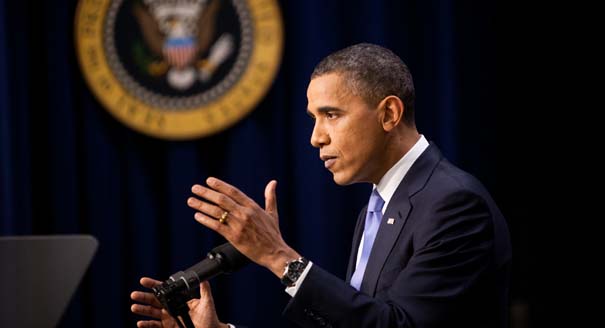
The Obama administration's Nuclear Posture Review gives much-needed momentum to the nuclear agenda President Obama set out in Prague last year.
Source: CNN

It is in the long-term interest of the United States to move towards a world free of nuclear weapons, the only things that can immediately threaten the very existence of the country.
The new Nuclear Policy Review better reflects the realities of the world than previous ones and will help guide U.S. policy for the next five years. It also extends a process that started under the Bush administration -- President George W. Bush also sought to reduce the role of nuclear weapons, though he didn't get credit for it.
The United States has greater conventional, non-nuclear military capabilities than other powerful countries; its military understands that it is nearly impossible to imagine a circumstance -- other than a nuclear attack against the United States or one of its allies -- when the country would credibly threaten to use nuclear weapons. This policy reflects that recognition. And the military is confident that new nuclear arms are not necessary for America's nuclear deterrent.
Obama's policy review demonstrates to the world the seriousness of America's commitment to the arms reduction and nonproliferation agenda, while being attuned to the political realities of Washington. This is the smartest approach Obama could take to reinforce his priorities in nuclear disarmament.
But the new policy review departs from previous strategies in several ways. Now, the stated core objective is to prevent the proliferation of nuclear weapons to other states and to prevent their use by terrorists. While other administrations recognized this, it was not made part of U.S. nuclear policy: Nonproliferation and counterterrorism were left to other policy domains.
The new strategy also says the goal of the United States is a world without nuclear weapons. But it also says that as long as the United States and its allies are faced with neighbors armed with nuclear arms, the United States will retain these weapons, and in a safe and reliable manner. The country is not going to get rid of its nuclear weapons alone.
The United States will try to lead by example and, as much as possible, reduce reliance on nuclear weapons in U.S. security, but also encourage and put pressure on others to do the same. This strategy will antagonize those on the far right, where there is an unreasonable view of the utility of nuclear weapons.
On the left, some may feel the president didn't go far enough. They were hoping the posture would declare that the sole purpose of nuclear weapons is to deter the use of those weapons by others.
But it's important to recognize that this is the best policy that does not limit the administration's broader nuclear disarmament goals. President Obama is a realist and knows that he needs 67 votes in the Senate to ratify the new START treaty with Russia.
While the United States could outline a strategy that would be applauded by disarmament advocates, it would reduce the chance of actually ratifying a real treaty to reduce nuclear weapons in the Senate. Obama realizes he can give plenty of Prague speeches, but he's not going to change the world with speeches.
So the administration decided to have a posture review that will get votes in the Senate to implement reductions that can lead to a future that disarmament advocates want even if the language may disappoint them now.
The review, combined with the new START treaty that will be signed on Thursday and the nuclear security summit in Washington on April 12-13, shows the United States means business ahead of the Non-proliferation Treaty Review Conference in May, where it will try to get other countries to take additional steps to stop the nuclear proliferation.
The United States is trying to keep an underlying bargain: The rest of the world agrees not to get nuclear weapons and to work with nuclear powers to keep those weapons from terrorists and other states, and the few states that already have nuclear weapons agree to get rid of them as soon as they can.
America is doing everything it can to reduce the role of nuclear weapons and reduce the number of nuclear arms, while not weakening international security.

Japan Chair for a World Without Nuclear Weapons, Senior Fellow
George Perkovich is the Japan Chair for a World Without Nuclear Weapons and a senior fellow in the Carnegie Endowment for International Peace’s Nuclear Policy Program. He works primarily on nuclear deterrence, nonproliferation, and disarmament issues.
Recent Work
George Perkovich
George Perkovich
Carnegie does not take institutional positions on public policy issues; the views represented herein are those of the author(s) and do not necessarily reflect the views of Carnegie, its staff, or its trustees.

In an interview, Rozina Ali discusses her new book on the rise and manifestations of Islamophobia in the United States.

Michael Young

In an interview, Ian Lustick and Eli Clifton discuss their new book on why a prominent ally has so much influence in America.
Michael Young

As the U.S. stumbles in its war with Iran, we are likely to see an acceleration of its disengagement from the region.
Michael Young

Middle Eastern states should welcome an accelerated U.S. disengagement from their region.
Michael Young

In an interview, former ambassador Charles Freeman assesses the Trump administration’s war against Iran.
Michael Young