

Q&A
Suzanne Maloney, Aaron David Miller, Karim Sadjadpour
{
  "authors": [
    "Karim Sadjadpour"
  ],
  "type": "legacyinthemedia",
  "centerAffiliationAll": "dc",
  "centers": [
    "Carnegie Endowment for International Peace"
  ],
  "collections": [],
  "englishNewsletterAll": "menaTransitions",
  "nonEnglishNewsletterAll": "",
  "primaryCenter": "Carnegie Endowment for International Peace",
  "programAffiliation": "MEP",
  "programs": [
    "Middle East"
  ],
  "projects": [],
  "regions": [
    "Middle East",
    "Iran"
  ],
  "topics": [
    "Political Reform"
  ]
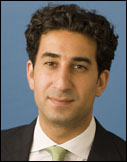
}
Source: Getty
Iranian President Mahmoud Ahmadinejad’s efforts to consolidate power by firing members of the cabinet and naming himself oil minister have ignited a controversy over his ambitions for more power and influence in the Iranian political system.
Source: BBC

Ahmadinejad’s utility for Khamenei has become increasingly suspect, Sadjadpour argued. In 2005, “the Supreme Leader used Ahmadinejad as a bludgeon against his opponents,” he noted, “but since those opponents have largely been defeated, Khamenei no longer sees the need to indulge Ahmadinejad.” However, it is unlikely that Khamenei will remove Ahmadinejad from office because he is such an unpredictable figure that could do something to damage the entire system. Moving forward, it is likely that Khamenei will work to quarantine and weaken Ahmadinejad, while allowing him to remain in office.

Senior Fellow, Middle East Program
Karim Sadjadpour is a senior fellow at the Carnegie Endowment for International Peace, where he focuses on Iran and U.S. foreign policy toward the Middle East.
Recent Work


Suzanne Maloney, Aaron David Miller, Karim Sadjadpour

Aaron David Miller, Karim Sadjadpour, Robin Wright
Carnegie does not take institutional positions on public policy issues; the views represented herein are those of the author(s) and do not necessarily reflect the views of Carnegie, its staff, or its trustees.

As the U.S. stumbles in its war with Iran, we are likely to see an acceleration of its disengagement from the region.

Michael Young

Huawei pushed hard to enter the Egyptian data centers market, until the Americans made a better offer.

Angie Omar

Middle Eastern states should welcome an accelerated U.S. disengagement from their region.
Michael Young

In an interview, former ambassador Charles Freeman assesses the Trump administration’s war against Iran.
Michael Young

The accord represents a pivotal moment in the region to avert a security vacuum in the Gulf.


Azeema Cheema, Mohanad Hage Ali