

Commentary
Marc Pierini
{
  "authors": [
    "Marc Pierini"
  ],
  "type": "legacyinthemedia",
  "centerAffiliationAll": "",
  "centers": [
    "Carnegie Endowment for International Peace",
    "Carnegie Europe"
  ],
  "collections": [
    "Turkey’s Transformation"
  ],
  "englishNewsletterAll": "",
  "nonEnglishNewsletterAll": "",
  "primaryCenter": "Carnegie Europe",
  "programAffiliation": "",
  "programs": [],
  "projects": [],
  "regions": [
    "Middle East",
    "Europe",
    "Türkiye"
  ],
  "topics": [
    "Political Reform",
    "Democracy"
  ]
}
Source: Getty
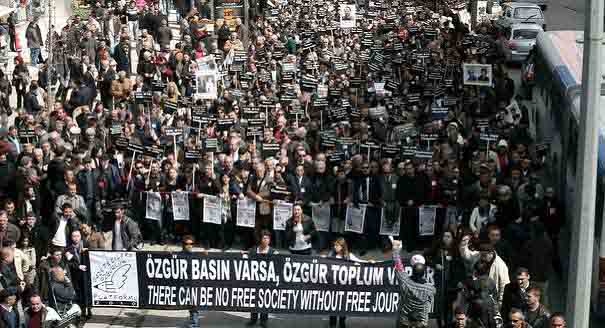
The Turkish paradox in terms of press freedom is that there is more debate at the margins of society but less pluralism in the mainstream.
Source: Hürriyet Daily News

I didn’t conduct yet another inquiry into press freedom. More modestly, I analyzed all the reports published on the subject by governmental and non-governmental, Turkish and foreign entities during the last two years. Although they had different focuses and methodologies, all these reports convey one single image: Turkey’s record is bad because it fares well below the country’s democratic credentials and is hurting the nation economically and diplomatically on the international scene.
I was struck by this simple reality: for 74 million people, Turkey has 65 million mobile phones in use, 44 million citizens enjoy access to online news at home or in Internet cafes and 31.8 million have active Facebook accounts. This means that several million messages are exchanged directly between citizens, fast and autonomously. Attempting to resist this evolution is not realistic, as boundaries are easily by-passed by sophisticated citizens and technology. The political world should be in tune with the society.My approach is a positive one: how to identify the avenues for improvement, where to concentrate efforts, those to be made in Turkey, those to be accomplished outside Turkey, especially in the European Union? My report attempts to illustrate what can be done, for example, to end the sterile debate on the number of imprisoned journalists; how to make a substantial, bold step forward (not a half-hearted interim measure) concerning the Anti-Terror law, Media Law and the Penal Code; how to create a positive relationship between the government and civil society organizations, or more collaboration with European NGOs; and how to re-invigorate the EU accession process of Turkey, which is highly relevant for press freedom.
Why should Turkey advance press freedom? The simple answer is: because it deserves it and because it needs it! The Turkish paradox in terms of press freedom is that there is more debate at the margins of society but less pluralism in the mainstream. And precisely a pluralistic society should by definition make room for difference and dissent on the political, economic, societal and cultural issues at hand.
Turkey is indeed a society with multiple points of view, with different lifestyles emanating from different strands of the population. This diversity makes Turkey valuable to the world, and it should be preserved through uninhibited and open debate. The ballot box is one side of democratic life, civil society is the other, because it generates debates through academia, culture, research and indeed the media.
Well, obviously, there are different courses of action, different models, for example China’s socio-economic progress without fundamental liberties, or Russia’s authoritarian leadership and low tolerance for criticism. In the final analysis, it all depends on which “club of nations” Turkey wants to belong to. This is the central point I also make in my upcoming book on Turkey.
My hunch is that Turkey already has an intimate understanding of European democratic values. I am not speaking of political circles here, but of the many citizens I talked to, during five years, from Eskişehir to Hamsiköy, from Mardin to Kayseri: whether conservative or secularist, they all impressed me with a deep sense that the EU way to manage a society meant progress for them and their children. They adhered to this way of governing a country. I am convinced that the many discussions recently held in so many Turkish cities about the future Constitution gave similar indications: Turks, all Turks, have deeply democratic aspirations.
This article originally appeared in the Hürriyet Daily News.

Senior Fellow, Carnegie Europe
Marc Pierini is a senior fellow at Carnegie Europe, where his research focuses on developments in the Middle East and Turkey from a European perspective.
Recent Work
Marc Pierini
Marc Pierini
Carnegie does not take institutional positions on public policy issues; the views represented herein are those of the author(s) and do not necessarily reflect the views of Carnegie, its staff, or its trustees.

As the U.S. stumbles in its war with Iran, we are likely to see an acceleration of its disengagement from the region.

Michael Young

Huawei pushed hard to enter the Egyptian data centers market, until the Americans made a better offer.

Angie Omar

The accord represents a pivotal moment in the region to avert a security vacuum in the Gulf.


Azeema Cheema, Mohanad Hage Ali

In an interview, Jason Burke discusses his sweeping account of the “revolutionists” who so shaped the 1970s and early 1980s.
Michael Young
There is a disturbing structural parallel between the old global energy economy and the new green transition.
Angie Omar