

Article
Thomas de Waal
{
  "authors": [
    "Thomas de Waal"
  ],
  "type": "commentary",
  "centerAffiliationAll": "",
  "centers": [
    "Carnegie Endowment for International Peace",
    "Carnegie Europe",
    "Carnegie Russia Eurasia Center"
  ],
  "collections": [],
  "englishNewsletterAll": "",
  "nonEnglishNewsletterAll": "",
  "primaryCenter": "Carnegie Europe",
  "programAffiliation": "",
  "programs": [],
  "projects": [],
  "regions": [],
  "topics": []
}
Source: Getty
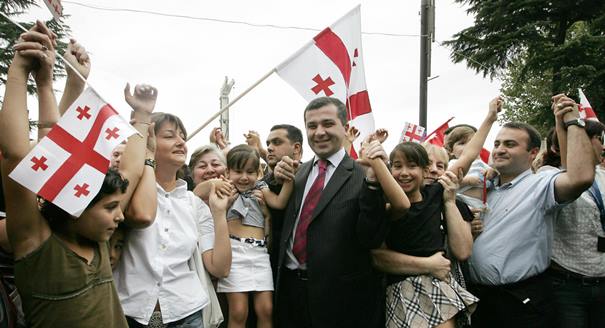
The new contender from the United National Movement, parliament minority leader David Bakradze has made this October’s election for president of Georgia something to watch.
These days it is hard for an election in the Caucasus to turn out boring.
This October’s election for president of Georgia—a post now to be trimmed of most of its powers under the new constitution—was looking like an uninteresting contest. But now the new contender from the United National Movement (UNM), parliament minority leader David Bakradze has made it something to watch.
The ruling Georgian Dream party has been riding high since it won the parliamentary elections last year. Approval levels for Prime Minister Bidzina Ivanishvili are still buoyant. Support for the former governing party, the United National Movement, has crumbled.
Given that, any Georgian Dream candidate looks likely to beat any UNM contender in October. But Ivanishvili chose a relatively obscure candidate, Giorgi Margvelashvili, who had been little known to the Georgian public before he became education minister in the new government.
Ivanishvili overlooked more obvious candidates such as defense minister and Western favorite Irakli Alasania, so Margvelashvili has to contend with the impression that he is merely the hand-picked candidate of the prime minister. (Indeed, Mikheil Saakashvili already taunted him by making the comparison with the Emperor Caligula appointing his horse a senator.)
Bakradze by contrast immediately claimed that he had been selected by primary, as opposed to the favorite who had been selected by one man.
Bakradze is virtually the only politician from the old regime who has maintained a favorable profile under the new one. The Georgian parliament has acquired teeth in the last year and the “two Davids,” —David Usupashvili, the speaker, and Bakradze, the leader of the minority—have done a good job working in tandem.
Before that, Bakradze was speaker of parliament and foreign minister, so he is a recognizable figure in Georgia. More importantly, he is the leading figure in what might be called the “reformist” wing of the UNM, speaking openly about the party’s mistakes and expressing regret about the revelations of torture and abuse committed while it was in office.
Bakradze suffers from the general UNM problem of being more popular in the West than he is in Georgia—unlike his main opponent, who is devout Orthodox Christian and closer to the electorate. Margvelashvili is still the clear favorite. But at least we now have a decent contest to look forward to.

Senior Fellow, Carnegie Europe
Thomas de Waal is a senior fellow at Carnegie Europe, specializing in Eastern Europe and the Caucasus.
Recent Work
Thomas de Waal
Thomas de Waal
Carnegie does not take institutional positions on public policy issues; the views represented herein are those of the author(s) and do not necessarily reflect the views of Carnegie, its staff, or its trustees.