

Commentary
John Kerry
{
  "authors": [
    "John Kerry"
  ],
  "type": "legacyinthemedia",
  "centerAffiliationAll": "",
  "centers": [
    "Carnegie Endowment for International Peace"
  ],
  "collections": [],
  "englishNewsletterAll": "",
  "nonEnglishNewsletterAll": "",
  "primaryCenter": "Carnegie Endowment for International Peace",
  "programAffiliation": "",
  "programs": [],
  "projects": [],
  "regions": [
    "North America",
    "United States"
  ],
  "topics": [
    "Political Reform",
    "Climate Change"
  ]
}
Source: Getty
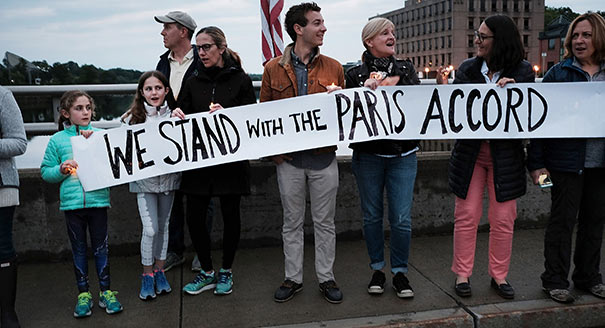
The Paris Agreement is going to continue without the United States of America and the United States is going to continue to remain committed to the Paris Agreement.
Source: NPR’s Morning Edition
DAVID GREENE, HOST:
Now, the man who signed the Paris climate agreement on behalf of the United States is pretty outraged by President Trump's decision. Then-Secretary of State John Kerry had worked years to get the U.S. to sign onto a plan that would reduce greenhouse emissions. We reached Secretary Kerry yesterday, shortly after Trump's announcement. And I asked him if this is the end of the Paris Agreement.
JOHN KERRY: No. The Paris Agreement's going to continue without the United States of America. And I believe America is going to continue to remain committed to the Paris Agreement. Today, I talked to the governor of California, Jerry Brown, the governor of New York, Andrew Cuomo, the governor of Massachusetts, Charlie Baker. They're all committed to continue to do what they're doing now, which will meet the standards of the Paris Agreement. So the American people will lead where the president of the United States has put America last.
GREENE: So is this significant then?
KERRY: Yes, it is significant. It's significant because the United States of America, together with China, led the world to the Paris Agreement. And for the president of the United States - when he didn't need to - to unilaterally walk away from the agreement, he's aligned us with Syria and Nicaragua. And by the way, Nicaragua wanted to do more. So we're last, not first, as the president says. And he based it on fake news because he kept saying, well, this is a burden on the United States.
GREENE: Right.
KERRY: No, that's not true. This is a standard which each country set for itself. No other country placed the burden on the United States or holds us accountable. All the president had to do was say, I don't like the burden; I'm going to change it. He could have changed it, but he got out of it because this is political, serving the narrow ideological interest of a narrow base of his party. And really, it's one of the most disastrous, shallow, untruthful decisions a president of the United States has made in my lifetime.
GREENE: Well, given all the work that went into this, Mr. Secretary, do you regret not pushing the Senate to ratify this as a treaty? Could that have avoided this pull out?
KERRY: No because the Senate never would have ratified it. It was run by Republicans, and you had people who would have filibustered it, and they never would have gotten do it. So the bottom line is this was made as a political agreement. It won't create jobs in America. It will reduce jobs in America. It won't protect the American average workers that he - the forgotten people that he pretends to be protecting. It's going to put them at greater risk for job loss as well as for damage from climate change itself.
GREENE: Is it a real pull-out, with this four years that it might last? I mean, is he really pulling out in some formal way or has just opened a window to negotiating?
KERRY: He said that effective - he said that effective immediately the United States will not continue to implement the agreements that we implemented. So to whatever degree he can stop them, he's going to try and stop them.
GREENE: So you're saying there was no impact on jobs in the U.S. economy from this agreement as the president argued.
KERRY: That is correct.
GREENE: You're saying that...
KERRY: Yes, there - no, there was an impact, and the impact was positive. We had a shift...
GREENE: Because there was an argument that there would be a higher electric bills for some Americans going forward. Are you saying that's just not possible, that would not have happened under this agreement?
KERRY: It depends on some particular part of the country and where. Writ large, we are reducing the cost of energy, and we're seeing solar energy now competitive with coal. And as people move to clean energy as the technology comes in, the cost of producing is going to go down. Cost has gone down for gasoline. Why? Because of natural gas and because of our supplanting, you know, fossil fuels that were hard and the worst polluters. It's tragic.
It's a great betrayal of the trust of the presidency and of the leadership that is needed right now to deal with climate change. And this will become more and more evident. This is why intelligent, thoughtful governors in the country have already stood up and said, we are going to live by Paris. And I believe that the American people want to live by Paris.
GREENE: Secretary Kerry, thanks as always. We appreciate it.
KERRY: Thank you.
This interview was originally broadcast on NPR’s Morning Edition.
Nonresident Scholar, Sustainability, Climate, and Geopolitics Program
John Kerry is a nonresident scholar the Carnegie Endowment for International Peace.
Recent Work
John Kerry
John Kerry
Carnegie does not take institutional positions on public policy issues; the views represented herein are those of the author(s) and do not necessarily reflect the views of Carnegie, its staff, or its trustees.

Huawei pushed hard to enter the Egyptian data centers market, until the Americans made a better offer.

Angie Omar

Middle Eastern states should welcome an accelerated U.S. disengagement from their region.

Michael Young

In an interview, former ambassador Charles Freeman assesses the Trump administration’s war against Iran.
Michael Young

By failing to address Palestinian representation, the current process is bound to lead to just another temporary arrangement.

Nathan J. Brown

Morocco and Algeria, each in its own way, are having to navigate the global economic fallout of the U.S.-Israeli military campaign against Iran.

Yasmine Zarhloule