- +18
James M. Acton, Saskia Brechenmacher, Cecily Brewer, …
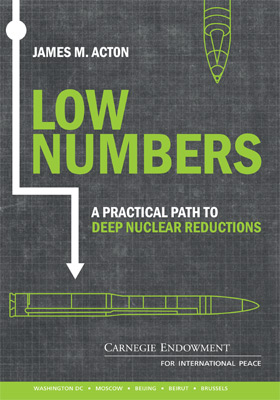
Low Numbers: A Practical Path to Deep Nuclear Reductions
As U.S. policy seeks to create the conditions that would allow for deep reductions in nuclear arsenals, the United States and Russia can undertake a practical approach to their stockpiles to 500 nuclear warheads each and those of other nuclear-armed states to no more than about half that number.
U.S. policy seeks to create the conditions that would allow for deep reductions in nuclear arsenals. This report offers a practical approach to reducing the U.S. and Russian stockpiles to 500 nuclear warheads each and those of other nuclear-armed states to no more than about half that number. This target would require Washington and Moscow to reduce their arsenals by a factor of ten.
To achieve these low numbers, the United States should:
- Take a comprehensive approach on arms control.
Achieving deep reductions in U.S. and Russian nuclear weapons will be difficult, for both technical and political reasons. Moreover, such reductions could create challenges to “strategic stability.” As a result, U.S. arms control policy must adopt a comprehensive approach aimed at verifiably eliminating warheads (including tactical and non-deployed ones), deterring rearmament, and reducing the incentives to use nuclear weapons first in a crisis.
To accomplish this, formal arms control efforts must limit certain types of high-precision conventional weapons, phase out missiles armed with multiple warheads, and enhance the transparency of nuclear weapon production complexes. More informal confidence building between the United States and Russia—on ballistic missile defense in particular—also has a key role to play, not least because it may help cement a lasting domestic political consensus in the United States around scaling defenses to the size of the threats posed by Iran and North Korea.
- Engage with U.S. allies to review security threats and responses.
Besides working with Russia, the United States must convince its allies— both in Europe and in East Asia—to support deep reductions. Together, they should initiate wide-ranging reviews to identify security threats and appropriate responses. These reviews should help illustrate the very narrow circumstances in which nuclear weapons could prove useful, thus reducing allies’ fears about deep reductions.
The United States should consult with allies before making decisions that directly affect their security (such as withdrawing capabilities or reducing weapons stockpiles). More generally, Washington should also work with allies to find ways of demonstrating and enhancing its political commitment to them so they—and potential adversaries—do not interpret reductions as signaling a weakening of the American commitment to extended deterrence.
- Address conventional imbalances.
Stabilizing conventional imbalances among the United States, China, and Russia is another daunting but necessary step toward deep reductions in nuclear weapons.
In the short term, the U.S.-Russia balance poses the biggest threat to the reductions process. Russia sees nuclear weapons as a way to off set its conventional inferiority. If it makes tactical nuclear arms control contingent on conventional arms control, the nuclear reductions process could be quickly derailed given the immense political challenges to resurrecting the conventional arms control regime in Europe. Nonetheless, the United States should continue to pursue conventional arms control efforts in Europe to reduce the chance that Russia will link them into the next round of nuclear negotiations. Over the longer term, the fluid conventional balance between the United States and China is likely to exert an increasing influence on the nuclear reductions process. The key issue is whether they can agree that rough equality of capability in the West Pacific serves both their interests. If they cannot, a costly conventional arms race between the two nations could ensue. The state that loses could increase its reliance on nuclear weapons and, correspondingly, become reluctant to participate in efforts to reduce nuclear arsenals.
- Push for a transparent and multilateral process.
The United States and Russia aim to eventually advance a multilateral arms control process with other nuclear-armed states. A key step toward this goal is enhanced transparency from France, the United Kingdom, and particularly China. Beijing, however, opposes transparency partly because it worries that openness would undermine the survivability of its nuclear forces. The first step toward multilateral arms control is, therefore, for China and the United States to engage in a program of mutual strategic reassurance.
As difficult as achieving a multilateral agreement among the five officially recognized nuclear-weapon states will be, it is complicated yet further by the impact of states outside the Nuclear Non-Proliferation Treaty—India, Pakistan, Israel, and North Korea. This process will probably be derailed entirely if Iran is successful in acquiring nuclear weapons.
While cutting the number of nuclear weapons so significantly is a formidable challenge, the United States, Russia, and other nations can do much in the short term to advance this goal—as the conclusion of this report highlights. Washington should lead this process to ensure that it at least gets started.

About the Author
Jessica T. Mathews Chair, Co-director, Nuclear Policy Program
Acton holds the Jessica T. Mathews Chair and is co-director of the Nuclear Policy Program at the Carnegie Endowment for International Peace.
- Unpacking Trump’s National Security StrategyOther
- Trump Has an Out on Nuclear Testing. He Should Take It.Commentary
James M. Acton
Recent Work
Carnegie does not take institutional positions on public policy issues; the views represented herein are those of the author(s) and do not necessarily reflect the views of Carnegie, its staff, or its trustees.

More Work from Malcolm H. Kerr Carnegie Middle East Center
- How Tehran Is Connecting the Ukraine Invasion to the Iran DealCommentary
Both events also could force Washington to rethink or revive its Middle East partnerships.

Karim Sadjadpour
- A Ticking Time-Bomb?Commentary
Disagreement between the United States and Iran over a revived nuclear accord may anchor volatile competition.

George Perkovich
- What Does It Mean that European States Have Triggered the Dispute Resolution Mechanism in the Nuclear Deal With Iran?Commentary
A regular survey of experts on matters relating to Middle Eastern and North African politics and security.
Michael Young

- What Europe’s Dispute about Iran’s Nuclear Program MeansCommentary
The British, French, and German foreign ministers have formally accused Iran of breaking the terms of the 2015 Iran nuclear deal, a step that could lead to sanctions. Are the Europeans preparing to pull the plug?

Jarrett Blanc
- Scratching Erdogan’s Nuclear ItchCommentary
Although Turkey is not likely to pursue a nuclear weapons program, it is expanding its nuclear industry by partnering with Russia.
Mark Hibbs