

Paper
Maria Fantappie
Source: Getty
Acting as an essential mediator in the Syrian crisis could fulfill Iraq's wishes to return to the regional scene and the Kurds’ goal of expanding their influence over neighboring regions.
If the Arab League Summit on March 29 served to highlight Iraq’s foreign policy aspirations, the Syrian crisis may turn these aspirations into reality. Iraq’s main political actors, Nouri al-Maliki and the Kurdish leaders, are seeking to position Iraq as the key to resolving the ongoing crisis in Syria, based on their shared border and Iraq’s ability to engage in talks with both the regime and the opposition groups. If it succeeded, Iraq could fulfill its foreign policy aspirations: reenter the regional and international scene, gain autonomy from its neighbors, and define itself as the new regional power broker.
When the Syrian revolution began last spring, Iraqi leaders calibrated their stance, eventually acting to capitalize on their geographic proximity to assert Iraq as the exclusive conduit to Syria. For the past year, Iraq has watched the Syrian crisis unfold, waffling between the different sides and eventually seating itself squarely “in the middle” where it can better oversee the evolution of the crisis.
In November, Iraq abstained from supporting Syria’s suspension from the Arab League, but later participated in the Istanbul “Friends of Syria” meeting held to drum up support for the opposition. At the Arab League Summit, Iraq condemned the “regime’s bloodshed against civilians” and called for a power transition, as did the regime’s detractors. But, taking the same stance as regime proponents, Iraq also denounced armed support for the opposition and foreign intervention. By maintaining its neutrality, Iraq has kept its lines of communication open with both the regime and the opposition groups.As it stands, Iraq can employ its two-headed political leadership—comprising the central government in Baghdad and the leaders of the Kurdish Regional Government —to extend its reach across the Syrian political spectrum. While Baghdad has comparatively good relations with Damascus, the Kurds have opened talks with the Syrian National Council (SNC), the opposition in exile’s central body. Since December, Iraq’s National Security Minister Faleh Al-Fayyad has visited with the regime and the Damascus-based opposition, the National Coordination Body for Democratic Change (NCB).
The influence Iraqi Kurds exercise over Syrian Kurdish participation in the SNC has compelled the SNC’s membership to travel to Iraqi Kurdistan for negotiations. Most importantly, Syria’s Kurdish National Council, which is sponsored by Iraqi Kurds, could prove to be Iraq’s trump card in tipping the balance in favor of either the regime or the opposition. Depending on where the Kurdish National Council ultimately stands, it could empower one of the opposition factions or, alternatively, help the regime establish a newfound legitimacy.
Iraq is moreover the physical gateway to central and northeast Syria, with which it shares a nearly 650-kilometer-long border. Since the beginning of the revolution, there have been many denunciations of the flow of fighters from Iraq to Syria. But the security forces tied to Maliki and the Kurds control the Iraqi provinces bordering Syria. The Iraqi army’s Seventh Division is deployed across Anbar Province which leads into central Syria—Deir ez-Zor, Damascus, and Homs—while Kurdish peshmerga forces patrol Ninewa and Dohuk, at the entrance to northern Syria’s Al-Hasakah province. Iraqi forces thus in theory control border traffic, and Iraq could conceivably allow arms to be funneled across its frontiers to both the Syrian regime and the armed opposition.
Among Syria’s neighbors, Iraq is at present the only country able to mediate both the armed conflict and the negotiation process. It will likely continue to be so, whether the crisis devolves into further armed struggle or moves toward finding a political compromise. And Iraq may find itself better able to realize its own foreign policy goals as its access to developments in Syria increases.
With Iraq’s influence in Syria on the rise, Baghdad may find itself with the opportunity to win autonomy from its most influential neighbors: Iran and Turkey. If Iraq is the key to determining the outcome of the Syrian crisis, Tehran will have to deal with Iraq as an equal partner—or even an essential ally—in order to preserve its own regional interests. Indeed, the Syrian crisis has already contributed to a similar reversal in the balance of power between Iraq and Turkey, with Iraqi Kurdistan now supporting the establishment of a self-administered Kurdish region across the border in Syria, which risks encouraging Kurdish demands for autonomy within Turkey itself.
Involvement in Syria could also enable Iraq to attract new players to its negotiating table and establish a multilateral web of alliances. Iraq could build its relationships on a give-and-take basis: by offering access to Syria, it may induce even its traditional rivals—including Saudi Arabia and other members of the GCC—to come to the table, broadening its regional alliances in the process.
With Turkey openly criticizing the Syrian regime, its reputation as a neutral arbiter has been tarnished. Iraq now hopes the crisis may empower it to assume this role instead. The longer Syria remains deadlocked between the regime and the opposition factions—and the longer that the international community remains incapable of flipping the situation in favor of one side or the other—the greater Iraq’s chances are of becoming the key to breaking the impasse.
But Iraq’s foreign policy designs are not without their challenges. Iraq’s neighbors could play into the domestic tensions already on the rise between its main political blocs—Maliki and his State of Law Coalition, Iraqiyya, the Sadrists, and the Kurds—to undermine its foreign policy ambitions, including those related to events in Syria.
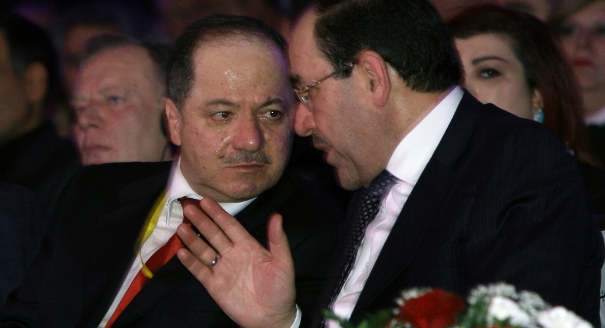
So far, Maliki and the Kurdish leadership in Iraq have prioritized pursuing their foreign policy agenda above dealing with domestic tensions. Success in Syria could fulfill both Maliki’s wishes to return Iraq to the regional scene and the Kurds’ goal of expanding their influence over neighboring regions populated by Kurds. If the Maliki-Kurdish axis endures, Iraq may become not only crucial to resolving the Syrian crisis but also the master of its own foreign policy—and a new regional balance of power.

Former Visiting Scholar, Carnegie Middle East Center
Maria Luisa Fantappie is Head of the Mediterranean, Middle East and Africa Programme at IAI. She served as Special Adviser at the Centre for Humanitarian Dialogue in Geneva (2020-2023) and at the International Crisis Group (2012-2020), engaging at the highest level of policy in Europe, the United States and across MENA (Iraq, Jordan, Saudi Arabia, Iran, Qatar, Oman and United Arab Emirates).
Recent Work
Maria Fantappie

Paul Salem, Yezid Sayigh, Maria Fantappie
Carnegie does not take institutional positions on public policy issues; the views represented herein are those of the author(s) and do not necessarily reflect the views of Carnegie, its staff, or its trustees.

Middle Eastern states should welcome an accelerated U.S. disengagement from their region.

Michael Young

The accord represents a pivotal moment in the region to avert a security vacuum in the Gulf.


Azeema Cheema, Mohanad Hage Ali

Morocco and Algeria, each in its own way, are having to navigate the global economic fallout of the U.S.-Israeli military campaign against Iran.

Yasmine Zarhloule
In an interview, Marc Lynch discusses his new book decrying the post-1990 U.S.-dominated order in the Middle East.
Michael Young
The community already suffers social discrimination, so addressing inequalities requires sustained interventions.
Musaed Aklan , Mohammad Al-Saidi