

{
  "authors": [
    "Changyong Rhee",
    "Andrew Burns",
    "Uri Dadush"
  ],
  "type": "event",
  "centerAffiliationAll": "dc",
  "centers": [
    "Carnegie Endowment for International Peace"
  ],
  "collections": [],
  "englishNewsletterAll": "asia",
  "nonEnglishNewsletterAll": "",
  "primaryCenter": "Carnegie Endowment for International Peace",
  "programAffiliation": "AP",
  "programs": [
    "Asia"
  ],
  "projects": [],
  "regions": [
    "East Asia",
    "South Korea",
    "China",
    "Taiwan",
    "Japan",
    "Southeast Asia",
    "North Korea",
    "North America"
  ],
  "topics": [
    "Economy",
    "Trade"
  ]
}
Asian Development Outlook 2013
Wed, April 17th, 2013
Washington, DC
The Asia and the Pacific region continues to be the global growth leader even as it faces significant development challenges and downside risks. The Asian Development Outlook 2013 report provides a comprehensive analysis of the region’s recent economic performance and its medium-term prospects.
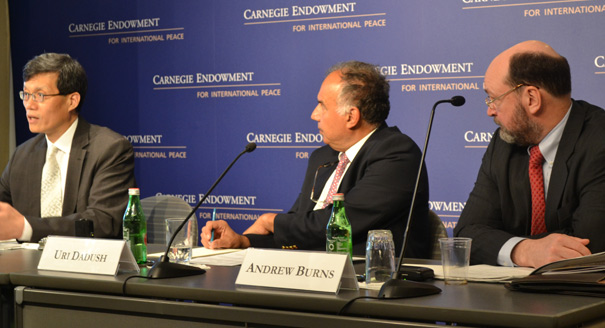
Asian Development Bank Chief Economist Changyong Rhee joined the World Bank’s Andrew Burns and Carnegie’s Uri Dadush to discuss the issues outlined in Asian Development Bank’s annual flagship publication and what they mean for the future of the region.
Growing Strong
- Asian Resilience: The report forecasts that growth in Asia’s developing nations will pick up from 6.1 percent in 2012 to 6.6 percent in 2013 and 6.7 percent in 2014, Rhee said. China’s rebound and ASEAN resilience are major drivers of regional growth, he added.
- Economic Rebalancing: According to Rhee, economic rebalancing in the region is already underway—current account surpluses are shrinking and growth is increasingly being driven by domestic demand. Capital flows to the region have rebounded to pre-crisis levels, backed by strong fundamentals and quantitative easing in advanced economies, he said. The report recommends that governments maintain stable macroeconomic policy and watch for inflation pressures and cross-border capital flows.
Challenges Ahead
- Chinese Growth Model: The region also faces several challenges, Burns cautioned. China’s growth is down this year, a trend policymakers in Beijing have suggested should be seen as a “new normal.” Moving away from the investment-led growth model will be a difficult challenge for Beijing, he added.
- Structural Reform: In developing Asia, the global financial crisis distracted attention from meaningful structural reforms, which were the fundamental source of growth, Burns stated. Dadush concurred that structural reform is key, and warned that Asian economies must resist temptation to stimulate when not appropriate.
Energy and Development
- Demand Pressure: Asian energy and commodities demand has risen along with growth, Rhee said. Sustaining Asian growth requires massively increasing its energy supply, but high dependence on fossil fuels poses environmental problems, he continued. If Asia fails to diversify its energy mix and make energy cleaner and more affordable, it is likely that CO2 emissions will double by 2035 to over 20 billion tons.
- Energy Poor: Asia is home to most of the world’s energy poor who are dependent on traditional fuels, Rhee said. Many Asian countries have large fossil fuel subsidies, but their main beneficiaries are not the poor, and these policies are distortive, costly, and inefficient, he continued.
Policy Recommendations
- Efficiency Benefits: Asian economies should encourage behavioral changes to reap energy efficiency benefits, Rhee said. Regional integration of energy markets will multiply benefits, he continued, although political and regulatory challenges are nontrivial. Rhee expressed hope that governments could establish a pan-Asian energy market by 2030.
- Renewables Potential: Rhee added that there is potential for great expansion of renewables in Asia. But renewable energy alone is not enough in the short run as the technology is still not cost-competitive, he said. Countries need cleaner and more efficient traditional energy for the transition period. Unconventional or shale gas could provide a bridge but will be more difficult to exploit in Asia than in the United States, Rhee said, so research and development will be key.
Carnegie does not take institutional positions on public policy issues; the views represented herein are those of the author(s) and do not necessarily reflect the views of Carnegie, its staff, or its trustees.
Event Speakers
Changyong Rhee
Changyong Rhee is director of the Asia and Pacific Department at the International Monetary Fund. Prior to joining the Fund, Rhee was chief economist at the Asian Development Bank.
Andrew Burns
World Bank
Former Senior Associate, International Economics Program

Dadush was a senior associate at the Carnegie Endowment for International Peace. He focuses on trends in the global economy and is currently tracking developments in the eurozone crisis.