

{
  "authors": [
    "Michele Dunne",
    "Shlomo Brom",
    "Khalil Toufakji"
  ],
  "type": "event",
  "centerAffiliationAll": "dc",
  "centers": [
    "Carnegie Endowment for International Peace"
  ],
  "collections": [],
  "englishNewsletterAll": "menaTransitions",
  "nonEnglishNewsletterAll": "",
  "primaryCenter": "Carnegie Endowment for International Peace",
  "programAffiliation": "MEP",
  "programs": [
    "Middle East"
  ],
  "projects": [],
  "regions": [
    "Middle East",
    "Israel",
    "Palestine"
  ],
  "topics": [
    "Political Reform",
    "Security",
    "Religion"
  ]
}
The Crisis in Jerusalem
Mon, December 8th, 2014
Washington, DC
Even before the Gaza war and its related demonstrations in Jerusalem and the West Bank in summer 2014, tensions were building in Jerusalem. These tensions were a result of the Israeli policies that are gradually transforming the territorial, demographic, and religious character of the city, as well as its connection to the West Bank. Violent attacks and counterattacks have escalated as access to the Haram al-Sharif/Temple Mount has changed, raising the profile of the religious aspect of the Israeli-Palestinian conflict alongside its nationalist and territorial dimensions.
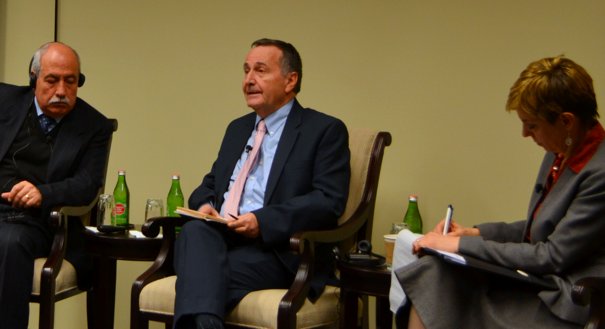
The Carnegie Endowment for International Peace hosted a panel discussion on the roots and implications of the crisis in Jerusalem. Renowned Palestinian expert Khalil Toufakji reviewed the changing map of Jerusalem, including Israeli policies and the implications for Palestinian life in the city. Israeli national security expert Shlomo Brom discussed Israeli policies surrounding Muslim, Christian, and Jewish holy sites in the city, as well as how Israeli/Palestinian issues will affect upcoming Knesset elections. Carnegie’s Michele Dunne moderated.
Shlomo Brom
Shlomo Brom is a visiting fellow with the national security and international policy team at the Center for American Progress, where his work focuses on U.S.-Israeli relations, Middle East security issues, and the Iranian nuclear program. He formerly served as a brigadier general in the Israeli Defense Forces.
Khalil Toufakji
Khalil Toufakji is director of the maps and surveys department at the Orient House, part of the Arab Studies Society in Jerusalem. The Arab Studies Society is a non-governmental organization that was founded in 1980 as a research and documentation center to record the historical, cultural and political history of Palestinians.
Michele Dunne
Michele Dunne is a senior associate in Carnegie’s Middle East Program, where her research focuses on political and economic change in Arab countries, particularly Egypt, as well as U.S. policy in the Middle East.
Carnegie does not take institutional positions on public policy issues; the views represented herein are those of the author(s) and do not necessarily reflect the views of Carnegie, its staff, or its trustees.
Event Speakers
Former Nonresident Scholar, Middle East Program

Michele Dunne was a nonresident scholar in Carnegie’s Middle East Program, where her research focuses on political and economic change in Arab countries, particularly Egypt, as well as U.S. policy in the Middle East.
Shlomo Brom
Institute for National Security Studies
Khalil Toufakji