

{
  "authors": [
    "Heather Grabbe",
    "Mikhail Minakov",
    "Richard Youngs",
    "Jan Techau"
  ],
  "type": "event",
  "centerAffiliationAll": "",
  "centers": [
    "Carnegie Endowment for International Peace",
    "Carnegie Europe"
  ],
  "collections": [
    "Europe’s Eastern Neighborhood"
  ],
  "englishNewsletterAll": "",
  "nonEnglishNewsletterAll": "",
  "primaryCenter": "Carnegie Europe",
  "programAffiliation": "",
  "programs": [],
  "projects": [
    "Rising Democracies Network"
  ],
  "regions": [
    "Middle East",
    "Russia",
    "Europe"
  ],
  "topics": [
    "Foreign Policy"
  ]
}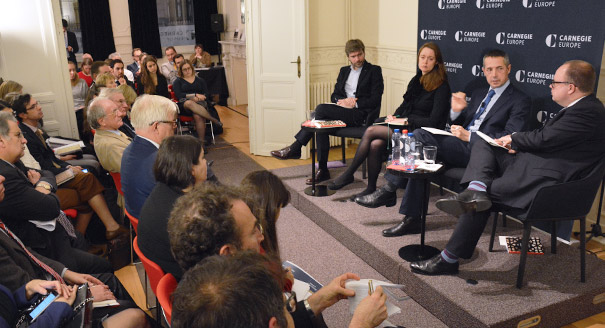
Should the EU Support Non-Western Democracy?
Mon, December 7th, 2015
Carnegie Europe
Calls for different forms of democracy are becoming more prominent and widespread. The future of global politics will depend greatly on whether and how democracy can be made more effective, participative, and accountable. Yet as Western politicians, diplomats, and experts argue in favor of non-Western democratic forms, it remains unclear what such models should look like.
In his latest Carnegie book, The Puzzle of Non-Western Democracy, Richard Youngs explains why a genuine rethink of democracy support is needed—both inside and outside the West—if democracy is to survive in a reshaped global order.
Youngs discussed these critical issues with Heather Grabbe, Jean Monnet fellow at the European University Institute, and Mikhail Minakov, associate professor in the Department of Philosophy and Religious Studies at the National University of Kyiv-Mohyla Academy. Jan Techau, director of Carnegie Europe, moderated.
Video
Podcast
Heather Grabbe
Heather Grabbe is a Jean Monnet fellow at the European University Institute.
Mikhail Minakov
Mikhail Minakov is an associate professor in the Department of Philosophy and Religious Studies at the National University of Kyiv-Mohyla Academy and editor in chief of the Ideology and Politics Journal.
Richard Youngs
Richard Youngs is a senior associate in Carnegie’s Democracy and Rule of Law Program, based at Carnegie Europe.
Jan Techau
Jan Techau is the director of Carnegie Europe.
Carnegie does not take institutional positions on public policy issues; the views represented herein are those of the author(s) and do not necessarily reflect the views of Carnegie, its staff, or its trustees.
Event Speakers
Heather Grabbe
Grabbe is director of the Open Society European Policy Institute.
Mikhail Minakov
Richard Youngs
Senior Fellow, Democracy, Conflict, and Governance Program

Richard Youngs is a senior fellow in the Democracy, Conflict, and Governance Program, based at Carnegie Europe. He works on EU foreign policy and on issues of international democracy.
Jan Techau
Director, Europe Team, Eurasia Group
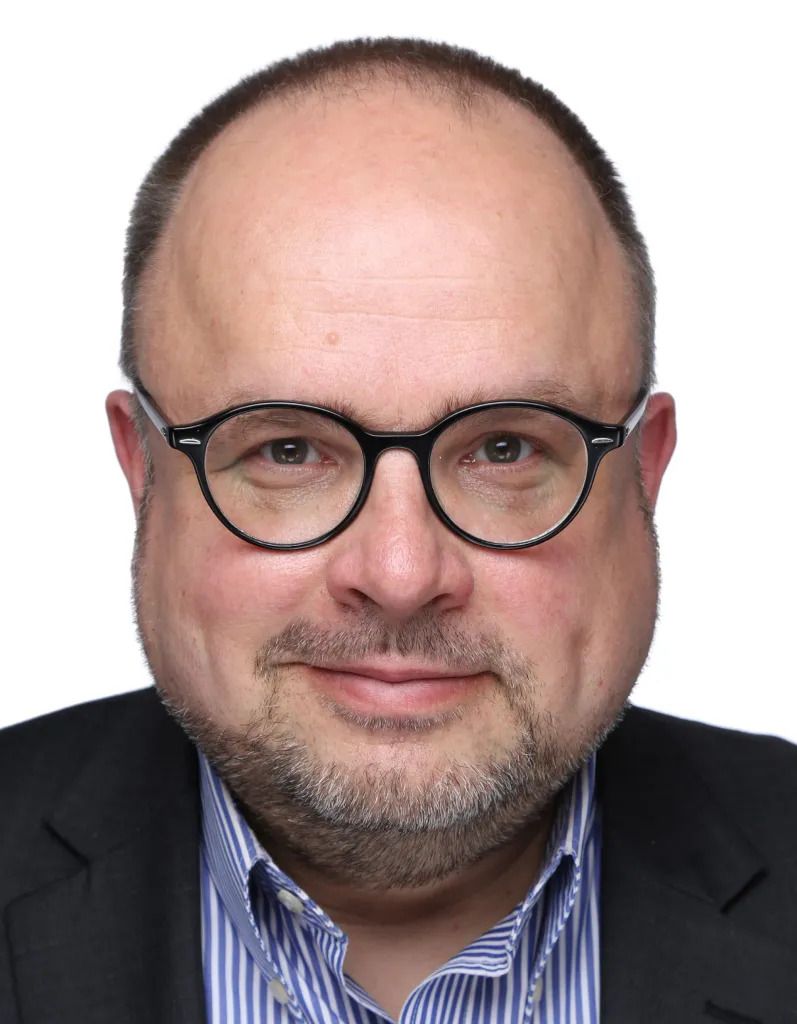
Techau is director with Eurasia Group's Europe team, covering Germany and European security from Berlin. Previously, he was director of Carnegie Europe.