

{
  "authors": [
    "Brad Roberts",
    "George Perkovich"
  ],
  "type": "event",
  "centerAffiliationAll": "dc",
  "centers": [
    "Carnegie Endowment for International Peace"
  ],
  "collections": [],
  "englishNewsletterAll": "ctw",
  "nonEnglishNewsletterAll": "",
  "primaryCenter": "Carnegie Endowment for International Peace",
  "programAffiliation": "NPP",
  "programs": [
    "Nuclear Policy"
  ],
  "projects": [],
  "regions": [
    "North America",
    "United States"
  ],
  "topics": [
    "Nuclear Policy"
  ]
}
U.S. Nuclear Weapons in the Twenty-First Century
Tue, June 28th, 2016
Washington, DC
Can and should the United States do more to reduce the role of nuclear weapons in its security strategy and the number of weapons in its arsenal? This question is particularly timely given the lively international debate on nuclear disarmament. In Brad Roberts’ new book, The Case for U.S. Nuclear Weapons in the 21st Century, he argues that this debate must be informed by the United States’ experience of trying to adapt deterrence to a post–Cold War world. Can important lessons be drawn from this experience for the disarmament enterprise?
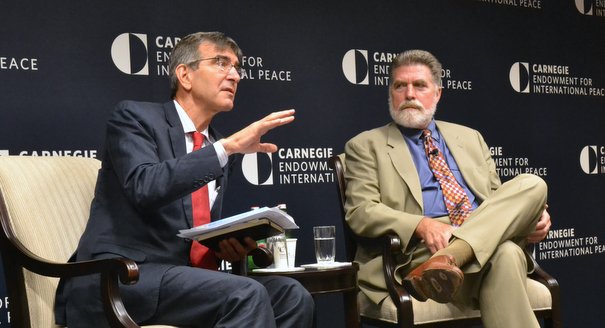
Brad Roberts discussed his analysis. Carnegie’s George Perkovich moderated a conversation on the above questions and more.
Brad Roberts
Brad Roberts is director of the Center for Global Security Research at Lawrence Livermore National Laboratory.
George Perkovich
George Perkovich is vice president for studies at the Carnegie Endowment for International Peace.
Carnegie does not take institutional positions on public policy issues; the views represented herein are those of the author(s) and do not necessarily reflect the views of Carnegie, its staff, or its trustees.
Event Speakers
Brad Roberts
Brad Roberts is director of the Center for Global Security Research at Lawrence Livermore National Laboratory. Among his recent publications is an edited CGSR Occasional Paper entitled “Taking Stock: US-China Track 1.5 Nuclear Dialogue."
Japan Chair for a World Without Nuclear Weapons, Senior Fellow

George Perkovich is the Japan Chair for a World Without Nuclear Weapons and a senior fellow in the Carnegie Endowment for International Peace’s Nuclear Policy Program. He works primarily on nuclear deterrence, nonproliferation, and disarmament issues, and is leading a study on nuclear signaling in the 21st century.