

{
  "authors": [
    "Anouar Boukhars",
    "Aymen Abderahmen",
    "Sarah Yerkes"
  ],
  "type": "event",
  "centerAffiliationAll": "dc",
  "centers": [
    "Carnegie Endowment for International Peace"
  ],
  "collections": [
    "Arab Awakening"
  ],
  "englishNewsletterAll": "menaTransitions",
  "nonEnglishNewsletterAll": "",
  "primaryCenter": "Carnegie Endowment for International Peace",
  "programAffiliation": "MEP",
  "programs": [
    "Middle East"
  ],
  "projects": [
    "Tunisia Monitor"
  ],
  "regions": [
    "North Africa",
    "Tunisia"
  ],
  "topics": [
    "Political Reform",
    "Security"
  ]
}
The Geographic Trajectory of Conflict and Militancy in Tunisia
Wed, September 20th, 2017
Washington, DC
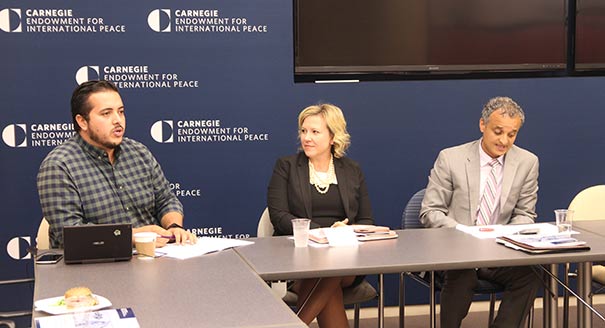
To launch a new paper by Carnegie nonresident scholar Anouar Boukhars, Carnegie’s Sarah Yerkes moderated a discussion between Boukhars and Aymen Abderahmen, a Tunisian human rights activist and journalist who is currently an Atlas Corps fellow serving at the Tahrir Institute for Middle East Policy.
In the paper, Boukhars seeks to understand and address the drivers of conflict in Tunisia’s border regions. In the discussion, Boukhars refuted the notion that the borders regions cause conflicts because they are hotbeds of smuggling and militarism. In reality, stated Boukhars, lack of development and marginalization by the centralized government in Tunis have created intense resentment within the border regions. The Tunisian government’s efforts to address the informal economy that has emerged in response to the lack of infrastructure has negatively affected the poorest and most vulnerable people on the border regions, individuals who depend on underground cross border trade with Libya for the essentials of life. The state unresponsiveness to the needs of the regions breeds distrust and antagonism towards state authorities and security systems, and creates an environment fertile for extremist recruitment. The consequent counter-terrorism efforts by the government ensnares the state and border regions in a vicious cycle of violence.
Boukhars recommended the Tunisian government move away from their security first approach to begin seriously tackling the factors that create insecurity. Abderahmen echoed Boukhars’ position that the Tunisian state is responsible for growing militancy. Speaking as a member of the Tunisian youth, he expressed frustration with the slowness of change in Tunisia, citing the desperation of his peers who had taken to the streets during the revolution, but had seen little in the way of perceived progress.
Carnegie does not take institutional positions on public policy issues; the views represented herein are those of the author(s) and do not necessarily reflect the views of Carnegie, its staff, or its trustees.
Event Speakers
Former Nonresident Fellow, Middle East Program
Boukhars was a nonresident fellow in Carnegie’s Middle East Program. He is a professor of countering violent extremism and counter-terrorism at the Africa Center for Strategic Studies, National Defense University.
Aymen Abderahmen
Senior Fellow, Middle East Program

Sarah Yerkes is a senior fellow in Carnegie’s Middle East Program, where her research focuses on Tunisia’s political, economic, and security developments as well as state-society relations in the Middle East and North Africa.