Because the global financial crisis has directly threatened the political survival of leaders of the main industrialized countries, it is expected to top the agenda of the upcoming G8 summit.
Financial Crisis to Top Agenda of G8 SummitThe global financial crisis is expected to top the agenda of the upcoming G8 summit, as the crisis has directly threatened the political survival of leaders of the main industrialized countries, an expert said.
"I expect the financial crisis to be again the most prominent single topic, though climate change and Iran -- unless the situation has stabilized by then -- will also feature prominently," Uri Dadush, director of the Carnegie Endowment for International Peace's international economics program, said.
"The financial crisis and the large rise in unemployment associated with it directly threaten the political survival of every one of the G8 leaders, and it is an area where international coordination is critical, and it is needed now," Dadush told Xinhua.
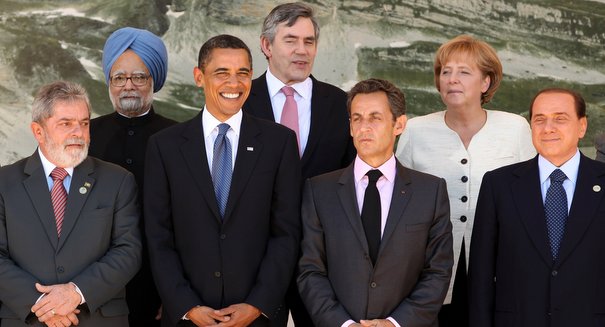
At the G8 summit, which is to be held on July 8-10 in L'Aquila, Italy, heads of state and government of Britain, Canada, France, Germany, Italy, Japan, Russia, and the United States are to discuss common concerns ranging from the financial crisis to arms proliferation.
"It is very important in international affairs because of the economic and military power of its members," Dadush said, but the main limitations of the G8 are "its lack of representation and legitimacy, and the absence of any serious capacity to execute and enforce its decisions."
The industrialized countries' bloc represents about 65 percent of the Gross World Product and more than 70 percent of the world military expenditures, but only about 14 percent of the world population.
"It has not, in my view, adequately balanced the interests of developing and developed countries," Dadush said.
He said that the G8 needs to broaden its membership to include at least China, India, and Brazil.
As to G8 reform, Dadush offered three suggestions: The United States needs to raise its savings rate and find ways to rein in its financial sector which is essentially out of control; Europe needs to find a common voice on international issues; Russia needs to create legitimate institutions to underpin its market reforms.
Comparing the G8 with the G20, Dadush said the G20 is much more appropriate for dealing with the climate change and financial crisis than the G8 because "it is far more representative of the different influential actors on the issue."
"But the G20 is too big a group for effective decision-making in the long-run," Dadush said. It incorporates 19 of the world's largest economies and the European Union.
"So, for the time being, both will co-exist; but over time, we should converge to a different group, one that is both more representative and efficient. That is not easy to find and will take some time," he said.
Former Senior Associate, International Economics Program
Dadush was a senior associate at the Carnegie Endowment for International Peace. He focuses on trends in the global economy and is currently tracking developments in the eurozone crisis.
Carnegie does not take institutional positions on public policy issues; the views represented herein are those of the author(s) and do not necessarily reflect the views of Carnegie, its staff, or its trustees.
China’s banking crisis in the 2000s was resolved by transferring the costs to households through financial repression—a decision that recapitalized the banks while exacerbating the structural imbalances that continue to shape the Chinese economy today.
While China's investment story seems contradictory from the outside, the real answers to Beijing's high-quality growth ambitions are hiding in plain sight across the nation's cities.