• Commentary
  • Research
  • Experts
  • Events
Carnegie China logoCarnegie lettermark logo
{
  "authors": [
    "Minxin Pei"
  ],
  "type": "legacyinthemedia",
  "centerAffiliationAll": "dc",
  "centers": [
    "Carnegie Endowment for International Peace",
    "Carnegie Europe"
  ],
  "collections": [],
  "englishNewsletterAll": "asia",
  "nonEnglishNewsletterAll": "",
  "primaryCenter": "Carnegie Endowment for International Peace",
  "programAffiliation": "AP",
  "programs": [
    "Asia"
  ],
  "projects": [],
  "regions": [
    "East Asia",
    "China",
    "Asia"
  ],
  "topics": [
    "Political Reform",
    "Democracy",
    "Economy"
  ]
}
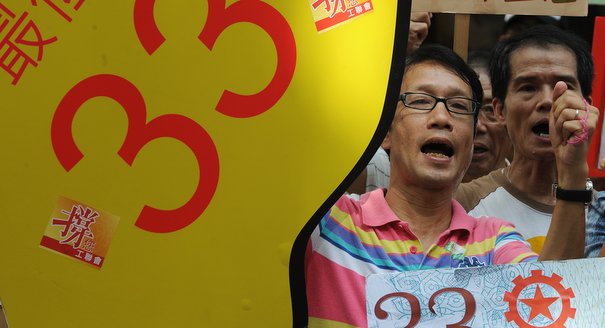
Source: Getty

In The Media

China's Political Awakening

While China’s labor activism signals a broader political re-awakening of its civil society, this emerging phenomenon does not guarantee fundamental change to the country’s autocratic political order.

Link Copied
By Minxin Pei
Published on Jul 14, 2010

Source: The Diplomat

China's Political AwakeningThe ongoing labour unrest in China is seen by many as a labour market response to uncompetitive wages offered by foreign companies. And, to a large extent, this is true. Changing demographics are reducing the supply of ultra-cheap young labourers from the countryside to coastal export-processing zones, giving labour more bargaining power.

But explaining China’s newly assertive workers purely on economic grounds misses the larger—and more interesting—political context. For labour activism is only one of the many signs of a broader political re-awakening in Chinese civil society.
For years, Western observers have been disheartened by the lack of political change in China. Modernization theory predicts that rapid economic progress should help liberalize the political system, but this hasn’t occurred in China since 1989. Until now.
 
In addition to migrant workers who have risked their jobs and personal safety in joining the strikes, China has seen other forms of civic activism and political assertiveness at the grassroots level.
 
What’s interesting about this new political reawakening is that on the surface it doesn’t look all that political. Instead of calling for democracy and freedom, participants in these activities focus on issues directly related to their economic interests, property rights and social justice. Examples include fighting off local governments’ attempts to build polluting factories, seize farmers’ land without compensation and evict urban residents from their homes. Criticism of government policy and performance in delivering public services and protecting social justice are routine in Chinese publications and on-line venues. And, of course, the ostensibly apolitical nature of such civic activism makes it much harder for the Communist Party to suppress it with brutal force.
 
Several forces have contributed to the reawakening. Clearly, the information revolution—a direct result of economic modernization—has helped change values and reduced the costs of organizing collective action. It has also magnified the political impact of such moves (even inspiring copycat action), while the rapidity with which the latest labour unrest has spread would have been inconceivable without the assistance of the Internet and cell phones.
 
Rising physical mobility of the population is another factor—as ordinary Chinese citizens have more opportunities to compare how conditions differ among China’s diverse localities, they acquire a greater awareness of the political and social injustice of their own surroundings and become less tolerant of such injustices.
 
In an important sense, the Communist Party’s own populist rhetoric has fuelled the expectations of Chinese society and, ironically, de-legitimized many of Beijing’s post-1989 policies that contributed to China’s rapid economic growth, such as courting foreign businesses, reducing social spending to boost investment and forcing tens of millions of ordinary Chinese to make enormous personal sacrifices (accepting low wages and losing their land and apartments for the sake of rapid economic growth). Now the Chinese government faces a dilemma: it has raised the people’s expectations, but meeting those expectations would be economically costly (more redistribution and social welfare) and politically risky (greater popular political participation).
 
The delayed political awakening of China’s civil society will have profound consequences. Economically, it will make it much harder for the government to continue to pursue its post-Tiananmen strategy of promoting economic growth at all cost. Politically, it may lead to greater disunity within the elites since some of them may be tempted to exploit rising populism for personal political advantage.
 
For a one-party regime for which elite unity is critical, any deep schisms within its top leadership could trigger a chain of de-stabilizing events. In addition, if the Chinese authorities fail to end the current labour unrest in foreign-invested firms, disgruntlement will likely spread to workers in other sectors (most likely in construction and mining, where working conditions are dangerous and pay extremely low).
 
Still, while the political awakening comes as a pleasant confirmation of the theory that economic progress will bring about political change, it can’t be assumed this emerging phenomenon will fundamentally change China’s autocratic political order. As a result of the post-Tiananmen repression, China’s civil society lacks independent centres of public morality, organizational networks and effective leadership. Most activities that challenge government authority are uncoordinated, disorganized and short-lived.
 
But if the Party thinks that it can continue to rule China in the same old way, it would be mistaken. If anything, the on-going labour unrest and the seismic shift in values in Chinese society show that the Party is governing a different country, where the old rules no longer apply.

About the Author

Minxin Pei

Former Adjunct Senior Associate, Asia Program

Pei is Tom and Margot Pritzker ‘72 Professor of Government and the director of the Keck Center for International and Strategic Studies at Claremont McKenna College.

    Recent Work

  • In The Media
    How China Can Avoid the Next Conflict

      Minxin Pei

  • In The Media
    Small Change

      Minxin Pei

Minxin Pei
Former Adjunct Senior Associate, Asia Program
Minxin Pei
Political ReformDemocracyEconomyEast AsiaChinaAsia

Carnegie does not take institutional positions on public policy issues; the views represented herein are those of the author(s) and do not necessarily reflect the views of Carnegie, its staff, or its trustees.

More Work from Carnegie China

  • Commentary
    China Financial Markets
    The Plaza Accord and Its Relevance for China

    The Plaza Accord was not an externally imposed punishment of Japan but part of a broader restructuring that Japanese economists and policymakers themselves recognized was necessary. Its effects were undermined, however, when Tokyo responded to the resulting slowdown with policies that exacerbated investment, credit expansion, and the very imbalances the adjustment was intended to resolve.

      Michael Pettis

  • The nuclear missile formation passes through Tian'anmen Square during a military parade on September 3, 2025 in Beijing, China.
    Paper
    Untangling the Nuclear Knot: A Constructive Agenda for Managing China’s Nuclear Relations with the United States and Its Allies

    The nuclear relationship between China and the United States is increasingly shaped by widening perception gaps rather than deliberate strategic design.

      Tong Zhao

  • Commentary
    China Financial Markets
    Who Paid for China’s Last Debt Cleanup, and Who Will Pay for the Next?

    China’s banking crisis in the 2000s was resolved by transferring the costs to households through financial repression—a decision that recapitalized the banks while exacerbating the structural imbalances that continue to shape the Chinese economy today.

      Michael Pettis

  • Robot arm with disposable test tube virus sampling in laboratory
    Commentary
    Caught in the Middle: Chinese Biotech Firms’ Divergent Responses to U.S. Sanctions

    Chinese biotech companies have been on the receiving end of U.S. economic coercion. Yet their responses have differed significantly because firm and state interests are not uniformly aligned. For Washington, treating all Chinese tech firms the same, irrespective of their actual interests, risks pushing them farther into Beijing’s corner.

      Xue Gong

  • An aerial drone photo taken on June 4, 2026 shows a wind-photovoltaic power storage station of Huadian Inner Mongolia New Energy Co., Ltd. as part of the Horinger data center cluster green energy supply demonstration project, in Hohhot, north China's Inner Mongolia Autonomous Region.
    Commentary
    Are Data Centers the Solution to China’s Renewables Excess Capacity?

    China’s latest energy plan explicitly calls for integrating data centers into the electricity system, particularly connecting them to green energy. It appears Beijing wants to use compute as a source of domestic demand to absorb renewables excess capacity.

      • Damien Ma

      Damien Ma

Get more news and analysis from
Carnegie China
Carnegie China logo, white
Keck Seng Tower133 Cecil Street #10-01ASingapore, 069535Phone: +65 9650 7648
  • Research
  • About
  • Experts
  • Events
  • Contact
  • Careers
  • Privacy
  • For Media
Get more news and analysis from
Carnegie China
© 2026 Carnegie Endowment for International Peace. All rights reserved.
