

Commentary
Uri Dadush
{
  "authors": [
    "Uri Dadush"
  ],
  "type": "legacyinthemedia",
  "centerAffiliationAll": "",
  "centers": [
    "Carnegie Endowment for International Peace"
  ],
  "collections": [],
  "englishNewsletterAll": "",
  "nonEnglishNewsletterAll": "",
  "primaryCenter": "Carnegie Endowment for International Peace",
  "programAffiliation": "",
  "programs": [],
  "projects": [],
  "regions": [
    "North America",
    "United States"
  ],
  "topics": [
    "Economy"
  ]
}
Source: Getty
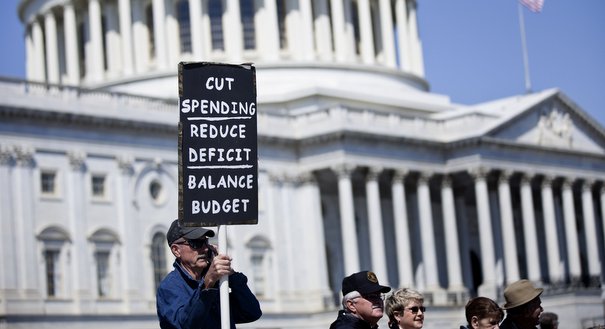
If the debt ceiling debate can help Americans begin to confront the country's fiscal anomalies—beginning with its huge healthcare costs, relatively low taxes, and defense budget—it is to be warmly welcomed.
Source: Financial Times

Whereas other advanced countries have been forced to raise taxes and cut spending by immediate financial market pressure or the fear of it, the US has been sheltered by its safe haven status and, in uncertain times, the world’s continued hunger for dollars – still the global reserve currency. Moreover, in contrast to the UK’s parliamentary system, America’s checks and balances would prevent strong executive action, even if there was stomach for it. Farcical (or tragic) as it may be, the political theatre featuring the debt ceiling is America’s way of confronting the problem before the market forces it to do so.
The rest of the world has a big stake in the outcome. With the eurozone in terrible trouble, and Japan in a quagmire, the risk of losing confidence in the world’s largest economy – still three times the size of China’s – is too dire to contemplate. Deep concerns about America’s fiscal deficits, and the Fed’s attempts to engineer lower long-term interest rates through quantitative easing, contribute massively to international tensions on currency levels (as the dollar comes under pressure), hot money flows and capital controls (as emerging markets overheat), and excessive reserve levels (as China and others amass Treasury Bills).
Finally, if done right, US tax reforms and expenditure cuts can help redress global imbalances. America’s structural current account deficit is not helped by China’s and Germany’s anti-consumption policies. But its deeper roots lie in US fiscal policy, with its comparatively low taxes (especially on corporations and and its top 1 per cent of earners who account for 17.6 per cent of total income), which directly and indirectly promotes consumption. Compared to other advanced countries, America under-taxes gasoline consumption and, indirectly, imported oil. Home building is artificially encouraged by its large mortgage interest rate reduction and many other tax incentives, diverting resources from the traded sectors. The US does not apply value added tax, a consumption tax, and another large potential source of revenues. It spends hugely more on healthcare than all other advanced countries without a pay-off in terms of improved health. And it still accounts for about half of global defence spending.
If the debt ceiling debate helps Americans begin to confront these anomalies, it is to be warmly welcomed.

Former Senior Associate, International Economics Program
Dadush was a senior associate at the Carnegie Endowment for International Peace. He focuses on trends in the global economy and is currently tracking developments in the eurozone crisis.
Recent Work
Uri Dadush
Uri Dadush
Carnegie does not take institutional positions on public policy issues; the views represented herein are those of the author(s) and do not necessarily reflect the views of Carnegie, its staff, or its trustees.

China has showcased its engineering prowess with small modular reactor demonstration projects. But turning these technological achievements into commercial success will be a greater challenge.

Tong Zhao

The Plaza Accord was not an externally imposed punishment of Japan but part of a broader restructuring that Japanese economists and policymakers themselves recognized was necessary. Its effects were undermined, however, when Tokyo responded to the resulting slowdown with policies that exacerbated investment, credit expansion, and the very imbalances the adjustment was intended to resolve.

Michael Pettis

The nuclear relationship between China and the United States is increasingly shaped by widening perception gaps rather than deliberate strategic design.
Tong Zhao
China’s banking crisis in the 2000s was resolved by transferring the costs to households through financial repression—a decision that recapitalized the banks while exacerbating the structural imbalances that continue to shape the Chinese economy today.
Michael Pettis

But their "principal to principal" model will only be as effective as the political strength of each leader back home.

Damien Ma