

Paper
Douglas H. Paal
{
  "authors": [
    "Douglas H. Paal"
  ],
  "type": "legacyinthemedia",
  "centerAffiliationAll": "dc",
  "centers": [
    "Carnegie Endowment for International Peace",
    "Carnegie China"
  ],
  "collections": [],
  "englishNewsletterAll": "asia",
  "nonEnglishNewsletterAll": "",
  "primaryCenter": "Carnegie China",
  "programAffiliation": "AP",
  "programs": [
    "Asia"
  ],
  "projects": [],
  "regions": [
    "North America",
    "United States",
    "East Asia",
    "China",
    "Southeast Asia",
    "Myanmar"
  ],
  "topics": [
    "Political Reform",
    "Democracy",
    "Economy",
    "Trade",
    "Foreign Policy",
    "Security"
  ]
}
Source: Getty
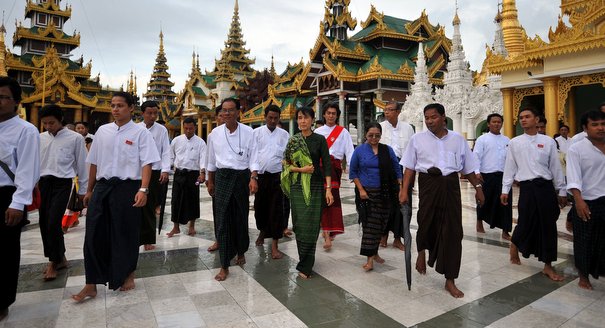
Recent changes in Myanmar’s behavior suggest that its leaders may be attempting to shift away from dependence on China and seek greater legitimacy at home.
Source: Asia Pacific Brief

Most notable from the perspective of Myanmar’s international relations was the government’s decision on October 1 to suspend work on a Chinese-contracted and financed dam on the upper Irrawaddy River at Myitsone. During the past more than two decades of sanctions imposed on the regime for its abortion of the 1990 elections and subsequent crackdowns, the Burmese have visibly grown more dependent on China’s support, trade, and investment. Defying China’s interests appears to be something new and rather brave.
In fact, however, the Burmese have a very long tradition of awkward relations with China, as is to be expected for a small independent state on the periphery of the Chinese empire. Starting with the Mongol invasion in 1287, which destroyed the glories of Pagan for the first time, through the Cultural Revolution in 1967, when anti-Chinese riots reduced the presence of Chinese in Burma the last time, history shows that China’s influence grows but then is checked periodically by outbursts of Burmese nationalism. We may be witnessing something like that now.
New president Thein Sein must have thought hard before he authorized suspension of the dam construction. As Myanmar’s most friendly and consequential neighbor, China has plenty of levers to pull to express its unhappiness and has a record of doing so. Informed speculation among exiles suggests Thein Sein was responding to a welling up of civic opposition to the project and its huge attendant costs in lands to be flooded and downstream effects on the river. A sense of excessive dependency on and service to China’s interests may also have been a factor. The power generated by the dam would have largely fed neighboring Yunnan province.
This would be a piece, with other tentative moves by the authorities to relax controls, including the release of several hundred political prisoners (out of thousands), repeated high-level, publicized meetings with Nobel laureate Aung San Suu Kyi, the most prominent opposition leader long held under house arrest, and peace agreements with two rebellious minorities on the borderlands. Despite the sham election that brought the new rulers to power, they are giving initial signs of seeking greater legitimacy at home.
Moreover, the capital Naypyidaw welcomed back the United Nations special envoy to Myanmar, after closing the door to his visits for years. The retired generals now in charge seem to want the world to know what they are doing too. Visas for journalists are now freely available. Presumably the leaders hope to persuade the United States and Europe to permit them to travel there again and lift the punishing sanctions on economic activity. They probably also want to persuade the Association of Southeast Asian Nations (ASEAN) to let Myanmar chair the organization in 2014, including playing host to the East Asian Summit, by reducing the embarrassment entailed by its presence.
The new American special representative to Myanmar, Derek Mitchell, made a visit to the country in September and gave the Burmese guidance, not publicly specified, on what any new steps toward genuine democracy and openness would gain in return. Subsequently, Myanmar’s foreign minister was welcomed at the State Department for the first time in decades to hear more of the same message. Mitchell returned quietly to Myanmar this week for further meetings in an effort to build momentum toward change.
The Obama administration is proceeding cautiously, but is not immobilized. Suspicion remains strong in the human rights community and among core staff on Capitol Hill. Myanmar has tried small openings before and they proved ultimately disappointing. Sanctions legislation was renewed in September for another twelve months, so there is time to evaluate Myanmar’s direction.
But in the meantime, there are options to entice better behavior from Naypyidaw. In exchange for verifiable human rights and political progress, Washington can decide against pressing other possible donor nations not to offer assistance. The World Bank, International Monetary Fund, and Asian Development Bank can be freed to do more technical work to help the economy develop as well as become less dependent on China.
One symbolically important step would be to elevate U.S. representation in Rangoon from chargé to ambassador. Although diplomacy is meant to get things done, and not to convey approbation or disapprobation, a return to normal relations will be a big boost for the regime and should be paired with appropriate progress, probably at a minimum freedom for the remaining political prisoners.
The author Paul Theroux once described the Burmese as a “race of dispossessed princes.” Today the 55 million live in unbecoming poverty, virtually voiceless in a land of natural richness and beauty. If there is a chance to change that narrative for the better, the United States should grab it.
Sanctions and diplomatic isolation have had the unintended effect of making Myanmar almost a new province of China. Surely the United States will welcome the opportunity to realistically facilitate Myanmar’s growing independence.

Distinguished Fellow, Asia Program
Paal previously served as vice chairman of JPMorgan Chase International and as unofficial U.S. representative to Taiwan as director of the American Institute in Taiwan.
Recent Work
Douglas H. Paal

Douglas H. Paal, Tong Zhao, Chen Qi, …
Carnegie does not take institutional positions on public policy issues; the views represented herein are those of the author(s) and do not necessarily reflect the views of Carnegie, its staff, or its trustees.

The Plaza Accord was not an externally imposed punishment of Japan but part of a broader restructuring that Japanese economists and policymakers themselves recognized was necessary. Its effects were undermined, however, when Tokyo responded to the resulting slowdown with policies that exacerbated investment, credit expansion, and the very imbalances the adjustment was intended to resolve.

Michael Pettis

The nuclear relationship between China and the United States is increasingly shaped by widening perception gaps rather than deliberate strategic design.
Tong Zhao
China’s banking crisis in the 2000s was resolved by transferring the costs to households through financial repression—a decision that recapitalized the banks while exacerbating the structural imbalances that continue to shape the Chinese economy today.
Michael Pettis

Chinese biotech companies have been on the receiving end of U.S. economic coercion. Yet their responses have differed significantly because firm and state interests are not uniformly aligned. For Washington, treating all Chinese tech firms the same, irrespective of their actual interests, risks pushing them farther into Beijing’s corner.

Xue Gong

China’s latest energy plan explicitly calls for integrating data centers into the electricity system, particularly connecting them to green energy. It appears Beijing wants to use compute as a source of domestic demand to absorb renewables excess capacity.

Damien Ma