

In The Media
Vikram Nehru
{
  "authors": [
    "Vikram Nehru"
  ],
  "type": "legacyinthemedia",
  "centerAffiliationAll": "dc",
  "centers": [
    "Carnegie Endowment for International Peace"
  ],
  "collections": [],
  "englishNewsletterAll": "asia",
  "nonEnglishNewsletterAll": "",
  "primaryCenter": "Carnegie Endowment for International Peace",
  "programAffiliation": "AP",
  "programs": [
    "Asia"
  ],
  "projects": [],
  "regions": [
    "Southeast Asia"
  ],
  "topics": [
    "Climate Change"
  ]
}
Source: Getty
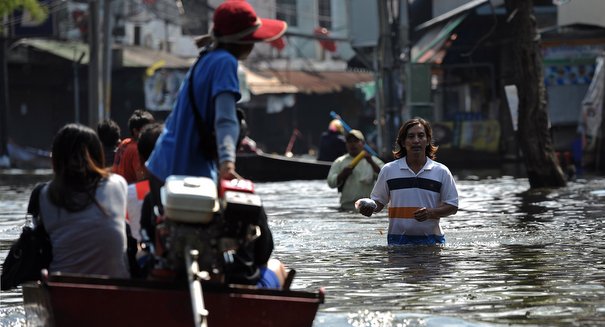
The 2011 floods are a wake-up call to the people and government of Thailand that climate-related risks are real and here to stay, and require a serious and determined response.
Source: Diplomat

The floods covered half the country’s land area, including an estimated 15 percent of the agricultural planted area, and with projected losses of about 6 million tons of milled rice. Some 2.8 million households are reported to have been affected, and about 10,000 factories inundated, leaving over 600,000 people out of work. Corporations such as Apple, Honda, Toyota, and Western Digital have suspended production, affecting their operations as far afield as Brazil and England. Destruction to assets is expected to exceed $10 billion (3 percent of GDP), and GDP growth this year will be hit by between 1 to 2 percentage points. To make matters worse, these losses have come when Thailand was just recovering from the knock-on effects of the Japanese earthquake and tsunami earlier this year.
While the current Thai floods have been particularly severe, they weren’t unexpected. Thailand has 25 river basins and 90 percent of annual rainfall occurs from May to October; as a result, floods in Thailand occur almost every year. But many climate change scientists have been predicting that matters are likely to get worse—floods, droughts, and storm surges may increase in frequency and severity in Southeast Asia. Of late, rains in Thailand have been more erratic and more plentiful. In 2010, for example, Thailand faced its worst drought in 20 years, and then extensive flooding later in the year. Making matters worse, Bangkok and the surrounding area—which accounts for 40 percent of Thailand’s GDP—is just one meter above sea level and is sinking gradually, making it highly vulnerable to storm surges from the Gulf of Thailand. The city is ranked among the top 11 Asian mega-cities at risk from climate change. Fortunately, storm surges didn’t strike during the current floods, which were due to unusually heavy rains, or the cost to life and property would have been much greater.
The floods are a stark reminder that Thailand—and Bangkok—face a future where climate-related risks are likely to rise. Everyone’s attention is rightly focused on dealing with the immediate consequences of the current calamity and its aftermath. But the government also has a golden opportunity to focus on changing the policies of the past that focused on growth to the detriment of sustainability, and it could reorient attention toward managing future climate-related risks and lowering them over time so that growth and welfare improvements can be sustained.
The government can best do this by significantly expanding budgetary allocations to water management, targeting these expenditures to high priority projects, and keeping enough fiscal space in reserve to deal with unexpected future risks (including a possible prolonged and serious downturn in the global economy). In this regard, however, the proposed 2012 budget was disappointing. Its tax and subsidy giveaways to corporations, car buyers, and home owners can hardly be considered a high priority use of resources. And its allocation for water management, although an increase over previous years, is small relative to the country’s needs. Such investments could not only yield high economic returns—a recent World Bank-financed report on the Bangkok metropolitan area estimated the rate of return to be between 8.5 percent and 11.5 percent in real terms—they also help the poor who are most affected by the floods and the least able to cope. These are projects that will not only be good for the long term growth of the country, but also be popular among the voters.
Appropriate budgetary allocations, however, are only part of the answer. Thailand also has to streamline and energize its water management institutions. At last count, there were eight institutions, each with different objectives and mandates, and little if any coordination between them. Some of them haven’t fully absorbed the implications of climate change and extreme weather events for their planning. Few engage with local communities and employ participatory approaches to dealing with flood risks and water management. And for some, decisions are too easily swayed by powerful interests at the expense of the public good and often the poor.
At the same time, Thailand must act quickly and avoid mistakes. Managing risks from extreme weather events, be they droughts, floods, or storm surges, requires fundamental changes in urban design and effective land use planning. Relevant municipal irrigation, infrastructure, and flood management institutions need to be streamlined and overhauled. Systems are required to deliver timely public information on water-related risks. And above all, there need to be relentless and continued efforts to provide appropriate infrastructure that help manage the conservation and drainage of water while at the same time supporting an efficient and competitive economy.
The agenda is massive and the need is urgent. The government’s 2012 budget may have fallen short, but all is not lost. The 2011 floods are a wake-up call to the people and government of Thailand that climate-related risks are serious and here to stay, and require a serious and determined response.

Former Nonresident Senior Fellow, Asia Program
Nehru was a nonresident senior fellow in the Carnegie Asia Program. An expert on development economics, growth, poverty reduction, debt sustainability, governance, and the performance and prospects of East Asia, his research focuses on the economic, political, and strategic issues confronting Asia, particularly Southeast Asia.
Recent Work
Vikram Nehru
Vikram Nehru
Carnegie does not take institutional positions on public policy issues; the views represented herein are those of the author(s) and do not necessarily reflect the views of Carnegie, its staff, or its trustees.

U.S. unpredictability has allowed China to capitalize on its positioning as the “responsible great power”. Paradoxically, the more China wins the perception game, the more likely expectations will rise for Beijing to deliver not just words but to demonstrate with its deeds.

Chong Ja Ian

Hanoi and Beijing have long treated each other as distant cousins rather than comrades in arms. That might be changing as both sides draw closer to hedge against uncertainty and America’s erratic behavior.

Nguyễn Khắc Giang

Malaysia’s chairmanship sought to fend off short-term challenges while laying the groundwork for minimizing ASEAN’s longer-term exposure to external stresses.

Elina Noor

For Malaysia, the conjunction that works is “and” not “or” when it comes to the United States and China.
Elina Noor

ASEAN needs to determine how to balance perpetuating the benefits of technology cooperation with China while mitigating the risks of getting caught in the crosshairs of U.S.-China gamesmanship.
Elina Noor