

Article
Muthiah Alagappa
{
  "authors": [
    "Muthiah Alagappa"
  ],
  "type": "legacyinthemedia",
  "centerAffiliationAll": "dc",
  "centers": [
    "Carnegie Endowment for International Peace"
  ],
  "collections": [],
  "englishNewsletterAll": "asia",
  "nonEnglishNewsletterAll": "",
  "primaryCenter": "Carnegie Endowment for International Peace",
  "programAffiliation": "AP",
  "programs": [
    "Asia"
  ],
  "projects": [],
  "regions": [
    "Southeast Asia"
  ],
  "topics": [
    "Political Reform",
    "Democracy"
  ]
}
Source: Getty
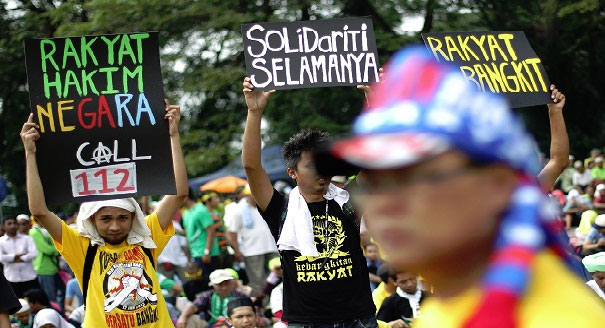
It is crucial that the upcoming Malaysian election be seen to be as clean and fair as possible.
Source: Edge Malaysia

Per these provisions, Malaysia should have a new parliament and government at the latest by the third quarter of 2013.That will be the 13th time a government has acceded to power through the ballot box. Except during 1969-1971, democratically elected governments have governed Malaysia since 1959.This is no mean feat. All Malaysians should be proud of that accomplishment.
At the same time, we must acknowledge that democracy in Malaysia has eroded over time. In the interest of stability, certain constitutional provisions have been placed beyond public debate and scrutiny. For the same reason, some civil liberties have been constrained. several provisions of the constitution that would have deepened democracy remain diluted or unimplemented.
The power and independence of some public institutions, especially the judiciary, have been compromised. For various reasons, the government, opposition parties, civil society, the private sector and the public at large have not fully adhered to democratic practices, leading to charges and counter-charges of anti-democratic practice.
Notwithstanding the erosion of democracy, and charges and counter-charges of anti-democratic practices, it is crucial that the upcoming election be seen to be as clean and fair as possible. All parties must accept the election outcome as the verdict of the people. That will avoid debilitating political struggles.
Clean elections and acceptance of the verdict are in the national interest and should supersede political interests of individuals and parties. In 2000, despite winning the popular vote, Al Gore accepted the verdict of the Supreme Court that went against him. Patriotism triumphed, preventing a bitter political struggle. Our political leaders are capable of, and must demonstrate, such maturity. They must commit themselves to uphold the integrity and legitimacy of the election process and to accept the election outcome.
This will be their greatest contribution to the country that will override all other promises and achievements. It is easy to weaken or break a system or institution but extremely difficult to rebuild and restore its credibility as witnessed by the wide-ranging public perceptions of our law enforcement institutions.
Political leaders of all stripes and responsible government officials must put the public good ahead of private interests. They must cherish, protect and strengthen the democratic system of government which is an important legacy of our forefathers and framers of the constitution. Although one or two individuals may have tended in that direction, unlike in other countries, our leaders did not take the path of outright autocracy, authoritarianism or military rule even when opportunities presented themselves.
Despite erosion in some basic features, over the last several decades, we have reaped the benefits of democratic rule. By allowing citizen participation and regularized competition for state power, democracy conferred the mandate of the people on the winning party and fostered peaceful change in government leadership.
Many developing countries have not been able to institute legitimate systems of government. We only have to look at the debilitating political struggles in our neighboring countries to realize the significance of our democratic inheritance. We should not squander that asset.
A democratic system of government has several merits. Most importantly, it provides the basis and mechanism for implementing the principle of popular sovereignty. Sovereignty today is explicitly tied to the support of the people. No ruler or government can be legitimate if he/she/it does not have the mandate of the people.
Second, democracy recognizes citizenship rights and treats all citizens on an equal plane. Civil liberties and the system of "one person, one vote" empower all citizens. Democracy does not create classes of citizens on the basis of selective franchise. It has the potential to provide a voice for marginalized and minority peoples.
Third, it provides a means for peaceful competition for state power. It delegitimizes seizure of state power by force of arms and other such means. Democracy enables peaceful change in government, including ouster of a government that abuses state power or no longer serves the interest of the people.
Fourth, it empowers and accommodates civil society as a key vehicle for interest articulation and governance. These are among some of the benefits of a democratic form of government.
Some, especially those with an autocratic bent and who cherish strong government, view democratic government as messy and incapable of delivering rapid economic growth. They believe government and leaders know what is best for the people. They prefer guided or controlled democracy.
Indonesia's experiences from the early 1960s to 1998 demonstrate the weaknesses of controlled democracy and autocratic rule. Despite 20 years of rapid economic growth, the legitimacy of the Suharto regime was severely undermined and decades of economic growth dissipated quickly. Today, Indonesia has a democratic system of government and its economy is beginning to pick up speed.
It is important to avoid the mistake of linking type of government and the rate of economic growth. The Chinese Communist Party has ruled China since 1949 but that country has experienced rapid economic growth only since 1979. Likewise, India has had a democratic government since 1947 but has experienced rapid economic growth only since 1991.
The explanation for growth lies in policies, the effectiveness of state institutions and the human resource base of the country, and not in the type of political system. The primary function of a political system is political: selection and legitimacy of government, and the deployment of state power to enhance the security and welfare of citizens. Here, democracy is undoubtedly the best form of government that relies on popular sovereignty. That it may be messy and requires a set of skills to manage government cannot be denied. But that should not be the reason for rejecting democracy. Rather, we should strengthen democracy to make it more resilient.
We should rebuild and deepen democracy in Malaysia. A durable democratic system of government will be our primary legacy to future generations. It will be as, if not even more, important than economic growth and development.
Although good governance and economic performance are important, they are not durable bases of legitimacy. It is a mistake to believe otherwise. A resilient political system is essential for political stability and internal security, which in turn are vital for economic development.
Deepening democracy in Malaysia entails strengthening electoral or procedural democracy as well as civil liberties. The emphasis in most quarters has been on electoral democracy, especially on the process for acquisition of state power. However, a mature democracy also requires checks and balances on the exercise of state power as well as the entrenchment of civil liberties.
Malaysia aspires to be a developed country by 2020. As a developed country, our political system must inculcate features of both electoral and substantive democracy. It must empower and check government, the opposition, state institutions, civil society, the private sector and citizens. All concerned must act responsibly within the constitutional framework and abide by democratic norms.
Adherence to democratic principles, norms, rules and procedures will strengthen democracy. We must reach a stage where the democratic system of government is the only game in town. All other forms of government must be delegitimized in principle and practice. I will write on specific ways to strengthen democracy in Malaysia in ensuing columns.
Former Nonresident Senior Fellow, Asia Program
Alagappa, formerly a nonresident senior fellow in the Asia Program, was the first holder of the Tun Hussein Onn Chair in international studies at the Institute of Strategic and International Studies in Kuala Lumpur, Malaysia. His research focuses primarily on Asian security, the political legitimacy of governments, civil society and political change, and the political role of the military in Asia.
Recent Work
Muthiah Alagappa
Muthiah Alagappa
Carnegie does not take institutional positions on public policy issues; the views represented herein are those of the author(s) and do not necessarily reflect the views of Carnegie, its staff, or its trustees.

US unpredictability has allowed China to capitalize on its positioning as the “responsible great power”. Paradoxically, the more China wins the perception game, the more likely expectations will rise for Beijing to deliver not just words but to demonstrate with its deeds.

Chong Ja Ian

Hanoi and Beijing have long treated each other as distant cousins rather than comrades in arms. That might be changing as both sides draw closer to hedge against uncertainty and America’s erratic behavior.

Nguyễn Khắc Giang

Malaysia’s chairmanship sought to fend off short-term challenges while laying the groundwork for minimizing ASEAN’s longer-term exposure to external stresses.

Elina Noor
For Malaysia, the conjunction that works is “and” not “or” when it comes to the United States and China.
Elina Noor

ASEAN needs to determine how to balance perpetuating the benefits of technology cooperation with China while mitigating the risks of getting caught in the crosshairs of U.S.-China gamesmanship.
Elina Noor