

In The Media
David Rothkopf
{
  "authors": [
    "David Rothkopf"
  ],
  "type": "legacyinthemedia",
  "centerAffiliationAll": "",
  "centers": [
    "Carnegie Endowment for International Peace"
  ],
  "collections": [],
  "englishNewsletterAll": "",
  "nonEnglishNewsletterAll": "",
  "primaryCenter": "Carnegie Endowment for International Peace",
  "programAffiliation": "",
  "programs": [],
  "projects": [],
  "regions": [
    "North America",
    "United States"
  ],
  "topics": [
    "Political Reform",
    "Economy"
  ]
}
Source: Getty
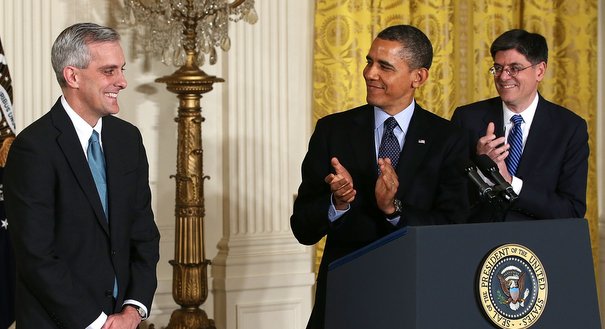
President Obama faces a series of personnel decisions that will say a great deal about the role international economics will play over the next four years.
Source: Foreign Policy

Of course, a large part of the reason the Obama team has focused heavily on domestic economic concerns is the crisis the president inherited -- one that was, in fact, the most pressing international economic issue of its day. But as the crisis was brought under control, the administration's approach grew more balanced. In fact, the Obama team has achieved more internationally than most observers have noted. Among the most important contributions of outgoing Treasury Secretary Tim Geithner, a Clinton-era veteran who grew greatly throughout his tenure in Alexander Hamilton's old job, was his willingness to candidly and actively participate in discussions surrounding the euro crisis and his efforts at building critical economic relationships with emerging powers both through the G-20 and through mechanisms like the Strategic and Economic Dialogue with China, which he co-chaired. What is more, Obama's promise to double exports within five years has been among the administration's most successful job-creation efforts, with early growth on the ambitious trajectory set by the president and overall performance approaching his targets. Meanwhile, the State Department and the White House have worked to put together support programs for countries like Egypt in order to help with the growth and job creation that are so important to stability.
Given the prospect of gradually accelerating growth at home and an extensive roster of opportunities and challenges abroad, the years ahead may create an opportunity for even more emphasis being given to international economic initiatives.
With Geithner's departure as well as that of U.S. Trade Representative (USTR) Ron Kirk and Labor Secretary Hilda Solis, the longstanding opening atop the Commerce Department, and the expected departure of Energy Secretary Steven Chu, the president faces in the next few weeks a series of personnel decisions that will say a great deal about the role international economics will play over the next four years.
The nomination of outgoing White House Chief of Staff Jack Lew to succeed Geithner sends an early signal that the president will continue to prioritize domestic economic issues, including fiscal questions. Lew, a former head of the Office of Management and Budget, is widely respected but is seen by those who have worked with him in Washington as a pick calculated to help work issues with Capitol Hill more than on the international economic stage. That said, the decision to replace Lew with Denis McDonough, the former deputy national security advisor, will place someone with acute awareness of the importance of international economic issues (especially in places where national security concerns are in play, such as the Middle East) in an even more prominent spot. Which is saying something, considering how influential the effective and smart McDonough was during the first term.
But the world will be watching for signals from the other appointments the president makes. Will USTR remain a backwater, as it has been for much of the past four years, or will it perhaps take the lead in pursuing a more activist trade agenda, perhaps including as a centerpiece initial work on a U.S.-EU trade deal? Will Commerce be at the center of the long-promised reorganization proposed by the president and championed by acting-OMB director Jeff Zients, one of Obama's most talented advisors and someone who also happens to be one of the few senior officials with real business experience? Will the administration continue to champion commercial interests overseas and the economic ties that are our most important link to most countries? Will it be able to put together international aid packages that can make a difference in stabilizing Egypt and other vital and fragile states?
Fortunately, in addition to the likes of Lew, McDonough, and Zients, the president has a very talented team already on board and capable of stepping into many of the open roles. Michael Froman, a friend of Obama from his law school days but also a former top aide to Bob Rubin, has been the president's international economic quarterback and, although behind the scenes, is recognized in capitals around the world and in business headquarters as the man to see on their most important issues. The question that has been hanging over Froman for a long time is whether he would get a cabinet post, such as USTR. Right now, the view among many of Froman's colleagues in the administration is that the job is his for the asking but that frankly, taking it might be a step down from the absolutely central role he plays on the whole range of issues in his current portfolio.
If Froman declines, current Treasury Under Secretary Lael Brainard and current Commerce Under Secretary Francisco Sánchez are reportedly in line for the USTR job. Both would bring needed diversity to the cabinet. But more importantly, both have been extremely valuable players -- Brainard running Treasury's entire international portfolio and the well-liked Sánchez, now one of the administration's top ranking Latino officials, recently having been cited by the members of the Washington International Trade Association as the trade official who deserves more recognition for his efforts on behalf of the president's export initiative. Both deserve promotions, and given Lew's need for strong international support, perhaps the best approach would be for Brainard to become deputy secretary at Treasury with Sánchez stepping in at USTR. (Please note: As of this hour, especially after my recent New York Times article suggesting the president could be a better manager than he has been by making better use of his strong team across the administration, I have yet to receive a call asking for my opinion.)
At Commerce, while Xerox CEO Ursula Burns is reportedly the leading candidate, contenders include Rebecca Blank, one of the most respected economists in the administration and someone who has developed legions of supporters for the job in her extended tenure in the "acting" secretary role. Sánchez is also seen as a contender for this job, as is Export-Import Bank CEO Fred Hochberg, who has overseen revolutionary growth at Exim, doubling loan figures and setting records throughout his tenure. (Blank, I'm told, has indicated to her team that no decisions on these key posts ought to be expected for a couple of weeks.)
I've included the Department of Energy in the list because nothing is more important to both America's economic recovery and to the world's shifting geopolitics than how the country manages the current paradigm shift in our energy supplies, available technologies, and demand, and in how they intersect with our concerns about climate. Chu was underappreciated in Washington because he was not a political animal, but no energy secretary in history has been so respected for his intellect or vision. The president is likely to replace him with a retired politician like Byron Dorgan, Jeff Bingaman, or Jennifer Granholm. But within the agency, he also has some terrific talent like Deputy Secretary Dan Poneman or, holding the international portfolio there, David Sandalow, who might also be seen as a successor to Poneman were he to move on. (Poneman, like Assistant Defense Secretary Derek Chollet, might be a solid replacement for McDonough at the NSC.)
Another key post in this mix is at the State Department, where Under Secretary for Economics Bob Hormats, who was recently described to me by a top business activist as "the one official in the administration who understands business better than any other," has led the department's efforts on initiatives from the Middle East to promoting investment in the United States. Rumor has it that incoming Secretary of State John Kerry has asked Hormats to stay on for a while. The two have a longstanding relationship, and the secretary is likely to find Hormats an exceptional asset.
Re-reading this, I'm struck by the fact that it is so broadly positive about the members of this team -- though, like any other self-respecting inside-the-Beltway commentator, I would really prefer to be more cynical and snarky. After all, beating up on the talented people who submit to the long hours and low pay of government work is our bread and butter. But the reality is that if he chooses to tap into it, the president has a first-rate group of experienced senior economic officials who are ready to help energize his international economic agenda. Now that America's domestic crisis is receding, it's time to develop the better connections to the global marketplace that will be so important to sustaining the country's growth and influence in the years ahead.
Former Visiting Scholar
David Rothkopf was a visiting scholar at the Carnegie Endowment as well as the former CEO and editor in chief of the FP Group.
Recent Work
David Rothkopf
David Rothkopf
Carnegie does not take institutional positions on public policy issues; the views represented herein are those of the author(s) and do not necessarily reflect the views of Carnegie, its staff, or its trustees.

China’s banking crisis in the 2000s was resolved by transferring the costs to households through financial repression—a decision that recapitalized the banks while exacerbating the structural imbalances that continue to shape the Chinese economy today.

Michael Pettis

But their "principal to principal" model will only be as effective as the political strength of each leader back home.

Damien Ma

U.S. unpredictability has allowed China to capitalize on its positioning as the “responsible great power”. Paradoxically, the more China wins the perception game, the more likely expectations will rise for Beijing to deliver not just words but to demonstrate with its deeds.

Chong Ja Ian

In the latest Five-Year Plan, the Chinese president cements the shift to an innovation-driven economy over a consumption-driven one.
Damien Ma

For Malaysia, the conjunction that works is “and” not “or” when it comes to the United States and China.

Elina Noor