

In The Media
Vikram Nehru
{
  "authors": [
    "Vikram Nehru"
  ],
  "type": "legacyinthemedia",
  "centerAffiliationAll": "dc",
  "centers": [
    "Carnegie Endowment for International Peace"
  ],
  "collections": [],
  "englishNewsletterAll": "asia",
  "nonEnglishNewsletterAll": "",
  "primaryCenter": "Carnegie Endowment for International Peace",
  "programAffiliation": "AP",
  "programs": [
    "Asia"
  ],
  "projects": [],
  "regions": [
    "Southeast Asia"
  ],
  "topics": [
    "Political Reform",
    "Democracy"
  ]
}
Source: Getty
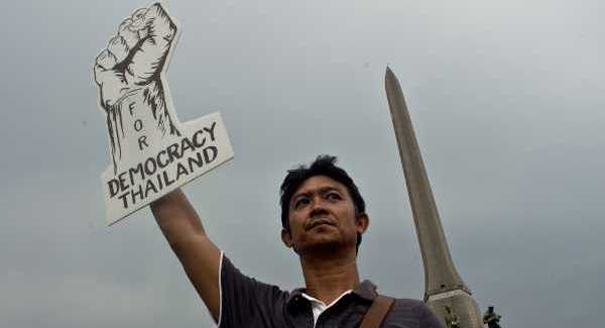
Thailand’s coup is rooted in the clash between the rising voice of the rural poor and the established power of the Bangkok elite. The resolution of this clash will determine the character of Thai democracy.
Source: Diplomat
Carnegie’s Vikram Nehru sat down with Shannon Tiezzi of the Diplomat to discuss the recent ouster of Thailand’s democratically elected government by the Thai military and constitutional court. In the interview, he explained why this coup is unique in Thailand’s long history of over a dozen coups, and examined the rising political power of the rural poor in the north and northeast of the country, the role of the monarchy in Thai politics and the coup, the implications of the coup for the region, and the steps that will be necessary to reach a democratic resolution. In particular, he emphasized the importance of ensuring political voice for both the increasingly influential rural poor and for the established Bangkok elite. How any proposed resolution handles the issue of federalism, the entrenched role of the Bangkok elite, and the establishment and entrenchment of non-partisan political institutions that stand above the fray will be the key issues to watch and will determine the nature and trajectory of Thailand’s democracy going forward, he concluded.
Former Nonresident Senior Fellow, Asia Program
Nehru was a nonresident senior fellow in the Carnegie Asia Program. An expert on development economics, growth, poverty reduction, debt sustainability, governance, and the performance and prospects of East Asia, his research focuses on the economic, political, and strategic issues confronting Asia, particularly Southeast Asia.
Recent Work
Vikram Nehru
Vikram Nehru
Carnegie does not take institutional positions on public policy issues; the views represented herein are those of the author(s) and do not necessarily reflect the views of Carnegie, its staff, or its trustees.

U.S. unpredictability has allowed China to capitalize on its positioning as the “responsible great power”. Paradoxically, the more China wins the perception game, the more likely expectations will rise for Beijing to deliver not just words but to demonstrate with its deeds.

Chong Ja Ian

Hanoi and Beijing have long treated each other as distant cousins rather than comrades in arms. That might be changing as both sides draw closer to hedge against uncertainty and America’s erratic behavior.

Nguyễn Khắc Giang

Malaysia’s chairmanship sought to fend off short-term challenges while laying the groundwork for minimizing ASEAN’s longer-term exposure to external stresses.

Elina Noor

For Malaysia, the conjunction that works is “and” not “or” when it comes to the United States and China.
Elina Noor

ASEAN needs to determine how to balance perpetuating the benefits of technology cooperation with China while mitigating the risks of getting caught in the crosshairs of U.S.-China gamesmanship.
Elina Noor