

Q&A
Matt Ferchen
{
  "authors": [
    "Matt Ferchen"
  ],
  "type": "legacyinthemedia",
  "centerAffiliationAll": "",
  "centers": [
    "Carnegie Endowment for International Peace",
    "Carnegie China"
  ],
  "collections": [
    "China and the Developing World",
    "China’s Foreign Relations"
  ],
  "englishNewsletterAll": "",
  "nonEnglishNewsletterAll": "",
  "primaryCenter": "Carnegie China",
  "programAffiliation": "",
  "programs": [],
  "projects": [],
  "regions": [
    "East Asia",
    "China"
  ],
  "topics": [
    "Economy"
  ]
}
Source: Getty
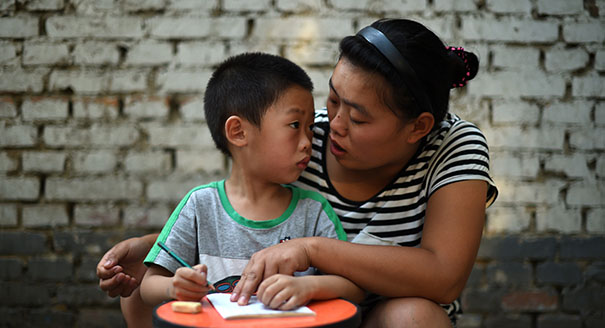
China has enjoyed decades of rapid growth, but remains a developing country where urban and rural citizens have vastly different economic opportunities and income levels.
Source: China Dialogue
The answer to whether China is still a poor country is a complicated mix of both yes and no. In terms of overall national wealth, or GDP, China now ranks either number two or number one, next to the United States. But in terms of GDP per capita, China still ranks only around number 90, reflecting China’s huge population and how far removed the average Chinese citizen’s lifestyle is from those in wealthier countries in North America and Western Europe.
Even within China itself, the answer to this question is complicated by the vast differences between those who live in the wealthier cities near the eastern coast and those who live in less affluent inland or rural parts of the country. Add to this the differences in income and lifestyle between those with the opportunity to get into the best universities, to get the best jobs in government or in business and those without such opportunities and the range of who in China is poor and who is middle class and who is rich only expands.One area where there is less debate about whether or not China is “poor” is in China’s identity on the world stage. In its foreign relations, China’s leaders have unequivocally chosen to represent China as a “developing county”. Being a developing country may not be exactly the same as being a poor country, but it certainly signals that China is a country that is not as wealthy or powerful as it would like to be.
China’s official foreign policy framework is laid out most clearly in the 2011 State Council white paper called “China’s Peaceful Development”, the title of which emphasises China’s status as a developing country and its overriding concern to continue to pursue its development aims in a way that help build and sustain a peaceful global environment. Granted, China’s developmental gains since the beginning of the Reform and Opening period in the 1980s mean that the country is vastly wealthier at home and more influential abroad than it was back then and the country’s leaders seek commensurate respect for China as a “great power” or 大国.
Even though it is clear that China’s leaders and certainly most of its people clearly identify China as a developing country, greater wealth and influence are common aspirations for the vast majority of Chinese. Not only is China’s developing country identity a source of contradiction at home, but abroad it also can create confusion. In developed countries such as the United States, many see China’s headline growth and GDP figures and see an increasingly wealthy and powerful competitor, not the poorer and weaker China of much of the past two centuries. And even in other regions such as Africa, Latin America or even Southeast Asia where there is a certain sense of admiration for China’s developmental achievements, leaders and people there see China as an increasingly rich and powerful nation.

Former Nonresident Scholar, Carnegie-Tsinghua Center for Global Policy
Ferchen specializes in China’s political-economic relations with emerging economies. At the Carnegie–Tsinghua Center for Global Policy, he ran a program on China’s economic and political relations with the developing world, including Latin America.
Recent Work
Matt Ferchen
Matt Ferchen, Anarkalee Perera

China’s banking crisis in the 2000s was resolved by transferring the costs to households through financial repression—a decision that recapitalized the banks while exacerbating the structural imbalances that continue to shape the Chinese economy today.

Michael Pettis

Chinese biotech companies have been on the receiving end of U.S. economic coercion. Yet their responses have differed significantly because firm and state interests are not uniformly aligned. For Washington, treating all Chinese tech firms the same, irrespective of their actual interests, risks pushing them farther into Beijing’s corner.

Xue Gong

China’s latest energy plan explicitly calls for integrating data centers into the electricity system, particularly connecting them to green energy. It appears Beijing wants to use compute as a source of domestic demand to absorb renewables excess capacity.

Damien Ma

But their "principal to principal" model will only be as effective as the political strength of each leader back home.
Damien Ma

U.S. unpredictability has allowed China to capitalize on its positioning as the “responsible great power”. Paradoxically, the more China wins the perception game, the more likely expectations will rise for Beijing to deliver not just words but to demonstrate with its deeds.

Chong Ja Ian