

Commentary
Malaysia’s chairmanship sought to fend off short-term challenges while laying the groundwork for minimizing ASEAN’s longer-term exposure to external stresses.
Elina Noor
{
  "authors": [
    "Paul Haenle",
    "Stephen Hadley"
  ],
  "type": "legacyinthemedia",
  "centerAffiliationAll": "dc",
  "centers": [
    "Carnegie Endowment for International Peace",
    "Carnegie China"
  ],
  "collections": [
    "U.S.-China Relations",
    "China’s Foreign Relations"
  ],
  "englishNewsletterAll": "asia",
  "nonEnglishNewsletterAll": "",
  "primaryCenter": "Carnegie China",
  "programAffiliation": "AP",
  "programs": [
    "Asia"
  ],
  "projects": [],
  "regions": [
    "North America",
    "United States",
    "East Asia",
    "China"
  ],
  "topics": [
    "Political Reform",
    "Economy",
    "Security",
    "Foreign Policy"
  ]
}
Source: Getty
The United States and China don’t agree on every issue. But in the past, the two countries have found ways to deal with their disagreements without obstructing progress in areas of common interest.
Source: Foreign Affairs
When U.S. President Barack Obama arrived at the White House in 2009, his Asia team met with its Chinese counterpart and exchanged views on how each side envisioned the bilateral relationship evolving in the years ahead. Chinese diplomats offered their suggestion: by elevating the U.S-Chinese relationship to a so-called strategic partnership, U.S. officials would show respect for China’s rising status in the world and build trust among the peoples of the two countries. Only then could Washington and Beijing begin engaging and cooperating in new and more mature ways. The Americans saw the process in reverse. The United States couldn’t agree to change the definition of the relationship until the two countries began acting and cooperating like strategic partners.
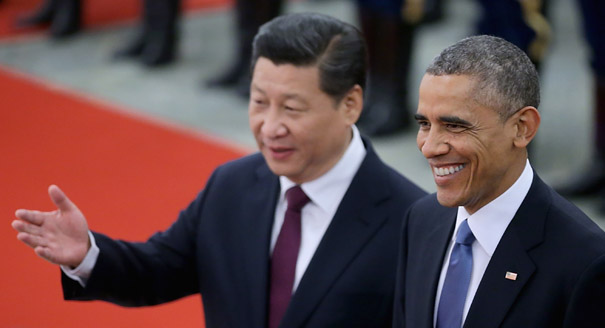
In the nearly six years since these initial conversations, this catch-22 has continued to be an obstacle in the U.S.-Chinese relationship, which is now focused on Chinese President Xi Jinping’s proposal to build a “new type of major-country relations” with the United States. When, at the no-necktie summit in California in 2013, Xi put forward the concept, he mentioned three foundational principles: no conflict and no confrontation; mutual respect, including for both countries’ core interests and major concerns; and win-win cooperation. The United States has long reiterated that the relationship should be based not on slogans but on the quality of the cooperation. Initially, however, Obama expressed a willingness to explore the proposal both because it came directly from the Chinese leader and because it aimed to address the historical tendency of destabilizing competition and war between rising and status quo powers. But China’s call for respect for core interests has been a showstopper in Washington, seen as an indication that what China really seeks is U.S. concessions on areas of long-standing disagreement between the two countries.
This is problematic for U.S. leaders, first because China’s core interests—historically Taiwan, Tibet, and Xinjiang—are nebulous and evolving. In April 2014, for example, China’s foreign ministry spokesman announced for the first time that the Diaoyu (Senkaku) islands are a core interest of China’s, although the mention was later deleted from the transcript. If that is true, the United States, by showing respect for China’s core interests, would be undermining the tenets of the U.S. alliance with Japan, which also claims those islands. Speculation that the South China Sea will be—or already has been—added to China’s list of core interests will run the United States up against the same set of problems. Further, these core interests include matters on which both countries have agreed to disagree since the normalization of bilateral relations in 1979. The idea that the starting point for a new type of major-country relations is that the United States (or China) would concede, overnight, on areas of longstanding disagreement is worrisome and unrealistic.In this context, a recent development on the Chinese side is noteworthy. At Obama and Xi’s meeting at the Great Hall of the People on November 12 last year, Xi elaborated on his definition of the new type of major-country relations by expanding the basic principles from three to six.
On the positive side, the Chinese have now included specific areas in which they are open to strategic cooperation: the Iran nuclear issue, denuclearization of the Korean Peninsula, Afghanistan, counterterrorism, climate change, and epidemic control. Much more will need to be done to flesh out the ways in which China would work with the United States on these pressing global challenges. But Washington should seize opportunities to improve the quality of cooperation and to operationalize a new model of relations—especially in areas where the United States and China can make progress that benefits the whole world. It’s likely that this addition was made in response to U.S. prodding about the two sides building cooperation in areas of common interest. The United States should see it as such and try to work with it.
On the negative side, respect for core interests was, once more, included in China’s list, although this time it was divided in two. In his new formulation, Xi’s second point called on both countries to “respect each other’s sovereign and territorial integrity.” Further down, in the fourth point, supposedly to signify a lower priority, Xi proposed that the countries “do not act against each other’s core interests.” Although these revisions are significant insofar as they demonstrate a Chinese recognition of U.S. concerns and a willingness to make adjustments to see the new type of major-power relations concept realized, they are not adequate from a U.S. perspective. The core interests clause will remain a sticking point until the language is removed or clarified completely.
Privately, Chinese experts have noted that the loaded “core interests” term is seen as a blank check in Washington and that consideration of it is, therefore, politically toxic. Any issue deemed to be a core interest of China will be inherently difficult to resolve and will require careful management over time. Focusing on these sensitive areas as the starting point for a new type of relationship could endanger the progress made by both countries in the 35 years since the establishment of formal diplomatic relations, and is therefore not a productive approach. Indeed, it is counterproductive to Chinese aims, as it would make it more difficult for U.S. leaders to work with their Chinese counterparts on the proposal and would likely cause some in the U.S. Congress and within the political system to take further steps, whether through legislation or otherwise, to push back against what may be perceived among the American public as a U.S. willingness to make concessions to the Chinese.
Certainly, no one can expect the United States and China to agree on every issue. But in the past, the two countries have found creative ways to deal with their disagreements without allowing them to obstruct progress in areas of common interest. In the 1972 Shanghai Communiqué, for example, the United States and China were able to acknowledge their different views on the issue of Taiwan without requiring either side to accept the other’s position overnight. If the Chinese side is serious about using the new type of major-country relations concept, it would do well to explore ways to gain the respect it seeks without forcing debates about sensitive areas of disagreement so deliberately. As past progress has proved, such issues are better dealt with quietly and gradually as leaders build trust. If the Chinese are unable to offer such flexibility and persistently push “core interests,” China risks the United States rejecting Xi’s proposal altogether.
If, however, Chinese leaders are willing to remove the references to core interests, U.S. leaders should not dismiss the proposal out of hand. The new type of major-country relations concept matters to the Chinese and to Xi personally. If the United States has made the strategic assessment that building a more constructive and positive relationship by enhancing cooperation on common interests is in the United States’ national security interests, and if we know that this concept is important to Chinese leaders, then in order to raise the chances that we will accomplish our own objectives, consistent with U.S. national interests, we should be open to engaging the Chinese on this idea.

Former Maurice R. Greenberg Director’s Chair, Carnegie China
Paul Haenle held the Maurice R. Greenberg Director’s Chair at the Carnegie Endowment for International Peace and is a visiting senior research fellow at the East Asian Institute, National University of Singapore. He served as the White House China director on the National Security Council staffs of former presidents George W. Bush and Barack Obama.
Stephen Hadley
Stephen Hadley is a principal of Rice, Hadley, Gates & Manuel LLC, an international strategic consulting firm founded with Condoleezza Rice, Robert Gates, and Anja Manuel. He is an Executive Vice Chair of the Board of Directors of the Atlantic Council and is also the former Board Chair of the United States Institute of Peace (USIP), where he continues to serve on the Board of Directors.
Carnegie does not take institutional positions on public policy issues; the views represented herein are those of the author(s) and do not necessarily reflect the views of Carnegie, its staff, or its trustees.

Malaysia’s chairmanship sought to fend off short-term challenges while laying the groundwork for minimizing ASEAN’s longer-term exposure to external stresses.

Elina Noor

For Malaysia, the conjunction that works is “and” not “or” when it comes to the United States and China.
Elina Noor

ASEAN needs to determine how to balance perpetuating the benefits of technology cooperation with China while mitigating the risks of getting caught in the crosshairs of U.S.-China gamesmanship.
Elina Noor
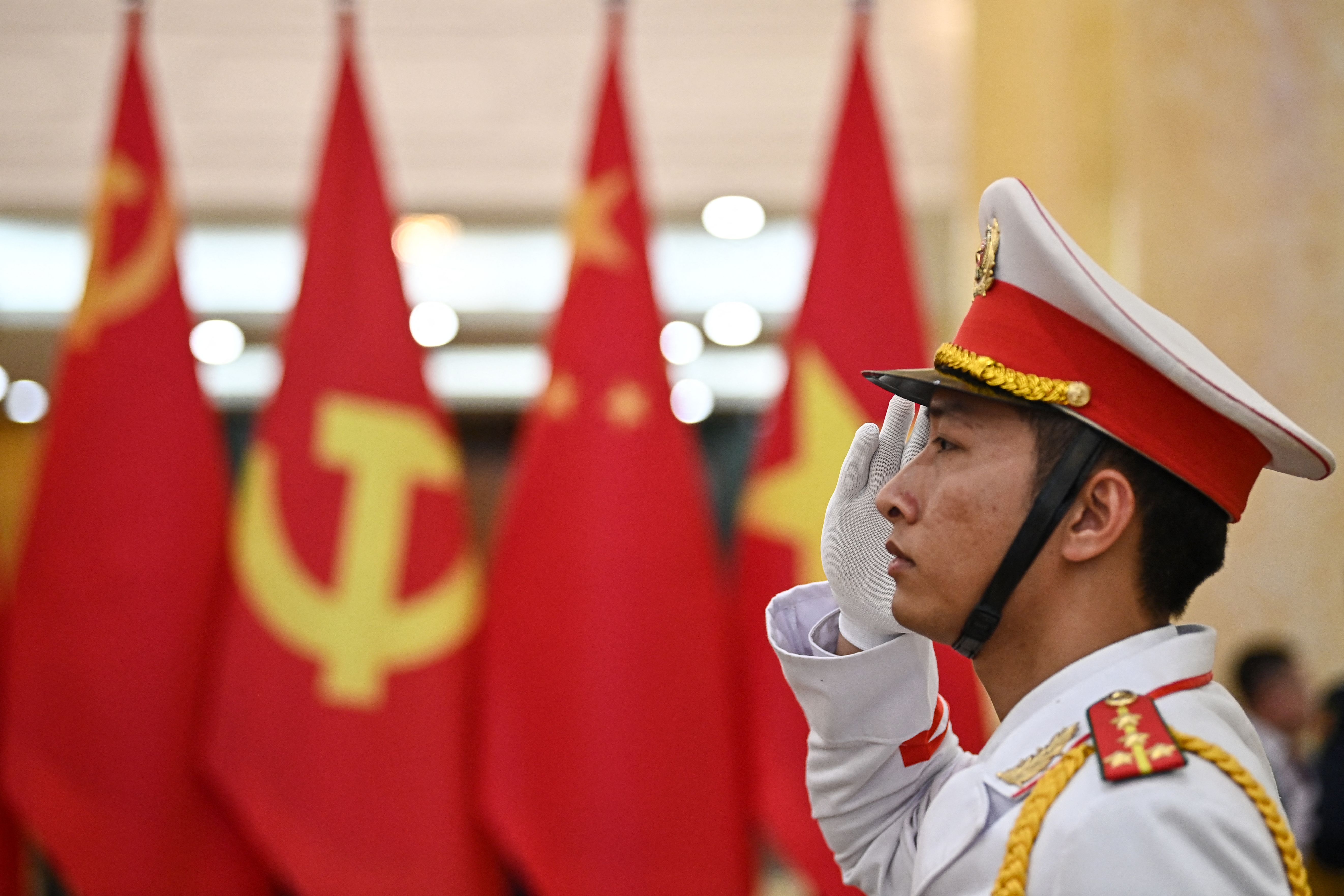
In July 2025, Vietnam and China held their first joint army drill, a modest but symbolic move reflecting Hanoi’s strategic hedging amid U.S.–China rivalry.

Nguyễn Khắc Giang

Regulation, not embargo, allows Beijing to shape how other countries and firms adapt to its terms.
Alvin Camba