

Paper
The nuclear relationship between China and the United States is increasingly shaped by widening perception gaps rather than deliberate strategic design.
Tong Zhao
{
  "authors": [
    "Alexey Arbatov"
  ],
  "type": "legacyinthemedia",
  "centerAffiliationAll": "",
  "centers": [
    "Carnegie Endowment for International Peace",
    "Carnegie Russia Eurasia Center"
  ],
  "collections": [],
  "englishNewsletterAll": "",
  "nonEnglishNewsletterAll": "",
  "primaryCenter": "Carnegie Endowment for International Peace",
  "programAffiliation": "",
  "programs": [],
  "projects": [
    "Eurasia in Transition"
  ],
  "regions": [
    "North America",
    "United States",
    "Russia",
    "Eastern Europe",
    "Ukraine"
  ],
  "topics": [
    "Security",
    "Military",
    "Foreign Policy",
    "Nuclear Policy",
    "Arms Control"
  ]
}
Source: Getty
Dialogue between Russia and the United States is needed to defuse tension and tone down irresponsible statements on both sides about nuclear weapons.
Source: Defense News
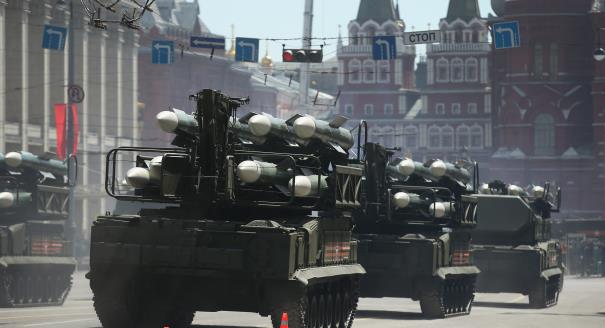
The threat of nuclear war between Russia and the West, long relegated to Cold War history, reappeared last year as the crisis in East-West relations escalated.Russian strategic bombers now fly long-range patrols near the coast of the US and its NATO allies, while Russian missile tests and military exercises involving simulated use of nuclear weapons raise the specter of nuclear war. The US responds as its defense analysts discuss options for boosting nuclear deterrence in Europe to counter Russian threats.
President Vladimir Putin unambiguously warned the West in August 2014, as the fighting raged in eastern Ukraine, not to forget that "Russia is not to be messed with. I want to remind you that Russia is one of the largest nuclear powers."
All of this has been interpreted in Europe and the US as aggressive posturing intended to intimidate the West. But inside Russia there is a different conversation. In a recent article in the highly regarded Russian defense weekly Voenno-Promyshelnnyi Kuryer (VPK) (Military Industrial Courier), prominent Russian defense expert retired Col. Mikhail Khodarenok draws alarming — for Russia — conclusions about the Russia-NATO military balance and the Russian military's prospects in a hypothetical conflict with the West. ...

Alexey Arbatov
Alexey Arbatov is the head of the Center for International Security at the Primakov National Research Institute of World Economy and International Relations.
Carnegie does not take institutional positions on public policy issues; the views represented herein are those of the author(s) and do not necessarily reflect the views of Carnegie, its staff, or its trustees.

The nuclear relationship between China and the United States is increasingly shaped by widening perception gaps rather than deliberate strategic design.

Tong Zhao

But their "principal to principal" model will only be as effective as the political strength of each leader back home.

Damien Ma

U.S. unpredictability has allowed China to capitalize on its positioning as the “responsible great power”. Paradoxically, the more China wins the perception game, the more likely expectations will rise for Beijing to deliver not just words but to demonstrate with its deeds.

Chong Ja Ian

Hanoi and Beijing have long treated each other as distant cousins rather than comrades in arms. That might be changing as both sides draw closer to hedge against uncertainty and America’s erratic behavior.

Nguyễn Khắc Giang

Across Asia, China is better positioned to withstand energy shocks from the fallout of the Iran war. Its abundant coal capacity can ensure stability in the near term. Yet at the same time, the country’s energy transition away from coal will make it even less vulnerable during the next shock.
Damien Ma