

Research
- +8
William J. Burns, Michael Chertoff, Catherine Ashton, …
{
  "authors": [
    "William J. Burns"
  ],
  "type": "legacyinthemedia",
  "centerAffiliationAll": "dc",
  "centers": [
    "Carnegie Endowment for International Peace",
    "Carnegie India"
  ],
  "collections": [],
  "englishNewsletterAll": "ctw",
  "nonEnglishNewsletterAll": "",
  "primaryCenter": "Carnegie Endowment for International Peace",
  "programAffiliation": "SAP",
  "programs": [
    "South Asia"
  ],
  "projects": [],
  "regions": [
    "North America",
    "United States",
    "South Asia",
    "India"
  ],
  "topics": [
    "Foreign Policy"
  ]
}
Source: Getty
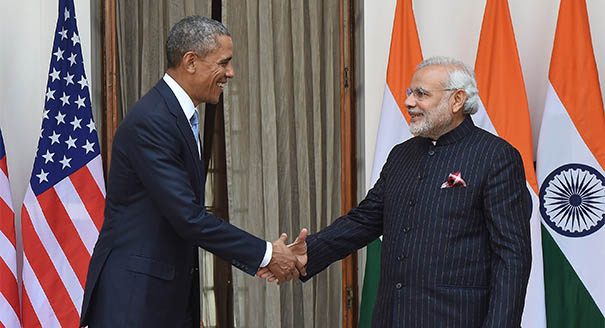
The real value of the U.S.-Indian partnership will come when both nations begin to view the other as indispensable for resolving the challenges at the core of today’s global disorder.
Source: Hindustan Times
The foundations of the global order seem increasingly unsteady. The intensity of upheavals in West Asia, Europe’s ongoing crisis, and great power competition in the Asia-Pacific, is matched only by the transformational forces rocking the global economy, climate, cyberspace, and other transnational domains.
The principal strategic task for the United States — and its partners — is to channel these forces and help shape international circumstances before other forces and events shape them for us.This should be the animating purpose of the strategic partnership between India and the US.
India’s rise is as significant a feature of today’s international landscape as any other. The same is true of its partnership with the US — a partnership between two countries that for the first time in history have a deep stake in each other’s success.
Thanks to sustained bipartisan consensus in both countries, and sustained efforts by both leaderships, the depth and breadth of today’s partnership would have been unthinkable two decades ago.
In the security realm, after years of non-alignment, India looks to the US as its largest defence supplier and both engage in more bilateral military exercises today than either does with any other country. In the economic realm, bilateral and people-to-people ties are growing tighter by the day. Two decades ago, two-way trade was at $8 billion a year. Today, it is on the verge of $100 billion. From Silicon Valley to Bengaluru and Wall Street to Mumbai, Indians and Americans are making an impact on one another and in the world.
For all the good news, both leaderships recognise that much work remains if we are to realise the full promise of this partnership. Ambitious bilateral goals — whether it is reaching $500 billion annual trade, working towards a free trade agreement, or fully integrating India into the broader Asian economic architecture — are necessary, but not sufficient.
The prerequisite to taking this leap is India’s economic revitalisation. Washington can contribute toward this by providing capital, technology, and expertise, but what New Delhi does for itself will matter far more in comparison.
If India’s economic success is substantial and sustainable, much is possible. This begins with the India-Pacific, where together India and the US can help build a regional order that protects convergent values and interests, starting with stronger engagement with Japan, Australia, and the smaller Southeast Asian states. Beyond the India-Pacific, India plays a critical role in nearly every region and issue of consequence — from the future of democracy to nuclear non-proliferation, great power politics to climate, and the impact of technological innovation on international affairs. In each of these areas and others, a common approach will be critical to enhancing the value of the strategic partnership.
For all the achievements of the past decade, it is the decade to come that will demonstrate whether the shared strategic bet will yield benefits and deliver on the two countries’ shared vision for the Pacific Century.
Former Carnegie President (2015-2021)
A former career diplomat, William J. Burns served as director of the CIA, deputy secretary of State, and ambassador to Russia and Jordan. Burns was also president of the Carnegie Endowment for International Peace from 2015 to 2021.
Recent Work
William J. Burns, Michael Chertoff, Catherine Ashton, …
William J. Burns
Carnegie does not take institutional positions on public policy issues; the views represented herein are those of the author(s) and do not necessarily reflect the views of Carnegie, its staff, or its trustees.

But their "principal to principal" model will only be as effective as the political strength of each leader back home.

Damien Ma

U.S. unpredictability has allowed China to capitalize on its positioning as the “responsible great power”. Paradoxically, the more China wins the perception game, the more likely expectations will rise for Beijing to deliver not just words but to demonstrate with its deeds.

Chong Ja Ian

Hanoi and Beijing have long treated each other as distant cousins rather than comrades in arms. That might be changing as both sides draw closer to hedge against uncertainty and America’s erratic behavior.

Nguyễn Khắc Giang

Across Asia, China is better positioned to withstand energy shocks from the fallout of the Iran war. Its abundant coal capacity can ensure stability in the near term. Yet at the same time, the country’s energy transition away from coal will make it even less vulnerable during the next shock.
Damien Ma

Malaysia’s chairmanship sought to fend off short-term challenges while laying the groundwork for minimizing ASEAN’s longer-term exposure to external stresses.

Elina Noor