Source: Washington Post
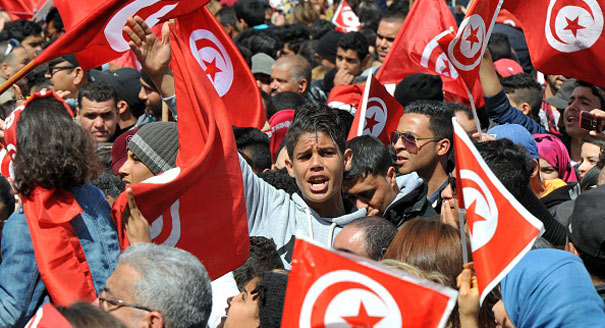
In a region full of upheaval and bloodshed, Tunisia, with its relatively peaceful transition, progressive constitution, inclusive politics, and free and fair elections, has stood as a lone shining example. Five years after igniting the Arab Awakening and inspiring the world, the bloom has come off the Jasmine Revolution. A combination of internal headwinds and regional whirlwinds are extinguishing Tunisian hopes for a consolidated new social contract. “Each of us here is a time bomb,” warned one protest organizer in the town of Kasserine.
With each passing day, disillusionment among Tunisians continues to grow, and with it grows the risk that the consensual fabric that has distinguished Tunisia from other countries in the region may tear. Even before the recent spate of
terrorist attacks and
violent protests, four out of five Tunisians said their country was headed in the
wrong direction. The tourism sector — a vital lifeline for the Tunisian economy — is
down 50 percent. Unemployment is high. Infrastructure is failing. And capital is streaming to the informal economy, depriving the state of much-needed revenue while depleting its legitimacy.
Although it has only about 11 million people and an economic output less than that of Rhode Island, Tunisia matters — to regional order, to the fate of reform and democracy in the Arab world and to the United States. Tunisia’s failure would not only dispirit all those who yearn and sacrifice for more pluralism in the Arab world. It would also send thousands more Tunisians into the arms of extremist groups and human traffickers, dealing a body blow to the fight against the Islamic State and Europe’s efforts to deal with the refugee crisis and its profound political and geopolitical consequences.
The good news is that it’s not too late to reverse Tunisia’s troubling recent trajectory.
The first step is acknowledging where Tunisians — and their international partners — have fallen short.
The hard truth is that admiration for Tunisia has yet to translate into coherent and effective international support. Deauville, the French city that hosted a major pledging conference in 2011, has become shorthand for the international community’s overpromising and grand gestures.
The real issue is not the overall amount of support, which while falling short of the mark has not been insignificant. The real issue is the mismatch between the support Tunisia has received and its real needs.
Although the revolution upgraded Tunisia’s regime hardware from an authoritarian to a democratic government, its operating system — its state institutions, laws, bureaucracies, courts and police — remained largely unchanged. These continued to serve their original function: to capture, not disperse, state resources. As a result, despite the best intentions of Tunisia’s new leadership, billions of dollars and dozens of projects never got off the ground, sending Tunisians back to the streets. This made it much more difficult for Tunisia’s leaders to get public support for necessary, if painful, economic reforms. And it shook international confidence in Tunisia and undermined efforts to generate international support.
Tunisians themselves hold significant responsibility, as well. Too little was done to uproot corruption, rebuild the brittle machinery of the state, secure gender equity, reach out to traditionally marginalized regions and groups, and make progress on a long list of critical legislative reforms. Unless Tunisians are willing to tackle these head-on, no level of international support — and no amount of reassuring gestures — will make a lasting difference.
The second step is to acknowledge that while Tunisia and its partners largely know and share a sense of the diagnoses and prescriptions for the country’s ills, they lack a mechanism for helping to turn their common agenda into results. This is why there is an urgent need to establish a new framework for partnership — a compact that couples Tunisian-led policy and bureaucratic reforms with more coordinated and concrete international assistance.
Rather than mutual cynicism and recriminations, the defining elements of this new effort should be mutual responsibility and mutual accountability, as well as pragmatism and prioritization. International partners should be prepared to implement projects and fund outstanding ones if Tunisia demonstrates a seriousness of purpose, for example by establishing a fast-track mechanism to expedite social development programs while beginning long-term bureaucratic restructuring. If Tunisia is prepared to advance public administration, investment and customs reforms, its partners should provide the necessary advice and expertise, as well as the support to cushion the inevitable dislocations this would produce. Smartly sequenced and mutually reinforcing steps can break through the bottlenecks that have inhibited progress and generate new momentum for Tunisia and, in time, for the region.
As finance and development ministers gather in Washington this week for the spring World Bank and International Monetary Fund meetings, they will undoubtedly focus their sights on the biggest global crises. They should also be sure to focus on the biggest opportunities — of which Tunisia still presents an important one. Looking ahead to the May Group of Seven summit in Japan, the U.N. General Assembly in September and a major investment conference in Tunis later in the fall, there is a real opportunity to be seized. Precisely because Tunisia can still succeed, we can’t afford to fail.
This article was originally published by the Washington Post.