

Paper
Douglas H. Paal
{
  "authors": [
    "Douglas H. Paal"
  ],
  "type": "legacyinthemedia",
  "centerAffiliationAll": "dc",
  "centers": [
    "Carnegie Endowment for International Peace",
    "Carnegie China"
  ],
  "collections": [
    "China’s Foreign Relations",
    "U.S.-China Relations"
  ],
  "englishNewsletterAll": "asia",
  "nonEnglishNewsletterAll": "",
  "primaryCenter": "Carnegie China",
  "programAffiliation": "AP",
  "programs": [
    "Asia"
  ],
  "projects": [],
  "regions": [
    "North America",
    "United States",
    "East Asia",
    "China"
  ],
  "topics": [
    "Economy",
    "Foreign Policy"
  ]
}
Source: Getty
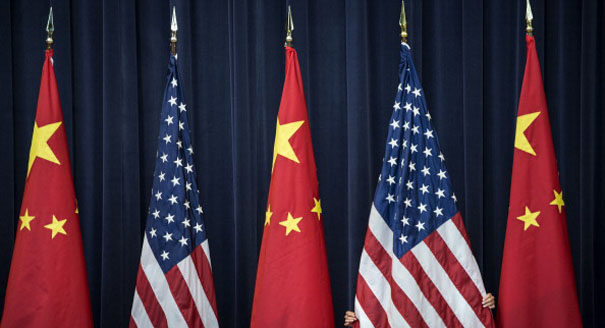
Trump’s election is an opportunity for the United States and China to construct an explicitly cooperative agenda.
Source: China Daily
The election of Donald Trump as the 45th president of the United States naturally has many observers nervous about the policy consequences. Here in the US, the reactions of many of Trump's political opponents were apoplectic at first; overseas, many are reacting to these domestic responses, and drawing dire conclusions.
The lack of deep policy debate during this presidential campaign has left many to try to weave policy interpretations together from terse sound bytes and random responses to the twists and turns of campaign politics. Therefore, it is wise to look to fundamentals rather than emotional outbursts.
Beyond questions of campaign tactics and the tone of this election, it can be said fairly that the election of Trump turned on at least several important public perceptions: Stagnation of American incomes and opportunity, perceived as coming from the unfair effects of globalization and incorrect domestic policy preferences; overextension of US military power on peripheral threats and weakness at the core; and inattention to the US' domestic economy and infrastructure.
Trump appealed to his voters by offering to negotiate better terms for America's economic and security arrangements with the rest of the world. He did not say he would isolate the US, but that as a successful businessman, he knows how to drive a better bargain.
He promised to address the gaps and shortfalls in US defenses that have developed during years of budget "sequestration". He will ask America's security partners and allies to remain together but to do more in their own defense and rely less on US security largesse. And he reflected the observable twin impulses of the American people to be less involved in non-vital domestic or regional conflicts, but also to be vigilant and effective against threats such as from the Islamic State group.
Trump has signaled his intention to stimulate the anemic US economy through, among other things, construction to repair crumbling infrastructure and new infrastructure for a 21st century economy. As a New Yorker, he knows how the city was raised to greatness in large measure through massive infrastructure improvements led by the visionary Robert Moses. It is time for a new vision. He pledges to trim back over-regulation imposed in recent years on the economy and society to find new sources of growth.
How should China react to all this? First, the dramatic redirection in US administrations is an opportunity for Beijing to reframe constructively the recent narrative in US-China relations. Since the Barack Obama administration announced its "rebalance" or "pivot" to Asia policy, the mix of competition and cooperation has steadily seen the competitive aspects, including military deployments, assume a larger role than the cooperative, such as the agreement on climate change.
Chinese observers say the "rebalance" is an attempt to contain China's rise. The recent US rhetorical focus on strengthening alliances in the western Pacific reinforced this perception.
China has responded to this in its own region with offers to help economically. This was symbolized dramatically with contracts signed for loans and infrastructure during the recent visit of Philippine President Rodrigo Duterte to Beijing. It is part of the Belt and Road Initiative (the Silk Road Economic Belt and 21st Century Maritime Silk Road) of Chinese President Xi Jinping. I call this response by Beijing the Chinese counterbalance to the American rebalance.
Beijing has accompanied this with growth of its military capabilities and activities, including the construction of artificial features in the South China Sea. But since the arbitral tribunal's award in July, Beijing has been expressing its desire "to turn the page", and the decibel levels of official pronouncements on both sides have declined.
Trump's election is an opportunity for the US and China to construct an explicitly cooperative agenda. The goal should be to establish a positive context within which to manage the inevitable strategic competition in the western Pacific.
A new approach should start with a calm effort to address specific sources of concern. On the economic side, Beijing should explain and reaffirm its own reform agenda, that as China moves up the economic ladder and consumes more, its markets will open to US exports, services and investment; it will take measures to ensure that dumping of steel and other products is not condoned; and offer credits and cooperation for the US' infrastructure revitalization.
Now that the political gridlock of recent years is about to end, China should project itself as the US' economic partner, to complement and not to compete with the American economy. And since the Trans-Pacific Partnership Agreement is in a coma, China should remind Trump of the potential to unlock opportunity with the Free Trade Area of the Asia Pacific, originally an American idea, now championed by Beijing.
On the security side, China should invite Trump to a Sunnylands-like meeting in the first six months of his term. Trump and Xi are not scheduled to attend international conferences until late in the year, too late if we are to rewrite proactively the Sino-US narrative. So Beijing should use the opportunity to manage the strategic competition and address specific challenges, such as the Democratic People's Republic of Korea's continuing serious provocations during next year's transition period in the US and possibly the Republic of Korea
These initiatives would be a welcome example of a new type of major country relationship.

Distinguished Fellow, Asia Program
Paal previously served as vice chairman of JPMorgan Chase International and as unofficial U.S. representative to Taiwan as director of the American Institute in Taiwan.
Recent Work
Douglas H. Paal

Douglas H. Paal, Tong Zhao, Chen Qi, …
Carnegie does not take institutional positions on public policy issues; the views represented herein are those of the author(s) and do not necessarily reflect the views of Carnegie, its staff, or its trustees.

The Plaza Accord was not an externally imposed punishment of Japan but part of a broader restructuring that Japanese economists and policymakers themselves recognized was necessary. Its effects were undermined, however, when Tokyo responded to the resulting slowdown with policies that exacerbated investment, credit expansion, and the very imbalances the adjustment was intended to resolve.

Michael Pettis

The nuclear relationship between China and the United States is increasingly shaped by widening perception gaps rather than deliberate strategic design.
Tong Zhao
China’s banking crisis in the 2000s was resolved by transferring the costs to households through financial repression—a decision that recapitalized the banks while exacerbating the structural imbalances that continue to shape the Chinese economy today.
Michael Pettis

Chinese biotech companies have been on the receiving end of U.S. economic coercion. Yet their responses have differed significantly because firm and state interests are not uniformly aligned. For Washington, treating all Chinese tech firms the same, irrespective of their actual interests, risks pushing them farther into Beijing’s corner.

Xue Gong

China’s latest energy plan explicitly calls for integrating data centers into the electricity system, particularly connecting them to green energy. It appears Beijing wants to use compute as a source of domestic demand to absorb renewables excess capacity.

Damien Ma