

Commentary
Maksim Samorukov
{
  "authors": [
    "Maksim Samorukov"
  ],
  "type": "commentary",
  "centerAffiliationAll": "",
  "centers": [
    "Carnegie Endowment for International Peace",
    "Carnegie Russia Eurasia Center"
  ],
  "collections": [],
  "englishNewsletterAll": "",
  "nonEnglishNewsletterAll": "",
  "primaryCenter": "Carnegie Endowment for International Peace",
  "programAffiliation": "",
  "programs": [],
  "projects": [
    "The Return of Global Russia: A Reassessment of the Kremlin’s International Agenda"
  ],
  "regions": [],
  "topics": [
    "Economy"
  ]
}
Source: Getty
Despite a large-scale visit by the Croatian leadership to Russia, we shouldn’t expect breakthroughs in bilateral collaboration, or to see Croatia turn into a close Russian ally. Sanctions, falling oil prices, and long-term stagnation in both countries can’t be overcome by presidential meetings, and real economic ties between the two countries are still modest.
Russia has accomplished a new political maneuver in the Balkans. While everyone was trying to evaluate Russia’s influence in Montenegro and Macedonia, Moscow unexpectedly began to align itself with one of the most pro-American nations in the region: Croatia.
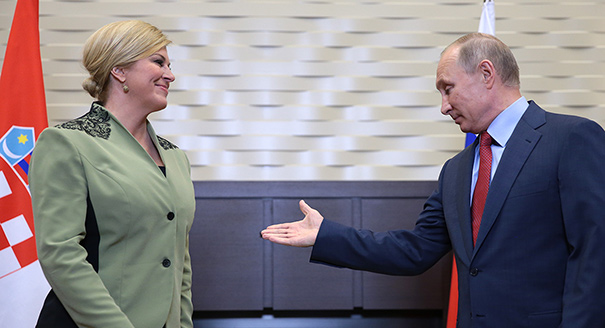
Croatian President Kolinda Grabar-Kitarović spent a full three days in Russia (October 18–20), meeting with both President Vladimir Putin and Prime Minister Dmitry Medvedev, among other senior figures. In the meantime, 150 Croatian businessmen attended a business forum in Moscow devoted to collaboration between Russia and Croatia. Such an extensive program hasn’t even been rolled out for Serbia, Russia’s closest Balkan ally.
The main event of the visit—the presidential meeting in Sochi on October 18—didn’t produce any radical results, but it wasn’t expected to. Both sides profited from the mere fact of the meeting.
The meeting helps Moscow dispel any notion of being isolated from Europe over the Ukraine crisis. Just two years ago, a report that a European leader had traveled to meet Putin would have sounded like an accusation. Now it’s just news.
A personal meeting with Putin is a temptation impossible to resist for Grabar-Kitarović, just as it is for most leaders of Central Eastern Europe. At other times, Putin is an aggressor and a tyrant who must be isolated. But the minute a personal meeting is on the books, it becomes the most important diplomatic event of the year. Who cares about isolation when they have the chance for a photo-op with Putin himself, sending the message to voters that their leader is at the center of global geopolitics?
Yes, Croatia is a parliamentary republic, and the prime minister holds more power. But President Grabar-Kitarović is a special case. Not many leaders of hard-up nations with a population of 4 million manage to hold personal meetings with the Chinese, Russian, and American leaders in the space of a few months, but Croatia’s president has done just that.
Grabar-Kitarović, who has served as minister of foreign affairs and as assistant to NATO’s secretary general, is very active in the international field. At the Sochi meeting, she even offered to act as a mediator between Russia and NATO, as she will soon travel to Washington for a meeting with U.S. President Donald Trump.
Much as both presidents love geopolitics, however, diplomatic reasons alone wouldn’t have been enough to organize such a massive visit. Another factor in Russo-Croatian relations came into play this year: the 1.3 billion euros that collapsing Croatian company Agrokor owes Russian state-controlled banks Sberbank and VTB.
Agrokor, a huge holding company mostly made up of food manufacturers and commercial chains, was created amid the turmoil of the 1990s by oligarch Ivica Todorić. By the start of 2017, Agrokor employed about 60,000 people across the Balkans, plus tens of thousands of suppliers. In total, it was responsible for about 16 percent of Croatia’s GDP. So, when Agrokor started going bankrupt in spring 2017, having failed to withstand competition from Western European chains following Croatia’s entry into the EU in 2013, the Croatian government was forced to intervene and introduce government oversight of the company.
At about this time, it emerged that Sberbank and VTB were among Agrokor’s biggest creditors, prompting fresh accusations of Russian interference in Balkan affairs. A simple comment from Sberbank—that the bank would attempt to regain its funds by all legal means—was interpreted as pressure on the Croatian government with the goal of seizing land that belonged to the holding company.
Agrokor’s fate has forced many other Croatian businesses to seriously reassess their ability to compete with Western European companies, hence the unprecedentedly large business forum in Moscow and talk of stimulating Croatian exports to Russia.
EU entry failed to boost the Croatian economy. The country’s inflation-adjusted GDP in 2016 was 8 percent lower than it was in 2008—the worst result in Central and Eastern Europe, not counting war-torn Ukraine. It’s not surprising, therefore, that having received none of the expected advantages from the EU, Croatian business has started seeking other avenues.
Traditionally, Croatia is of interest to Russia first and foremost in the field of energy. A month ago, Gazprom negotiated a new ten-year contract with Croatia to supply 1 billion cubic meters of gas per year. Russia is likewise interested in possible new contracts for modernizing electric power plants, something it already did in the 2000s. And then, of course, there’s the Kremlin’s main and seemingly eternal energy project in the Balkans: at times the South Stream gas pipeline, at others Turkish Stream. The Russian government would be pleased to see Croatia involved in either.
The Croatian government is trying hard to turn the country into a regional energy hub. Soon, construction will begin on an LNG terminal on Krk Island, a project supported by Trump himself during his July meeting with Grabar-Kitarović. Most likely, the Croatians will want to attract the attention of other large energy exporters as well, which is why some of the Russian-backed projects may be realized.
Still, we shouldn’t expect breakthroughs in bilateral collaboration, or to see Croatia turn into a close Russian ally. Sanctions, falling oil prices, and long-term stagnation in both countries can’t be overcome by presidential meetings, and real economic ties between the two countries are modest. Back in the early 2000s, Russia was among Croatia’s top three foreign trade partners, but now it accounts for just 1.5 percent.
Right now, Russia has Agrokor’s debt to Sberbank and VTB on its side. But in the current atmosphere of total war against the Kremlin’s scheming, nobody is going to let Moscow convert that into a serious strengthening of its position in Croatia. This is a commercial issue and, in some form, the money will eventually be returned. European courts even took Moscow’s side regarding loans issued to Ukraine under its former president, Viktor Yanukovych.
In addition, both Croatia’s political class and its public are wary of Russia. For them, Russians are first and foremost Serbia’s allies, and during the Ukraine crisis, Croatians aligned themselves with Kiev. Prime Minister Andrej Plenković suggested using the Croatian experience of the 1990s to regulate the conflict in Ukraine’s Donbas region, which spurred indignation from the Russian Ministry of Foreign Affairs. President Grabar-Kitarović herself has made harsh statements about Moscow’s foreign policy on a number of occasions.
The recent visit is, however, a step on the road to normalizing relations. It is an attempt to restore collaboration between the two countries to its traditional level, following the desolation of recent years. Under current conditions, that is no small thing.

Fellow, Carnegie Russia Eurasia Center
Samorukov is a fellow at the Carnegie Russia Eurasia Center.
Recent Work
Maksim Samorukov
Maksim Samorukov
Carnegie does not take institutional positions on public policy issues; the views represented herein are those of the author(s) and do not necessarily reflect the views of Carnegie, its staff, or its trustees.

China’s banking crisis in the 2000s was resolved by transferring the costs to households through financial repression—a decision that recapitalized the banks while exacerbating the structural imbalances that continue to shape the Chinese economy today.

Michael Pettis

In the latest Five-Year Plan, the Chinese president cements the shift to an innovation-driven economy over a consumption-driven one.

Damien Ma
Rather than climate ambitions, compatibility with investment and exports is why China supports both green and high-emission technologies.

Mathias Larsen
“Involution” is a new word for an old problem, and without a very different set of policies to rein it in, it is a problem that is likely to persist.
Michael Pettis

While China's investment story seems contradictory from the outside, the real answers to Beijing's high-quality growth ambitions are hiding in plain sight across the nation's cities.

Yuhan Zhang