

Commentary
But their "principal to principal" model will only be as effective as the political strength of each leader back home.
Damien Ma
{
  "authors": [
    "Richard Sokolsky",
    "Aaron David Miller"
  ],
  "type": "legacyinthemedia",
  "centerAffiliationAll": "",
  "centers": [
    "Carnegie Endowment for International Peace"
  ],
  "collections": [],
  "englishNewsletterAll": "",
  "nonEnglishNewsletterAll": "",
  "primaryCenter": "Carnegie Endowment for International Peace",
  "programAffiliation": "",
  "programs": [],
  "projects": [],
  "regions": [
    "North America",
    "United States",
    "Russia"
  ],
  "topics": [
    "Foreign Policy"
  ]
}
Source: Getty
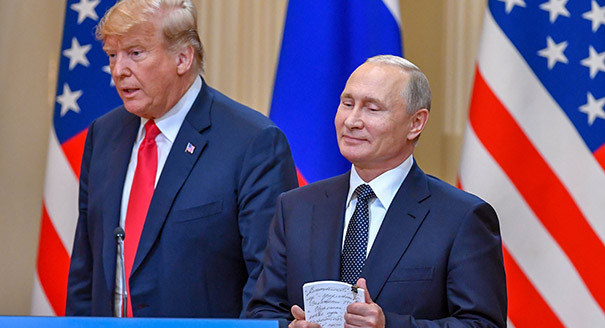
The Helsinki Summit wasn’t about foreign policy at all; it was designed to advance and protect Trump’s personal Putin agenda.
Source: USA Today
The confusion, chaos, and political firestorm generated by the Helsinki summit have hardly dissipated. Yet President Donald Trump, ever the (un)reality TV show maestro, has already announced plans for the second episode in Washington this fall.
We will spare you the suspense: Without the promise of what diplomats call “deliverables,” there's no reason for the sequel. Indeed, there are plenty of compelling reasons to cancel the show. Trump, however, has his own personal, political, and egotistical reasons for engaging Russian President Vladimir Putin; and unfortunately they have very little to do with advancing U.S. national interests.
There was no foreign policy strategy or well-defined set of objectives for the Helsinki summit. Had there been no news conference, the summit would have been shrugged off as another presidential photo-op. But Trump’s performance revealed a terrifying reality — a president incapable of seeing national interests through any filter other than his own ego, political needs and anxieties. Rather than hold Putin accountable for interfering in U.S. elections, he obsessed over Clinton’s emails and threw the U.S. Intelligence Community under a bus.
Helsinki wasn’t about foreign policy at all; it was designed to advance and protect Trump’s personal Putin agenda — either his fear that Russia has leverage over him, his clear preference for dealing with authoritarians over America’s democratic allies, or his contrarian desire to give the middle finger to all those who dared to warn him not to deal with Putin one-on-one. There’s no reason to think a reprise will be any different, particularly if, as is likely, the president has another long private meeting with Putin.
After his ill-fated encounter with Russian Premier Nikita Khruschev in June 1961, President John F. Kennedy said that "he savaged me.’’ Trump may not have known it immediately but Putin did the same to him.
The Russian president’s comment that he favored Trump over Clinton in the 2016 elections fed the narrative of Russian interference. Putin’s mastery of the issues dominated the news conference, making Trump look weak and clueless by comparison. Trump’s failure to raise publicly any of Putin’s transgressions in Ukraine and Syria and his acceptance of Putin’s denial of election interference all paint a picture of a groveling American leader eager to suck up to rather than stand up to Putin.
For those keeping score, Trump treated Putin and Russia as America’s equal; ameliorated Russia’s isolation; created the clear sense that he preferred the Russian leader to America’s traditional allies; and got nothing in return other than an agreement to begin regular working level dialogues on a range of issues — something that could have been arranged in a phone call or exchange of letters between the two leaders. When Putin handed Trump the World Cup soccer ball, quipping, "the ball is in your court," that said it all.
Trump’s desire to improve U.S.-Russian relations is understandable; they are the worst in post-Cold War history and the two countries have important shared interests to advance — combating the proliferation of weapons of mass destruction, global terrorism and Islamic Jihadism and further reducing nuclear weapons — and differences to manage, notably over Ukraine and Syria. And then of course there is Putin’s enduring desire to undermine democracy in America and among its allies, to sow discord within NATO and to enervate the EU — an agenda that Trump, incomprehensibly, appears to embrace.
In a normal administration, with a president focused on the national interest and demanding serious planning and preparations by a well-oiled bureaucratic machinery, summits can be productive. But in the bizarro world of the Trump administration, there is little evidence to suggest that the dysfunctional national security team has the discipline or the organization to do serious summit preparations and planning for Summit II.
Moreover, Trump's notions of a U.S.-Russian détente are completely at odds with the reality that the bureaucracy, Congress, the news media and the Washington foreign policy establishment intensely dislike what they see as Trump’s appeasement of Putin. And the two sides are far apart in their positions on Ukraine, Syria, and NATO activities in eastern Europe.
A sequel summit might make progress on nuclear arms control and specifically extending the duration of the New START treaty that expires in 2021. But it is hard to escape the conclusion that Trump, furious and flummoxed over the unremitting bipartisan criticism and negative public reaction to his Helsinki performance, wants another chance to demonstrate both that he doesn’t give a damn about his critics and that he can hold his own with the cagey Putin on the world stage.
Vanity and personal vulnerability are driving Trump’s Russia policy, not sound strategy. And that’s very bad for America and anyone who cares about the nation’s security at home and abroad.
Nonresident Senior Fellow, Russia and Eurasia Program
Richard Sokolsky is a nonresident senior fellow in Carnegie’s Russia and Eurasia Program. His work focuses on U.S. policy toward Russia in the wake of the Ukraine crisis.

Senior Fellow, American Statecraft Program
Aaron David Miller is a senior fellow at the Carnegie Endowment for International Peace, focusing on U.S. foreign policy.
Carnegie does not take institutional positions on public policy issues; the views represented herein are those of the author(s) and do not necessarily reflect the views of Carnegie, its staff, or its trustees.

But their "principal to principal" model will only be as effective as the political strength of each leader back home.

Damien Ma

U.S. unpredictability has allowed China to capitalize on its positioning as the “responsible great power”. Paradoxically, the more China wins the perception game, the more likely expectations will rise for Beijing to deliver not just words but to demonstrate with its deeds.

Chong Ja Ian

Hanoi and Beijing have long treated each other as distant cousins rather than comrades in arms. That might be changing as both sides draw closer to hedge against uncertainty and America’s erratic behavior.

Nguyễn Khắc Giang

Across Asia, China is better positioned to withstand energy shocks from the fallout of the Iran war. Its abundant coal capacity can ensure stability in the near term. Yet at the same time, the country’s energy transition away from coal will make it even less vulnerable during the next shock.
Damien Ma

Malaysia’s chairmanship sought to fend off short-term challenges while laying the groundwork for minimizing ASEAN’s longer-term exposure to external stresses.

Elina Noor