

Article
Paul Stronski
{
  "authors": [
    "Paul Stronski"
  ],
  "type": "legacyinthemedia",
  "centerAffiliationAll": "dc",
  "centers": [
    "Carnegie Endowment for International Peace"
  ],
  "collections": [],
  "englishNewsletterAll": "ctw",
  "nonEnglishNewsletterAll": "",
  "primaryCenter": "Carnegie Endowment for International Peace",
  "programAffiliation": "russia",
  "programs": [
    "Russia and Eurasia"
  ],
  "projects": [],
  "regions": [
    "North America",
    "United States",
    "Russia"
  ],
  "topics": [
    "Foreign Policy"
  ]
}
Source: Getty
A conciliatory approach with Russia has not worked out for the past three U.S. presidents or a long list of European leaders, and it likely won’t for Trump either.
Source: Axios
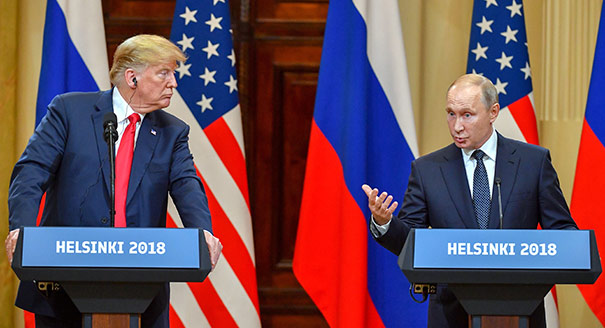
Next week's Helsinki summit poses the risk that President Trump could make a rash offer to Vladimir Putin in an attempt to improve U.S.–Russian relations. It's possible he might recognize Moscow’s annexation of Crimea, assent to Syrian President Assad’s continued rule or waver on America’s commitment to NATO.
The big picture: As much as Trump may want to turn the page with Putin, his recent call for a one-on-one meeting without aides is risky. Putin is a shrewd negotiator. A conciliatory approach with Russia has not worked out for the past three American presidents or a long list of European leaders, and it likely won't for Trump either.
Putin has been playing leaders for years:
Trump wants splashy deliverables to show he can go toe-to-toe with Putin on the global stage. But instead of agreeing to whatever Putin wants on Ukraine or Syria for the sake of a deal, Trump should articulate a vision for how his administration plans to secure U.S. interests vis-à-vis Russia. Reviving arms-control discussions or agreeing to increase educational, cultural and scientific exchanges would be good places to start. Both would help rebuild trust and lay the groundwork for future improvements in relations.
The bottom line: Trump boasts of not “preparing very much” for high-stakes diplomacy — an approach that has not secured results with North Korea's denuclearization. To avoid getting played again, he should approach the Helsinki summit with concrete objectives to avoid improvising a costly deal.
Former Senior Fellow, Russia and Eurasia Program
Paul Stronski was a senior fellow in Carnegie’s Russia and Eurasia Program, where his research focuses on the relationship between Russia and neighboring countries in Central Asia and the South Caucasus.
Recent Work
Paul Stronski
Paul Stronski
Carnegie does not take institutional positions on public policy issues; the views represented herein are those of the author(s) and do not necessarily reflect the views of Carnegie, its staff, or its trustees.

But their "principal to principal" model will only be as effective as the political strength of each leader back home.

Damien Ma

U.S. unpredictability has allowed China to capitalize on its positioning as the “responsible great power”. Paradoxically, the more China wins the perception game, the more likely expectations will rise for Beijing to deliver not just words but to demonstrate with its deeds.

Chong Ja Ian

Hanoi and Beijing have long treated each other as distant cousins rather than comrades in arms. That might be changing as both sides draw closer to hedge against uncertainty and America’s erratic behavior.

Nguyễn Khắc Giang

Across Asia, China is better positioned to withstand energy shocks from the fallout of the Iran war. Its abundant coal capacity can ensure stability in the near term. Yet at the same time, the country’s energy transition away from coal will make it even less vulnerable during the next shock.
Damien Ma

Malaysia’s chairmanship sought to fend off short-term challenges while laying the groundwork for minimizing ASEAN’s longer-term exposure to external stresses.

Elina Noor