

Commentary
Andrei Kolesnikov
{
  "authors": [
    "Andrei Kolesnikov"
  ],
  "type": "commentary",
  "centerAffiliationAll": "",
  "centers": [
    "Carnegie Endowment for International Peace",
    "Carnegie Russia Eurasia Center"
  ],
  "collections": [
    "Inside Russia"
  ],
  "englishNewsletterAll": "",
  "nonEnglishNewsletterAll": "",
  "primaryCenter": "Carnegie Endowment for International Peace",
  "programAffiliation": "",
  "programs": [],
  "projects": [],
  "regions": [],
  "topics": [
    "Economy"
  ]
}
Source: Getty
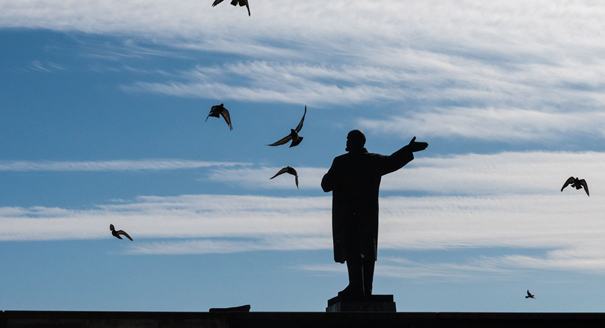
A protest vote is growing in Russia. But this is not a pivot toward socialism; rather, it is an expression of anger that the government has torn up the Putin-era social contract.
A specter is haunting Russia—the specter of Communism. But this time, unlike in Karl Marx’s original formulation, the specter is really dead. We often hear that Russian politics is making an inevitable pivot to the left, and that the political system needs to reinvent itself to find room for a genuinely left-wing party. But all that talk is only preparing everyone for yesterday’s war. The fight is now elsewhere.
Of course, Russians are unhappy with issues, such as the rise in the retirement age. They are expressing their outrage where they can, for example, by supporting Communist Party and far-right LDPR candidates at the recent regional elections. But we should not confuse left-leaning protest with an appetite for socialist revolution.
The success of opposition candidates in September’s regional elections across Russia was much more a vote against the Kremlin-backed ruling party, United Russia, than in favor of the Communists. It wasn’t just that people were angry with the government about its pension reforms; they were angry that the government had revoked a fundamental item in the unwritten Putin-era social contract—do not touch the social benefits system.
Paradoxically, United Russia’s ratings are falling, but the left is not gaining popularity at its expense. According to a Levada Center poll, 37 percent of the voters were ready to vote for United Russia in December 2017, but only 28 percent supported the party in August 2018. And yet support for the left-leaning Communist Party and A Just Russia Party remained the same—9 percent and 3 percent, respectively. The LDPR’s poll numbers haven’t changed either—they were around 11 percent.
This suggests that we aren’t witnessing the growing demand for a party of the left, but a more general crisis of the party system. In December 2017, 17 percent of respondents said they wouldn’t vote at all, and that number had increased to 22 percent by August 2018. In the most recent poll, a further 7 percent of those who decided to come to the polls said they would invalidate or spoil their ballots.
Trust ratings for political parties in Russia are also extremely low, occupying the 18 position in a list of 19 institutions—only Russia’s largest companies fare worse in public opinion. Of course, this stems in large part from the fact that the genuine party system has long been dead, and what we currently have is a menu where there is nothing interesting for the voter to choose from. This problem won’t be solved by the government deciding to form new pseudo-parties. It is not new parties or ideologies that people want.
The Russian public wants social justice, but its political enthusiasm is dulled by an absence of political and economic competition and, in particular, a lack of new faces.
People want change. In August 2017, Denis Volkov of the Levada Center and I did some research on people’s readiness for change. Forty-two percent supported radical change, while 41 percent were in favor of gradual change. In May 2018, the Levada Center repeated the same question—“What kind of change do you want?”—to the same pool of respondents across Russia. The number of those wanting radical change had shot up to 57 percent, while only 25 percent of the respondents said they wanted to see incremental change.
A closer look reveals that the “radicals” are very unclear about what they actually want, beyond a general craving for fundamental change. People simply want to escape a Bermuda Triangle of inflation, low earnings, and the risks of unemployment. They would be happy for the banner of change to be held aloft by Putin, former finance minister Alexei Kudrin, or Communist Party leader Gennady Zyuganov—or Stalin, for that matter.
Many of these same people voted for Putin in the presidential election earlier this year; however, they voted for him not as such but in the role of Mr. It-Shouldn’t-Get-Worse. For people with low expectations, “not worse” is synonymous with “better.” Yet the public mood has been soured by the recent social initiatives. This is a perfectly rational reaction to a situation where they see the state filling its own coffers while fueling social inequality. If, the reasoning goes, the taxes the government extracts from the people can be used to finance anything, including an impending arms race with the United States, how can the public be expected to trust any state-sponsored project, including the one introducing a new party?
The new grassroots demand for change has been described as populist. It has similarities to what is happening in Europe: left-wing political parties are being displaced by populist movements and leaders who manage to utilize both left-wing and right-wing discourse in their rhetoric.
In Russia, the new craving for change is not clearly articulated. It lacks a leader, organization, and ideological coloring. But it is hard to pin the “populist” label on people who are only demanding a minimal degree of justice from a political system that at best works inefficiently and frequently works to enrich itself by spending the money it collects from the people merely to buy back their loyalty. A political system like this is internally redundant.
But the malady can be cured. A double dose of the medicine of “competition and rotation” can at least help the patient to get over his depression—unless, of course, the aim of the government is to artificially maintain the patient in that condition.
Former Senior Fellow, Carnegie Russia Eurasia Center
Kolesnikov was a senior fellow at the Carnegie Russia Eurasia Center.
Recent Work
Andrei Kolesnikov
Andrei Kolesnikov
Carnegie does not take institutional positions on public policy issues; the views represented herein are those of the author(s) and do not necessarily reflect the views of Carnegie, its staff, or its trustees.

The Plaza Accord was not an externally imposed punishment of Japan but part of a broader restructuring that Japanese economists and policymakers themselves recognized was necessary. Its effects were undermined, however, when Tokyo responded to the resulting slowdown with policies that exacerbated investment, credit expansion, and the very imbalances the adjustment was intended to resolve.

Michael Pettis
China’s banking crisis in the 2000s was resolved by transferring the costs to households through financial repression—a decision that recapitalized the banks while exacerbating the structural imbalances that continue to shape the Chinese economy today.
Michael Pettis

In the latest Five-Year Plan, the Chinese president cements the shift to an innovation-driven economy over a consumption-driven one.

Damien Ma
Rather than climate ambitions, compatibility with investment and exports is why China supports both green and high-emission technologies.

Mathias Larsen
“Involution” is a new word for an old problem, and without a very different set of policies to rein it in, it is a problem that is likely to persist.
Michael Pettis