

Paper
James M. Acton, Ankit Panda
{
  "authors": [
    "James M. Acton"
  ],
  "type": "other",
  "centerAffiliationAll": "dc",
  "centers": [
    "Carnegie Endowment for International Peace"
  ],
  "collections": [
    "Entanglement"
  ],
  "englishNewsletterAll": "ctw",
  "nonEnglishNewsletterAll": "",
  "primaryCenter": "Carnegie Endowment for International Peace",
  "programAffiliation": "NPP",
  "programs": [
    "Nuclear Policy"
  ],
  "projects": [],
  "regions": [],
  "topics": [
    "Nuclear Policy",
    "Arms Control"
  ]
}
Source: Getty
The future risks of inadvertent escalation due to entangled conventional and nuclear systems will depend on broader geopolitical developments, advances in non-nuclear weapons, changes in states’ military doctrines, and whether states can implement risk mitigation measures.
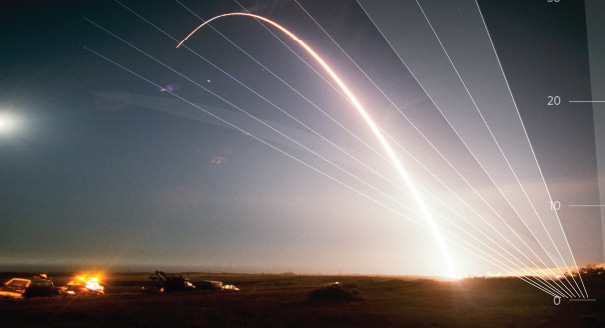
Source: Nautilus Institute/Technology for Global Security
In a conventional conflict between the United States and China or Russia, each belligerent might attack the other’s command, control, communication, and intelligence (C3I) capabilities to gain a warfighting advantage. However, because a number of C3I assets are dual-use, such attacks would degrade the target’s nuclear command-and-control system, creating serious risks of inadvertent escalation. Looking forward, at least four factors will influence the severity of the risks created by such entanglement.
First, geopolitical developments will have indirect effects, including altering (for better or worse) the likelihood of war. Second, improvements in nonnuclear weapons, such as the development of long-range hypersonic gliders, could increase the threat posed to nuclear C3I capabilities. Moreover, because early-warning assets involved in nuclear operations might be able to track such weapons, they could become more likely to be subject to attack. Third, states’ conventional or nuclear doctrines could change, including by increasing or reducing the role accorded to attacks on C3I assets. Finally, unilateral or cooperative risk-mitigation measures could be implemented. Unilateral measures are the most promising under current political circumstances and could be as simple as raising awareness of the risks associated with entanglement within defense and military establishments.

Jessica T. Mathews Chair, Co-director, Nuclear Policy Program
Acton holds the Jessica T. Mathews Chair and is co-director of the Nuclear Policy Program at the Carnegie Endowment for International Peace.
Recent Work

James M. Acton, Ankit Panda
James M. Acton
Carnegie does not take institutional positions on public policy issues; the views represented herein are those of the author(s) and do not necessarily reflect the views of Carnegie, its staff, or its trustees.

Faced with an increase in strategic maneuvering by Moscow and Pyongyang, Beijing will not sit idly by and allow Putin and Kim to shape the security environment on its behalf.

Tong Zhao

China views U.S. missile defense as posing a greater potential threat to China’s nuclear deterrent than other U.S. military capabilities.
Tong Zhao, Dmitry Stefanovich
There are certainly other issues among other P5 countries, but the U.S.-China competition is so by far the most consequential great power rivalry in the international system, and it has very far-reaching geopolitical implications at and beyond the Pacific region.
Tong Zhao

Satellite data has revealed the construction of new nuclear missile silos in Gansu and Xinjiang in western China. How U.S. and Chinese experts interpret the buildup and the motivations behind it could greatly reshape their security relationship.
Tong Zhao
There are three guiding principles that can help make future arms control dialogues more successful.

Andrey Baklitskiy, Alexandra Bell, Tong Zhao