

Q&A
Paul Haenle, Philippe Le Corre
{
  "authors": [
    "Philippe Le Corre"
  ],
  "type": "other",
  "centerAffiliationAll": "dc",
  "centers": [
    "Carnegie Endowment for International Peace"
  ],
  "collections": [],
  "englishNewsletterAll": "asia",
  "nonEnglishNewsletterAll": "",
  "primaryCenter": "Carnegie Endowment for International Peace",
  "programAffiliation": "AP",
  "programs": [
    "Asia"
  ],
  "projects": [],
  "regions": [
    "East Asia",
    "China",
    "Western Europe"
  ],
  "topics": [
    "Foreign Policy"
  ]
}
Source: Getty
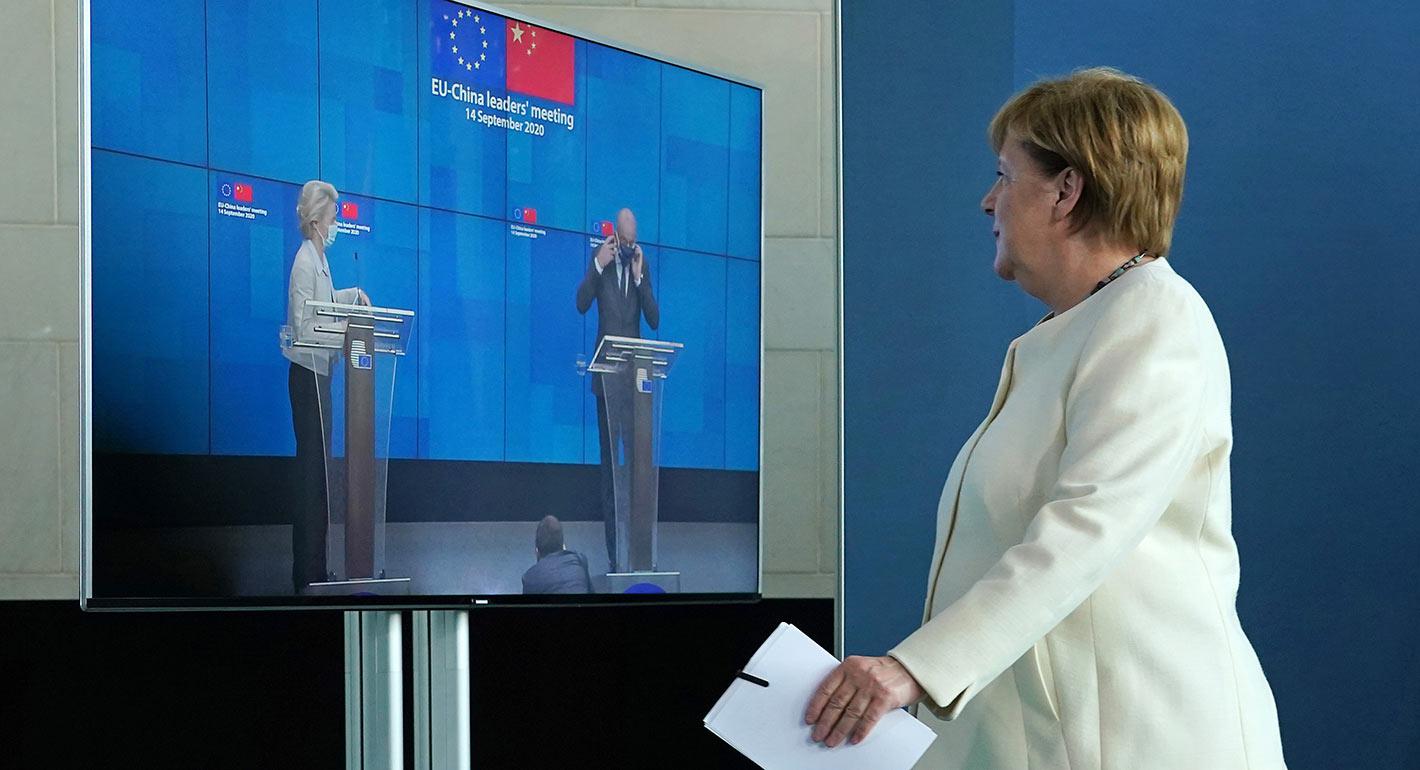
Despite China’s apparent enthusiasm, the “year of Sino-European friendship” has brought more challenges than successes, due to a mix of promise fatigue on the European side; growing Chinese assertiveness on the international stage; and increasing Chinese propaganda and controversies around the Covid-19 pandemic.
Source: Echo Wall
Both China and the European Union enjoy anniversary years, and 2020, marking the 45th anniversary of their diplomatic relations, was meant to be a special one. From early 2019, Chinese government think-tanks and media started publishing lengthy reports on the state of the EU and its members, praising a flourishing bilateral relationship and calling for further steps. Chinese analysts were especially keen on stressing that relations with China’s largest export market were at their height – quite unlike the Sino-American relationship, which had sunk into acrimony under the Trump administration.
Despite China’s apparent enthusiasm, the “year of Sino-European friendship” has brought more challenges than successes, due to a mix of promise fatigue on the European side (with regard to a better access to the Chinese market for European companies in particular); growing Chinese assertiveness on the international stage; and increasing Chinese propaganda and controversies around the Covid-19 pandemic. In addition, Europeans have started to realize that China is not just an aspiring global power, it has become one. President Xi Jinping’s assertion that, “This new era will see China moving closer to center stage and making greater contributions to mankind,” has turned into reality. China has in fact already moved to center stage. In a year marked by a global pandemic, however, China’s double approach towards the EU and its members has thus far been unsuccessful.
Former Nonresident Senior Fellow, Europe Program
Philippe Le Corre was a nonresident senior fellow in the Europe Program at the Carnegie Endowment for International Peace.
Recent Work

Paul Haenle, Philippe Le Corre


Erik Brattberg, Philippe Le Corre, Paul Stronski, …
Carnegie does not take institutional positions on public policy issues; the views represented herein are those of the author(s) and do not necessarily reflect the views of Carnegie, its staff, or its trustees.

China’s banking crisis in the 2000s was resolved by transferring the costs to households through financial repression—a decision that recapitalized the banks while exacerbating the structural imbalances that continue to shape the Chinese economy today.

Michael Pettis

Chinese biotech companies have been on the receiving end of U.S. economic coercion. Yet their responses have differed significantly because firm and state interests are not uniformly aligned. For Washington, treating all Chinese tech firms the same, irrespective of their actual interests, risks pushing them farther into Beijing’s corner.

Xue Gong

China’s latest energy plan explicitly calls for integrating data centers into the electricity system, particularly connecting them to green energy. It appears Beijing wants to use compute as a source of domestic demand to absorb renewables excess capacity.

Damien Ma

But their "principal to principal" model will only be as effective as the political strength of each leader back home.
Damien Ma

U.S. unpredictability has allowed China to capitalize on its positioning as the “responsible great power”. Paradoxically, the more China wins the perception game, the more likely expectations will rise for Beijing to deliver not just words but to demonstrate with its deeds.

Chong Ja Ian