• Commentary
  • Research
  • Experts
  • Events
Carnegie China logoCarnegie lettermark logo
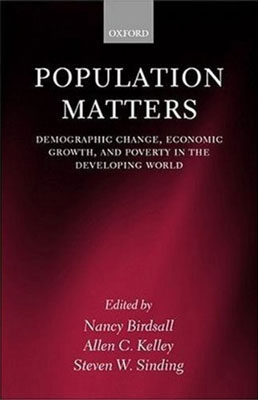
Population Matters: Demographic Change, Economic Growth, and Poverty in the Developing World
Book

Population Matters: Demographic Change, Economic Growth, and Poverty in the Developing World

The effect of demography on economic performance has been the subject of intense debate in economics for nearly two centuries. In recent years opinion has swung between the Malthusian views of Coale and Hoover, and the cornucopian views of Julian Simon.

Link Copied
By Nancy Birdsall, Allen Kelley, Stephen Sinding
Published on Sep 27, 2001

Additional Links

Table of Contents

Source: Carnegie

The effect of demography on economic performance has been the subject of intense debate in economics for nearly two centuries. In recent years opinion has swung between the Malthusian views of Coale and Hoover, and the cornucopian views of Julian Simon. Unfortunately, until recently, data were too weak and analytical models too limited to provide clear insights into the relationship. As a result economists as a group have not been clear or conclusive.

This volume, based on a collection of papers that heavily rely on data from the 1980s and 1990s and on new analytical approaches, sheds important new light on demographic-economic relationships, and it provides clearer policy conclusions than any recent work on the subject. In particular, evidence from developing countries throughout the world shows a pattern in recent decades that was not evident earlier: countries with higher rates of population growth have tended to see less economic growth. An analysis of the role of demography in the 'Asian economic miracle' strongly suggests that changes in age structures resulting from declining fertility create a one-time 'demographic gift' or window of opportunity, when the working age population has relatively few dependents, of either young or old age, to support. Countries which recognize and seize on this opportunity can, as the Asian tigers did, realize healthy bursts in economic output. But such results are by no means assured: only for countries with otherwise sound economic policies will the window of opportunity yield such dramatic results. Finally, several of the studies demonstrate the likelihood of a causal relationship between high fertility and poverty. While the direction of causality is not always clear and very likely is reciprocal (poverty contributes to high fertility and high fertility reinforces poverty), the studies support the view that lower fertility at the country level helps create a path out of poverty for many families.

Population Matters represents an important further step in our understanding of the contribution of population change to economic performance. As such, it will be a useful volume for policymakers both in developing countries and in international development agencies.

To order a copy of this book, please contact Oxford University Press at: book.orders@oup.co.uk 

About the Authors

Nancy Birdsall

Former Senior Associate

Allen Kelley

Stephen Sinding

Authors

Nancy Birdsall
Former Senior Associate
Allen Kelley
Stephen Sinding
EconomyTrade

Carnegie does not take institutional positions on public policy issues; the views represented herein are those of the author(s) and do not necessarily reflect the views of Carnegie, its staff, or its trustees.

More Work from Carnegie China

  • Commentary
    Today’s Rare Earths Conflict Echoes the 1973 Oil Crisis — But It’s Not the Same

    Regulation, not embargo, allows Beijing to shape how other countries and firms adapt to its terms.

      Alvin Camba

  • Commentary
    How China’s Growth Model Determines Its Climate Performance

    Rather than climate ambitions, compatibility with investment and exports is why China supports both green and high-emission technologies.

      Mathias Larsen

  • Overproduction in China
    Commentary
    What’s New about Involution?

    “Involution” is a new word for an old problem, and without a very different set of policies to rein it in, it is a problem that is likely to persist.

      Michael Pettis

  • Commentary
    The Chinese Investment Riddle: What Cities Reveal

    While China's investment story seems contradictory from the outside, the real answers to Beijing's high-quality growth ambitions are hiding in plain sight across the nation's cities.

      Yuhan Zhang

  • Commentary
    Using China’s Central Government Balance Sheet to “Clean up” Local Government Debt Is a Bad Idea

    China's stimulus addiction cannot go on forever. Beijing still has policy space to clean up the country's massive debt issue, but time is running short.

      Michael Pettis

Get more news and analysis from
Carnegie China
Carnegie China logo, white
Keck Seng Tower133 Cecil Street #10-01ASingapore, 069535
  • Research
  • About
  • Experts
  • Events
  • Contact
  • Careers
  • Privacy
  • For Media
Get more news and analysis from
Carnegie China
© 2026 Carnegie Endowment for International Peace. All rights reserved.