Source: The Paper
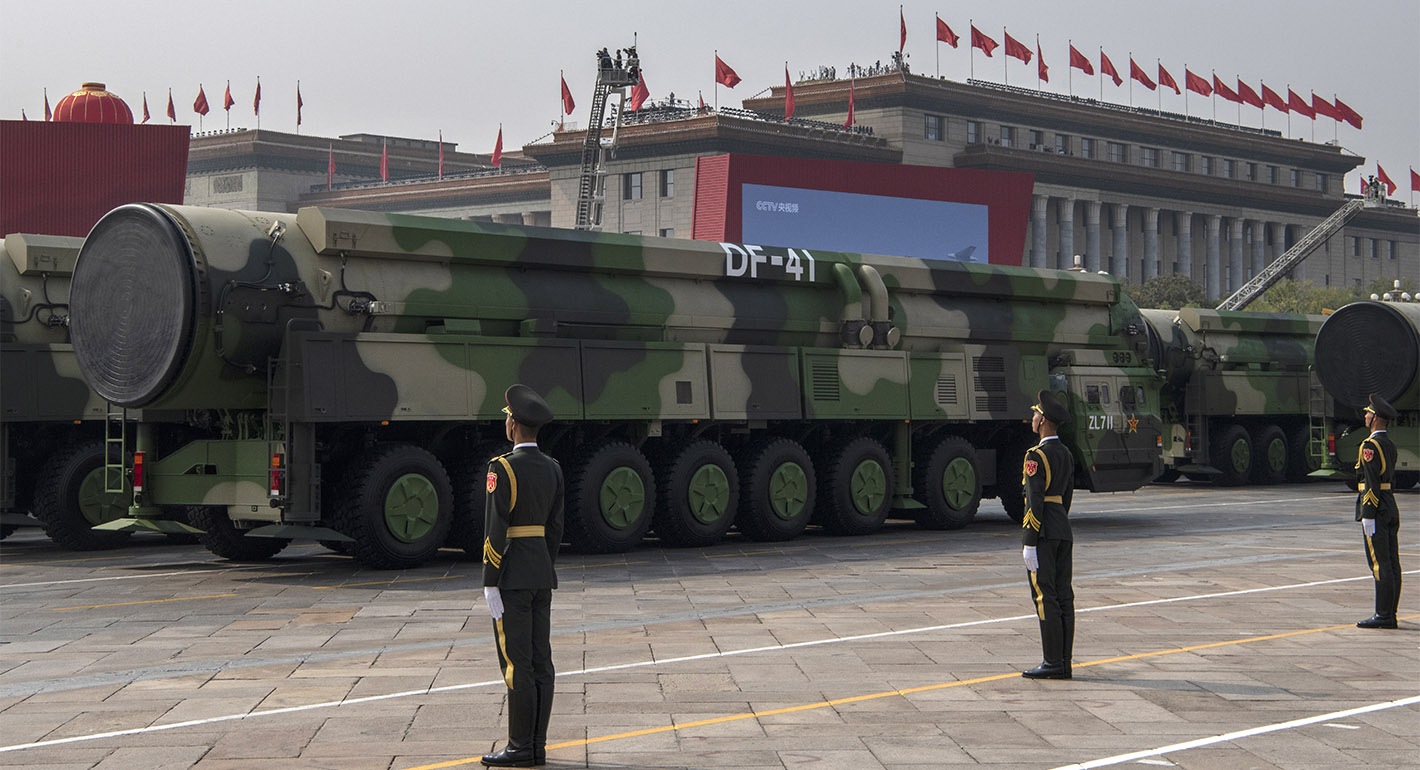
In the lead up to and after China’s National Day military parade on October 1, a number of journalists asked me how China’s strategic nuclear forces compare to those of other countries. This is a difficult question to answer. The founders of the People’s Republic of China said early on that, “you fight your way and I fight my way,” and “we do not compare our treasures to those of the Dragon King (who is the richest).” Because the needs of every country vary according to their situations and strategies, it is difficult to make simple comparisons of their respective advantages.
In this article, I am going to use MIRVs, (Multiple Independently Targetable Reentry Vehicles), which can carry several warheads, as an example to list some of my thoughts on this matter.
Beijing’s purpose in developing nuclear weapons is to dissuade its opponents from launching nuclear strikes against China and to avoid nuclear threats to the country by establishing a retaliatory nuclear capability. If China’s retaliatory capability were negligible, Beijing would find itself in a troublesome situation: the situation could lead opponents to be opportunistic and think that, if they strike China a bit harder, they will be able to offset China’s nuclear retaliatory capabilities.
China has three basic paths towards strengthening its nuclear retaliatory capacity: It can strengthen the survivability of its nuclear weapons, increase their numbers, or strengthen its missiles’ capacity to penetrate missile defense systems. It could also opt for various combinations of these three paths.
If China chooses to build an appropriate number of nuclear weapons to strengthen its retaliatory capability, then this path can be divided into two sub-paths: It can either increase the number of delivery systems or build delivery systems that can carry a greater number of warheads. It could also opt for a combination of these two strategies.
If we increase the number of warheads per missile, then this would clearly increase our nuclear strike capability. However, it would also increase the value of striking each MIRVed missile for China’s opponents. Should an opponent launch a preemptive strike and succeed in destroying a delivery system carrying a single warhead, then they would only eliminate that one warhead. Should they succeed in destroying a MIRVed missile, then they could eliminate a large number of warheads with a single strike. Hence, deploying MIRVs can increase the efficiency of a preemptive strike, giving an opponent all the more reason to consider one.
Deploying several warheads on a single delivery system is like putting many of your eggs in one basket. Thus, when the risk of an incoming attack increases, decisionmakers will be under pressure to use their MIRVed missiles as early as possible to prevent their baskets, and their eggs, from being destroyed. However, if their eggs are placed in a greater number of baskets, decisionmakers would be more confident that their opponent could not destroy every basket, giving them more time and choices when responding.
China should choose to appropriately increase the number of delivery systems and deploy single warheads on each delivery system as long as its economy permits. Only then can Beijing maintain a balance between offensive and defensive capabilities. Some more expensive platforms, such as nuclear submarines, need to carry MIRVed missiles in order to reduce costs per warhead. In these cases, the survivability of the platform itself is of key importance. Land-based systems, meanwhile, are less costly. Therefore, one should prioritize increasing the number of launch vehicles rather than the number of warheads on each one.
The situation in the United States and Russia is different from that in China. These countries have many more deployed warheads than does China, and they possess a large number of retired warheads waiting to be dismantled. The economic cost of turning some of them into deployed MIRVs would be low.
Hence, there's no need to compete; China only has to cover its own needs.
This article was originally published in Chinese by The Paper.