Ukraine and its partners are nervously watching debates in the United States and the EU over continued security assistance. In Washington, Congress has not moved on U.S. President Joe Biden’s request for $61 billion in aid, stalled by Republican demands for U.S.-Mexico border security funding. In the EU, Hungarian President Victor Orban vetoed a 50 billion euro support package.*
Ukraine’s ability to defend itself against ongoing Russian attacks hangs in the balance. If U.S. funding is allowed to lapse, European allies will be unable to make up the difference in weapons systems and ammunition for Ukraine’s needs. Ukrainian forces are already rationing munitions and coping with a surge in Russian artillery, drones, and loitering munitions. As one soldier told the BBC in December, “Without ammunition, this [American howitzer] will just be scrap metal. It is a nice machine—we can drive it, but we won’t be able to fight with it.”
Russian President Vladimir Putin knows that Ukraine’s ability to defend itself against ongoing Russian attacks depends on Western aid. The trend lines are not encouraging. Remaining U.S. security assistance funds for Ukraine will likely be depleted in early 2024. The U.S. defense industrial base is falling behind Russia’s ability to produce much-needed weapons and materiel. And the Kremlin has bolstered its own inventory with imports from North Korea and Iran.
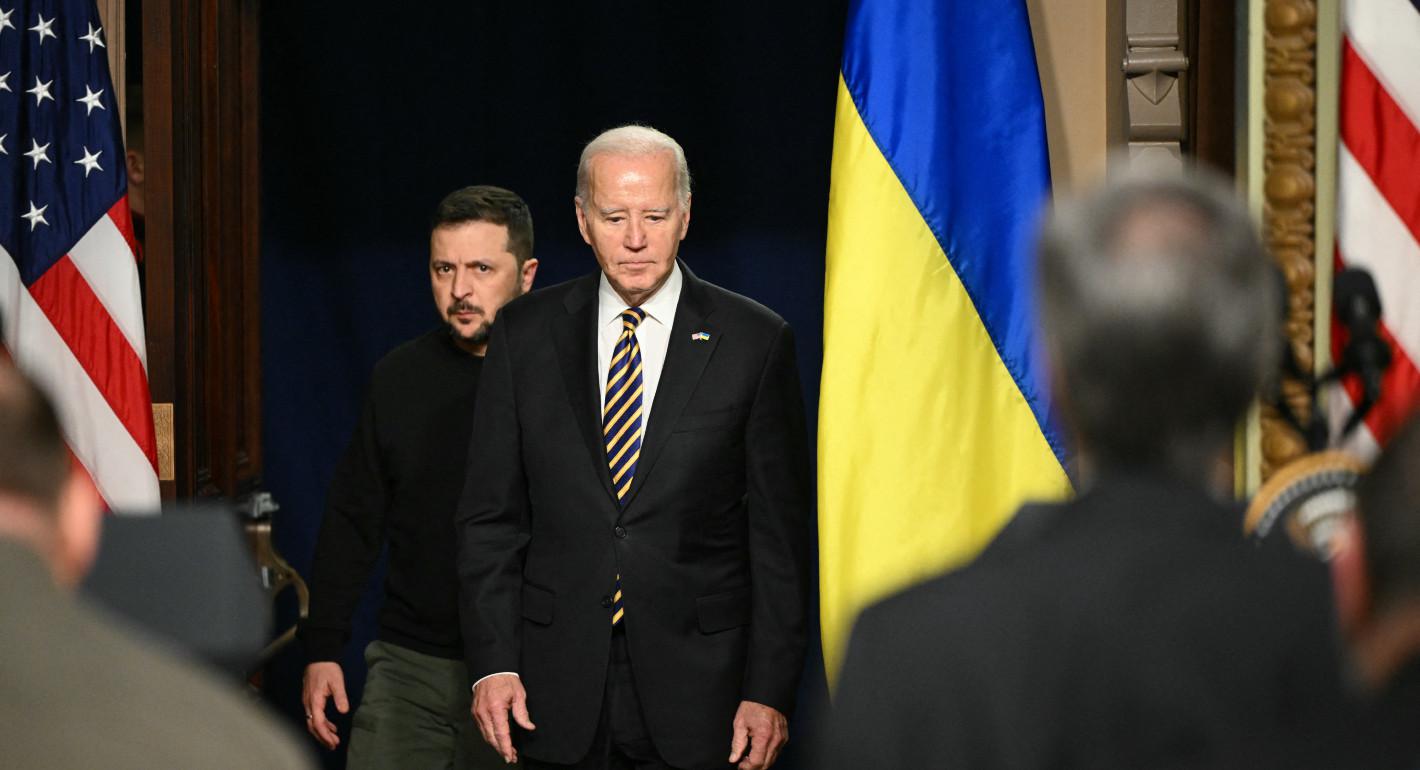
Appearing with Ukrainian President Volodymyr Zelenskyy at the White House on Tuesday, Biden said, “We’ve seen what happens when dictators don’t pay the price for the damage and the death and the destruction they cause, and they keep going when no price is paid.” Indeed, a Russia that believes it has defeated Ukraine and Western support will become increasingly emboldened and dangerous in the years to come. If Putin is convinced that Western support for Ukraine is petering out, the world will soon have to cope with a bruised, overconfident, and vengeful Russia that believes it has outlasted the will of the West. This outcome could have major consequences for NATO’s core mission of deterring future Russian aggression—a mission that so far has prevented the Kremlin from expanding its military adventurism beyond Ukraine’s borders.
Champagne in Moscow
Russia’s official demands to end the war have not changed, at least in public. The Kremlin is already beginning to gloat that it is beating the collective West in Ukraine. Days after swilling champagne with Russian defense industry leaders in Moscow, Putin reiterated during his annual call-in show that Russia will not stop fighting until Ukraine is “demilitarized,” “denazified,” and “neutral.” “Either we get an agreement . . . or we solve this by force,” he said. Those are the words of a leader who is confident that he has the upper hand.
At present, the tides favor Russia. Russia has doubled its defense budget to support the war and to regenerate some of its lost combat power. Russia’s mobilized defense industrial base is outproducing the West in key areas despite its inefficiencies, quality control issues, labor shortages, and the sanctions against it. If the Kremlin concludes that it can “win” in Ukraine, that it has broken the West’s political will, and that it outperformed the defense industrial bases of the United States and Europe, Russian leaders could become overconfident in the years ahead about their own capabilities.
There is precedent for such behavior. Under Putin’s leadership, each time the Russian government has believed that it has “won” a conflict—in Georgia in 2008, Ukraine in 2014, Syria in 2015, and Ukraine in 2022—Putin has drawn conclusions about the United States and the West: where the redlines are, what actions they are willing to take, and the credibility of security commitments they are willing or unwilling to make. With each conflict, Russian leaders have gained confidence in their abilities and in their understanding of their enemies. Within a few years from launching one conflict, they have launched progressively bigger and bolder operations. By 2022, they felt confident enough to commit the entirety of their country’s professional landpower forces to an invasion of Ukraine, at tremendous losses for themselves in what became a misjudgment of historical proportions.
Russian forces in Ukraine today, damaged and deficient in core capabilities as they are, have recovered some of their bearings after a full year of partial mobilization. They continue to use repetitive and costly ground assaults and artillery barrages. They are out-performing Ukraine and the combined West in rates of fire and sustained attacks on Ukraine. They have shortened their cycles of adaptation and innovation that have reduced important advantages Ukraine previously enjoyed on the battlefield such as fielding new weapons systems like first-person-view drones.
The Perils of Dangerous Conclusions
The consequences of the West abandoning Kyiv will go beyond Ukraine. The risk is growing that the Kremlin could soon conclude that it has outlasted Ukraine and seen the limitations of the West’s political will and appetite for supporting a protracted war. If that happens, Putin could conclude that the West’s combined intelligence, military planning, weapons, tactics, and defense production will have been put to the test—and failed to turn the tide of the war in the end.
If the Kremlin believes that its brute-force methods, ability to absorb staggering losses of equipment and personnel, and defense industrial base can overmatch Western assistance and political will in Ukraine, the outcome would be dangerous for NATO moving forward, and that must not be allowed to happen. It could significantly erode, if not upend, deterrence.
That would be a faulty conclusion for the Kremlin to make, because Russia is not fighting NATO. Yet the West has little control over what lessons Moscow draws from this and other conflicts. The West holds many technological, economic, and financial advantages over the Russian military by most metrics, if it would fully prioritize and activate these capabilities. Russian strategists and planners themselves were some of the strongest believers in NATO’s economic, political, and military superiority prior to the 2022 invasion of Ukraine. The Russian assessments were informed by a complex set of indicators and assumptions, with corresponding numerical scores to measure and compare state power. The assessments were based on indicators like the military correlation of forces and other expressions of power like political cohesion and the ability of defense firms to increase production in support of a war. As of 2016, one Russian estimate placed U.S. conventional military advantages over Russia at 4:1, political advantages at 5:1 (measures of the authority of the state, cohesion, and other factors that allow a government to execute policies), and economic advantages at 6:1 (GDP and material and financial assets).
If Russia were to snatch victory by exhausting and outlasting Ukraine and the West, Russian strategists will most likely downgrade their assessments about NATO power moving forward on the basis of political cohesion, will to fight, and defense industrial production potential. At the same time, Russian strategists and officials might raise their own scores in some areas, when considering Russian operational performance in Ukraine, despite the serious deficiencies and limitations that have been exposed throughout the war.
How much those comparative assessments change, and whether they impact Russian perceptions about the strength of NATO’s deterrence, will depend on choices that the West makes now. NATO still holds—and will hold—multiple military advantages over Russia, but it has areas it must shore up.
“We want to position Ukraine by the end of next year in a way that forces Russia to decide whether to come to the negotiating table on terms that are acceptable to Ukraine . . . or face a stronger Ukraine,” said U.S. Deputy National Security Advisor Jon Finer, describing the U.S. goal for 2024. Putin will only do this if he realizes that Kyiv and its partners are politically and materially committed to their cause and that trends will not favor Russia.
The most important reason to continue to fund security assistance to Ukraine is for Ukraine, which wants to live free from Kremlin subjugation and brutality. The Ukrainian Armed Forces fight hard, and they do not ask anyone to fight for them. In the past two years, they have already destroyed a majority of the pre-2022 professional Russian army.
Calls from U.S. lawmakers about a revised strategy for Ukraine and a theory of victory with resources available are valid. There are opportunities for Ukraine in 2024 to set conditions on the battlefield, continue to impose high costs on Russia, and build a military force that can deter future Russian aggression. It is in the West’s interest to continue supporting Ukraine, including with an updated strategy in mind.
Russia will likely be dangerous whether it is defeated in Ukraine or not. The West cannot lose sight of the long-term security problems that Russia will pose as it recovers from the war, regenerates its military power, and—quite probably—seeks revenge. The West is at a critical juncture. The United States and Europe must be prepared for high-intensity warfare in a world with multiple hostile actors. Continued funding for Ukraine is a key pillar of that mission.
*This post has been updated to reflect that the EU aid package totals 50 billion euros, or about $55 billion.