

Commentary
The government’s gains in the northwest will have an echo nationally, but will they alter Israeli calculations?
Armenak Tokmajyan
{
  "authors": [
    "Aron Lund"
  ],
  "type": "commentary",
  "blog": "Diwan",
  "centerAffiliationAll": "",
  "centers": [
    "Carnegie Endowment for International Peace"
  ],
  "collections": [],
  "englishNewsletterAll": "",
  "nonEnglishNewsletterAll": "",
  "primaryCenter": "Carnegie Endowment for International Peace",
  "programAffiliation": "",
  "programs": [],
  "projects": [],
  "regions": [
    "Jordan",
    "Syria"
  ],
  "topics": []
}
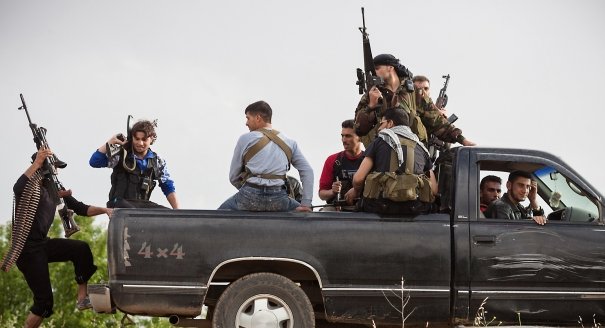
Yesterday, we had a look at the southern front in Syria and noted its intimate connections to Jordan—both through tribal and cultural ties—and through the involvement of King Abdullah's General Intelligence Directorate, because of Jordan's role in channeling U.S. and Saudi support to the rebels.
Another factor linking Jordan to the war in Syria is the presence of Jordanians, and Palestinians from Jordan, as foreign fighters in the Syrian jihadi factions. The Jordanian preacher Mohammed al-Shalabi, better known as Abu Sayyaf, recently claimed that there are a thousand Jordanians fighting in Syria. According to Shalabi, these fighters are spread across three factions: the Islamic State of Iraq and al-Sham (ISIS), Jabhat al-Nusra, and the Islamic Ahrar al-Sham Movement. The first two of these groups have roots in the al-Qaeda network, although ISIS now seems to be drifting away from the leadership of Ayman al-Zawahiri, while the last of the three, Ahrar al-Sham, is an independent Salafi faction active only in Syria.
To understand more about the little-known Salafi movement in Jordan, I interviewed Dr. Joas Wagemakers, a specialist on the subject. Dr. Wagemakers is an assistant professor and post-doctoral research fellow of Islamic Studies at Radboud University Nijmegen in the Netherlands, and the author of A Quietist Jihadi: The Ideology and Influence of Abu Muhammad al-Maqdisi, which was published in September 2012. Many of his articles can be read here.
WAGEMAKERS: They've welcomed it for three reasons: first, it's a chance to help overthrow a ruler in a Muslim country, which is part of what jihadi-Salafism is about.
Second, it's not a very controversial jihad since even quieter Salafis and the Jordanian regime are saying that President Bashar al-Assad is a brutal dictator who's killing his own people (though perhaps not in so many words).
Third, Abu Mohammed al-Maqdisi has long stressed that fighting should be done in an organized, proper, Islamically legitimate, effective, and fruitful way. In other words, fighting should not just be focused on killing, but should strive for conquering a territory where the mujahidin can set up an Islamic state. All of this is possible in Syria, with Islamic factions like Jabhat al-Nusra and the ISIS fighting in the country and controlling bits of territory.
The fact that Syria is next door and does not have a strong army killing the mujahidin (like the Americans were doing in Iraq) only adds to this.
WAGEMAKERS: There are no real jihadi-Salafi organizations and there never really have been any either. The first reason for this may be the influence of Nasreddin al-Albani on the Jordanian Salafi movement. Albani was strongly against setting up organizations and institutes and the Salafi movement as a whole in Jordan is still rather loosely and informally organized, although less so than before.
The second reason for this is that the radical groups that came into existence in the 1990s were all not quite sure what they wanted. They were against the United States, Israel, and the regimes of the Muslim world, but exactly how to go about resisting these was quite a different matter. Groups ("organizations" is too formal a word for them) such as these included Jaish Mohammed and Bay’at al-Imam. Bay'at al-Imam was typical of many of these groups in the sense that a set of radical ideas brought them together, but they differed on the details and what to do exactly.
The third reason for a lack of Jihadi-Salafi organization is, of course, the policies of the regime, which cracks down on subversive activities and bureaucratizes the rest, making it very difficult for organizations to be set up either illegally or legally. There is an organization now called Jam’iyat al-Kitab wal-Sunna, which had some Jihadi-Salafi members when it was founded in the 1990s, but these have left the organization long ago and it's now no longer a Jihadi-Salafi organization at all. It never was, really, but its members did have sympathies in that direction.
WAGEMAKERS: There is no clear hierarchy, but in practice, Abu Mohammed al-Maqdisi is clearly the most important Jihadi-Salafi scholar in Jordan. Maqdisi (b. 1959) is originally a Palestinian from the West Bank who grew up in Kuwait and ended up in Jordan after the Gulf War. He's probably never been engaged in any military action, although he is in prison at the moment for allegedly having support terrorist movements, but his writings are quite radical.
The rest, like Abu Mohammed al-Tahawi, Mohammed al-Shalabi (Abu Sayyaf), Loqman al-Riyalat, and Jarrah al-Rahahila, have little to no international standing, have not produced any significant writings and only have a local following. Tahawi is the most senior sheikh in Jordan right now, but he's ill. Shalabi is an important spokesman, but he's suspected by some of being little more than a firebrand.
A case can be made that Abu Qatada al-Filastini is another scholarly heavyweight—and he certainly is—but his influence in Jordan is like that of other non-Jordanian scholars, simply because he was away from Jordan for a long time and has only returned recently, spending his time under arrest with no direct local influence.
WAGEMAKERS: Not really. They believe the king is an unbeliever and would like the regime to be overthrown in favor of an Islamic regime, but they are not really making any efforts to overthrow the regime in any way. With the situation in Syria sapping all the military power from their ranks, I don't see this happening anytime soon.
The government’s gains in the northwest will have an echo nationally, but will they alter Israeli calculations?
Armenak Tokmajyan
The country’s leadership is increasingly uneasy about multiple challenges from the Levant to the South Caucasus.
Armenak Tokmajyan
Recent leaks made public by Al-Jazeera suggest that this is the case, but the story may be more complicated.
Mohamad Fawaz
The U.S. is trying to force Lebanon and Syria to normalize with Israel, but neither country sees an advantage in this.
Michael Young
A regular survey of experts on matters relating to Middle Eastern and North African politics and security.
Michael Young