• Research
  • Diwan
  • About
  • Experts
Carnegie Middle East logoCarnegie lettermark logo
PalestineSyria
{
  "authors": [
    "Toby Dalton",
    "Sadia Tasleem"
  ],
  "type": "other",
  "centerAffiliationAll": "",
  "centers": [
    "Carnegie Endowment for International Peace"
  ],
  "collections": [],
  "englishNewsletterAll": "",
  "nonEnglishNewsletterAll": "",
  "primaryCenter": "Carnegie Endowment for International Peace",
  "programAffiliation": "",
  "programs": [
    "Nuclear Policy"
  ],
  "projects": [],
  "regions": [
    "South Asia",
    "Pakistan"
  ],
  "topics": [
    "Nuclear Policy"
  ]
}
Other

Nuclear Emulation: Pakistan’s Nuclear Trajectory

Pakistan’s nuclear policy is heavily influenced by 1960s NATO flexible response strategy, and has essentially imported its contradictions into Islamabad’s own. This emulation has raised serious questions about Pakistan’s “full-spectrum deterrence” credibility, deterrence stability and future measures to manage regional security competition.

Link Copied
By Toby Dalton and Sadia Tasleem
Published on Jan 22, 2019

Source: Washington Quarterly

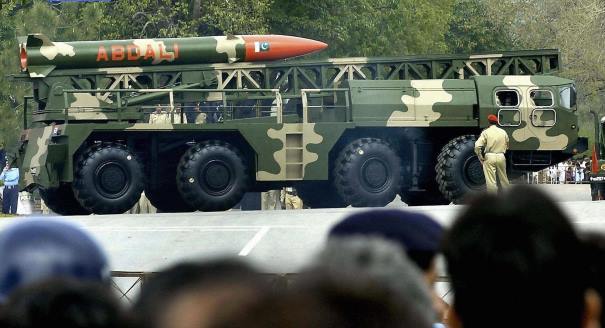
“The more it changes, the more it stays the same”—Jean-Baptiste Alphonse Karr could well have been writing his famous epigram about Pakistan’s nuclear deterrence policy. For a nuclear program some have called the “fastest growing in the world,” how can this axiom apply? After declaring a strategy in the early 2000s of “minimum credible deterrence,” to deter a perceived existential threat from India, in 2013 Pakistan announced that henceforth it would adopt a “full spectrum deterrence capability,” 1 backed by a suite of air-, land- and sea-based nuclear delivery vehicles that Islamabad tested over the last decade. These include short-range, “tactical” missiles that are postured to deter “limited” Indian conventional military operations, and longer-range missiles that might be used either for countervalue or counterforce targeting. This is a picture of a nuclear arsenal in full bloom, whose growth probes the limits of what can be deterred with the threat of nuclear use. 

But looking beyond new terminology and more advanced weapons systems, there are threads of a consistent logic driving Pakistan’s nuclear decision making. For Pakistani officials and scholars, increasing and diversifying Pakistan’s nuclear arsenal is not seen as a policy choice, but rather a compulsion to maintain an effective deterrent vis-à-vis India. Any advances in India’s conventional military capability, nuclear arsenal, or strategic position amplify the perception of an incessant and unremitting threat for which Pakistan has no recourse other than nuclear weapons. In this view, deterrence is more relative and elastic than fixed; “full-spectrum” capabilities provide a way to keep up and ensure that Pakistan’s deterrence remains credible, rather than a new strategy as such. 

Scholarly works on deterrence in South Asia have long recognized that Pakistan’s nuclear policy is heavily influenced by, or perhaps even derivative of, the dominant discourse of the Cold War, and particularly that from the United States. The American nuclear scholar Vipin Narang concludes, for instance, that “the Pakistani nuclear posture is explicitly modeled on NATO’s flexible response posture which threatened the first use of nuclear weapons in theater should conventional deterrence fail.” 2 It is logical that Pakistan—and other post-Cold War adopters of nuclear deterrence—would seek to learn applied lessons from the experience of the major nuclear powers. Indeed, there are a range of reasons that Pakistan would seek to emulate the NATO experience in particular, given surface similarities in deterrence challenges.

This article was originally published in the Washington Quarterly.

Read the article

Authors

Toby Dalton
Senior Fellow and Co-director, Nuclear Policy Program
Toby Dalton
Sadia Tasleem
PhD Candidate, University of British Columbia
Sadia Tasleem
Nuclear PolicySouth AsiaPakistan

Carnegie does not take institutional positions on public policy issues; the views represented herein are those of the author(s) and do not necessarily reflect the views of Carnegie, its staff, or its trustees.

More Work from Malcolm H. Kerr Carnegie Middle East Center

  • Research
    The Military and Private Business Actors in the Global South: The Politics of Market Access

    The interaction of national armed forces and private business sectors offers a useful lens for viewing the politics of numerous countries of the so-called Global South. A rising trend of military political activism—often accompanied by military commercial activity—underlines the importance of drivers and outcomes in these relationships.

      Yezid Sayigh, Hamza Meddeb

  • Commentary
    The Gaza War and the Rest of the World

    Scholars from Carnegie’s global network comment on how the ongoing conflict between Israelis and Palestinians is affecting their areas of interest, and what the implications of this may be.

      • +11

      Maha Yahya, Rosa Balfour, Judy Dempsey, …

  • Commentary
    How Tehran Is Connecting the Ukraine Invasion to the Iran Deal

    Both events also could force Washington to rethink or revive its Middle East partnerships.

      Karim Sadjadpour

  • Commentary
    Diwan
    A Ticking Time-Bomb?

    Disagreement between the United States and Iran over a revived nuclear accord may anchor volatile competition.

      George Perkovich

  • Commentary
    Diwan
    Calculations in Kabul

    Turkey’s success in finding a role in Afghanistan could bring its leadership valuable benefits.

      Marc Pierini

Get more news and analysis from
Malcolm H. Kerr Carnegie Middle East Center
Carnegie Middle East logo, white
  • Research
  • Diwan
  • About
  • Experts
  • Projects
  • Events
  • Contact
  • Careers
  • Privacy
  • For Media
Get more news and analysis from
Malcolm H. Kerr Carnegie Middle East Center
© 2026 Carnegie Endowment for International Peace. All rights reserved.