

Commentary
What should happen when sanctions designed to weaken the Belarusian regime end up enriching and strengthening the Kremlin?
Denis Kishinevsky
{
  "authors": [
    "Temur Umarov"
  ],
  "type": "commentary",
  "blog": "Carnegie Politika",
  "centerAffiliationAll": "",
  "centers": [
    "Carnegie Endowment for International Peace",
    "Carnegie Russia Eurasia Center"
  ],
  "englishNewsletterAll": "",
  "nonEnglishNewsletterAll": "",
  "primaryCenter": "Carnegie Russia Eurasia Center",
  "programAffiliation": "",
  "programs": [],
  "projects": [],
  "regions": [
    "China"
  ],
  "topics": [
    "Security",
    "Global Governance",
    "Foreign Policy"
  ]
}
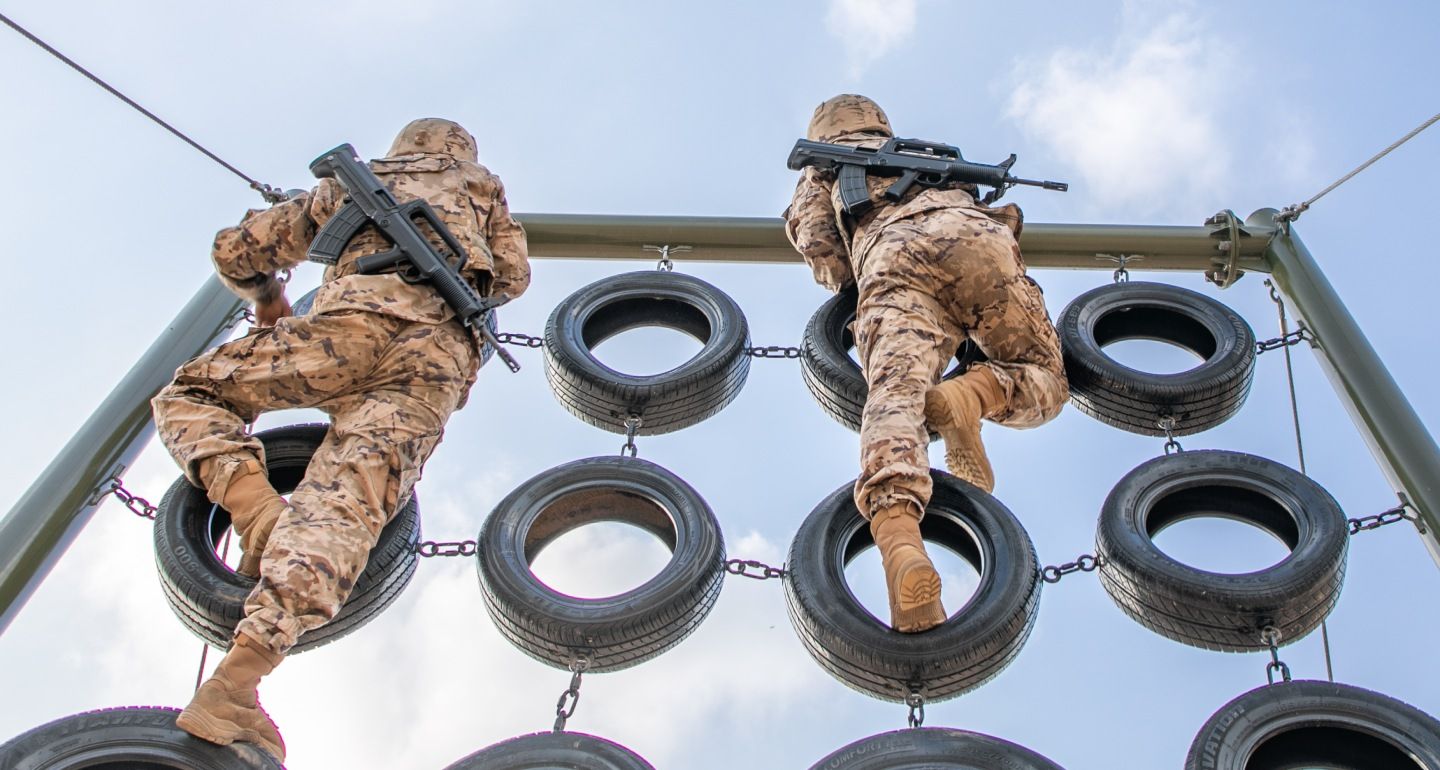
Source: Getty
China has found a unique niche for itself within the global security ecosystem, eschewing military alliances to instead bolster countries’ internal stability using law enforcement. Authoritarian regimes from the Central African Republic to Uzbekistan are signing up.
China’s ascent has been one of the most notable events in global politics in recent decades. China already outperforms the United States by many economic metrics including GDP at purchasing power parity. Its Belt and Road Initiative has made it the main investor, creditor, and trade partner for most of the world, pushing Washington to launch a trade war in 2016.
But beyond the economy, it is not immediately obvious that China has become a world leader. Beijing continues to avoid directly intervening in third countries’ conflicts. It is not creating an extensive network of military bases abroad or forming alliances. Nor is it in any hurry to call relations with close partners like Russia “alliances.”
However, in recent years, China has begun to systematically expand its influence in the security sphere. Beijing’s so-called Global Security Initiative, launched in 2022, remains a framework without clear obligations. Nevertheless, China is the first country to compete with the United States for the role of “global policeman.”
To better understand how this ambitious program is being implemented in practice, three experts from the Carnegie Endowment for International Peace’s Asia Program—Sheena Greitens, Isaac B. Kardon, and Cameron Walz—studied around a thousand exercises and workshops conducted by Chinese law enforcement agencies in 138 countries over the past twenty-five years.
Their findings, briefly summarized in this article, show that China has carved out a unique niche for itself within the global security ecosystem, focused on supporting the internal stability of ruling regimes rather than on military alliances. It is therefore unsurprising that China’s Global Security Initiative has proven especially attractive to autocracies, including those of Central Asia, despite their longstanding cooperation with Russia in this field.
China is the third country in modern history after the United States and the Soviet Union to make its own security system a global export. Armed with the knowledge of its forebears’ mistakes, Beijing picked a different path from Washington and Moscow from the very beginning.
During the Cold War, international security systems were organized primarily on the basis of ideological confrontation. In China’s case, the central impetus was economic expansion. Under Xi Jinping, China has become a major hub in the global economy. Beijing has invested as much as $160 billion in third countries under the Belt and Road Initiative. This large-scale economic presence required protection from local crises.
Traditional tools, like the aircraft carriers, overseas bases, and military alliances favored by the American model, were poorly suited for this. Aircraft carriers cannot protect Chinese gold mine workers from conflicts with local communities, and military bases do not help prevent terrorist attacks against Chinese embassies. As a result, China was forced to seek other, more flexible methods to safeguard its interests.
Although China only officially launched its Global Security Initiative in 2022, it has been active in this area since the early 2000s. One of the first steps was a training program for the United Nations’ foreign peacekeeping troops at the China People’s Police University.
Beijing first attempted to bring its own security model to the world in 2015 as part of the Belt and Road Initiative. The logic was simple: foreign economic projects needed protection, so investments and security began to be thought of as a single package.
Since then, the confrontation with the United States has added to China’s economic rationale for expanding its security network. However, instead of simply copying the U.S. model of securitizing foreign policy, China found a more effective alternative.
The key difference between each country’s approach is in the choice of basic tools. The United States has its armed forces, while China relies primarily on law enforcement agencies. This allows Beijing to shrug off accusations of military expansionism while also promoting its own understanding of state security.
In the Chinese view, the main threat to stability comes not from other countries but from within: extremism, separatism, terrorism, and color revolutions. Such threats are impossible to counteract with purely military means. They require hybrid tools, which China first built at home and then began to promote around the world.
Central to China’s efforts is the People’s Armed Police. After separating from the People’s Liberation Army in 1982, this body mainly handled internal security until the 1990s, when its position began to strengthen under Jiang Zemin. It became a superagency under Xi Jinping, absorbing counter-terrorist and border patrol functions and coming under the control of the Central Military Commission: the highest governing body within China’s armed forces.
Initially, police powers were expanded for domestic political reasons: Chinese leadership needed a tool to effectively maintain order in the country, especially in sensitive regions like Xinjiang. However, over time, the Chinese government realized that the People’s Armed Police was ideally suited for protecting its interests abroad as well. In 2010, China conducted fourteen international training courses for foreign police officers. By 2019, that number had increased almost tenfold to 138.
The COVID-19 pandemic slowed this expansion, and outreach has yet to return to pre-pandemic levels. Beijing has also reconsidered its foreign policy strategy. Instead of the rather aggressive “wolf warrior diplomacy” that emerged in response to American pressure during Trump’s first term, China has returned to its modus operandi: non-binding umbrella initiatives like the successful Belt and Road.
The shift produced Xi Jinping’s quartet of initiatives: the Global Development Initiative, Global Civilization Initiative, Global Governance Initiative, and Global Security Initiative—China’s most coherent attempt to structure and institutionalize previously disparate practices in international security.
The Global Security Initiative’s objectives have been formulated as broadly as possible, which enables a wide variety of countries to sign on and the UN Secretary General to approve of Beijing’s actions. However, its nebulous rhetoric conceals pointed content.
China offers its partners specific security services as part of the initiative, including tools to protect political stability. Data compiled by Carnegie Endowment researchers on international courses led by Chinese law enforcement agencies include dozens of exercises dedicated to suppressing protests and uprisings.
China has already conducted courses related to maintaining public order and directly or indirectly protecting political leadership in at least thirty-two countries. A fraction of these training courses dealt with relatively neutral tasks, such as responding to epidemics and natural disasters. However, most of the programs involved practicing crowd control, riot control, and “maintaining stability.”
The largest category in this block relates to “VIP protection.” Hundreds of soldiers in the Central African Republic’s elite Presidential Guard have undergone such training. The fighters also received training to “protect the regime” from Russia’s Wagner Group mercenaries present in the country.
Chinese proposals also include technological know-how that China actively uses to control its own population. These tools are in demand among authoritarian regimes around the world. Central Asian countries, now the primary recipients of Chinese law enforcement training, are showing particular interest in them.
China is expanding its presence in Uzbekistan and Kazakhstan by introducing “smart city” technologies. In Tajikistan, the People’s Armed Police has set up two bases on the Afghan border. These are unique facilities without Chinese analogues in other countries. In Kyrgyzstan, China protects its assets using private security companies.
As Washington tries to reduce its involvement in the global security architecture, China’s security footprint abroad is growing—not because Beijing is actively imposing it, but because of growing demand. While the Trump administration undermines global stability by force, China is positioning itself as a reliable partner capable of protecting the existing world order. Yet Beijing is not ready to assume direct responsibility for its maintenance. Rather, it is offering an alternative—a set of tools that allow countries to preserve the status quo on their own. It’s an offer many regimes have found hard to pass up.
For original research on the activities of Chinese law enforcement agencies abroad, see:
Carnegie does not take institutional positions on public policy issues; the views represented herein are those of the author(s) and do not necessarily reflect the views of Carnegie, its staff, or its trustees.
What should happen when sanctions designed to weaken the Belarusian regime end up enriching and strengthening the Kremlin?

Denis Kishinevsky

The supposed threats from China and Russia pose far less of a danger to both Greenland and the Arctic than the prospect of an unscrupulous takeover of the island.

Andrei Dagaev

Western negotiators often believe territory is just a bargaining chip when it comes to peace in Ukraine, but Putin is obsessed with empire-building.

Andrey Pertsev
Unexpectedly, Trump’s America appears to have replaced Putin’s Russia’s as the world’s biggest disruptor.
Alexander Baunov
Baku may allow radical nationalists to publicly discuss “reunification” with Azeri Iranians, but the president and key officials prefer not to comment publicly on the protests in Iran.

Bashir Kitachaev